
Agranulocytosis Monitoring Calculator
Medication Monitoring Schedule Calculator
When a drug you’ve been taking for weeks or months suddenly turns dangerous, it’s not paranoia-it’s medicine. Agranulocytosis is one of those rare but deadly reactions that can sneak up without warning. It’s not just a lab result. It’s a body shutting down its defenses. And if you’re on certain medications, you’re at risk-even if you feel fine.
What Exactly Is Agranulocytosis?
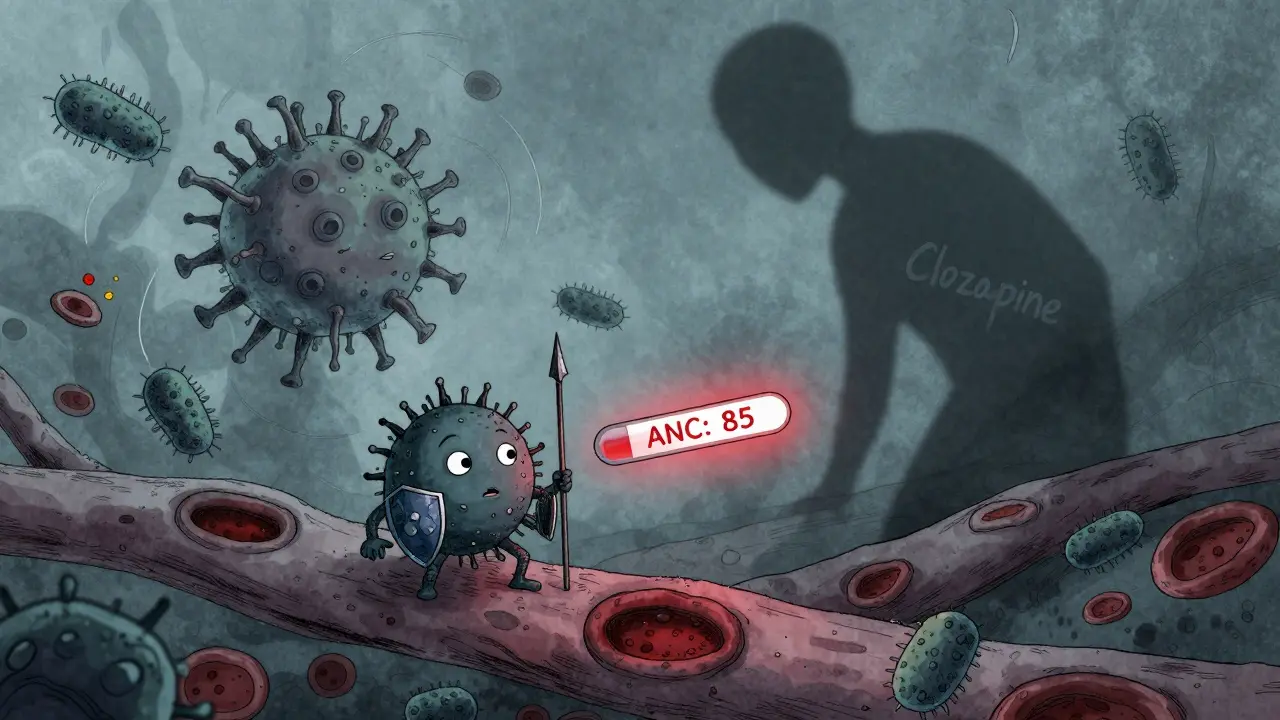
Agranulocytosis means your body has fewer than 100 neutrophils per microliter of blood. Neutrophils are the frontline soldiers in your immune system. They swarm bacteria, kill infections, and keep you from getting sick. When they drop below that 100 mark, even a simple sore throat can become a life-threatening emergency. This isn’t regular low white blood cell count. This is the extreme end-neutropenia taken to a dangerous level.
Most cases-up to 70%-are caused by medications. It’s not a guess. It’s backed by data from VisualDx and clinical studies. The drugs don’t always cause it outright. Sometimes, they trigger your immune system to attack your own neutrophils. Other times, they poison the bone marrow where these cells are made. Either way, your body stops making the guards that protect you.
Which Medications Are the Biggest Risks?
Not all drugs carry the same danger. Some are known offenders. Others barely register. Here’s who’s on the list:
- Clozapine-used for treatment-resistant schizophrenia. Its risk is real: 0.77% of users develop agranulocytosis. That’s nearly 1 in 130 people. Because of this, the FDA requires weekly blood tests for the first six months.
- Propylthiouracil and methimazole-antithyroid drugs. Propylthiouracil has a higher risk (0.36 per 1,000 patient-years) than methimazole (0.16). If you’re on one of these and get a fever, don’t wait.
- Trimethoprim-sulfamethoxazole-an antibiotic. Studies show users have 15.8 times higher risk than those not taking it.
- Dipyrone-a painkiller banned in the U.S. but still used elsewhere. It carries a risk of 1.2 per 10,000 patient-years.
On the other hand, common NSAIDs like ibuprofen have almost no link. That’s important to know. You don’t need to fear every pill you take. But you do need to know which ones require attention.
How Fast Can It Happen?
There’s no single timeline. Agranulocytosis can strike within days of starting a drug-or years later. Most cases show up between one and three months after beginning treatment. But cases have been reported as early as 48 hours and as late as five years after starting clozapine. That’s why monitoring can’t be a one-time thing. It has to be ongoing.
And here’s the scary part: many patients don’t feel sick until it’s too late. A 2022 survey by the Aplastic Anemia & MDS International Foundation found that 86% of patients waited more than 48 hours before getting diagnosed. Why? Because symptoms look like the flu: fever, sore throat, mouth ulcers, chills. Doctors often mistake it for a virus. Patients are sent home with advice to rest. By the time they’re readmitted, their neutrophils are gone.
Monitoring: The Only Shield You Have
If you’re on a high-risk drug, blood tests aren’t optional. They’re your lifeline.
For clozapine, the rules are strict:
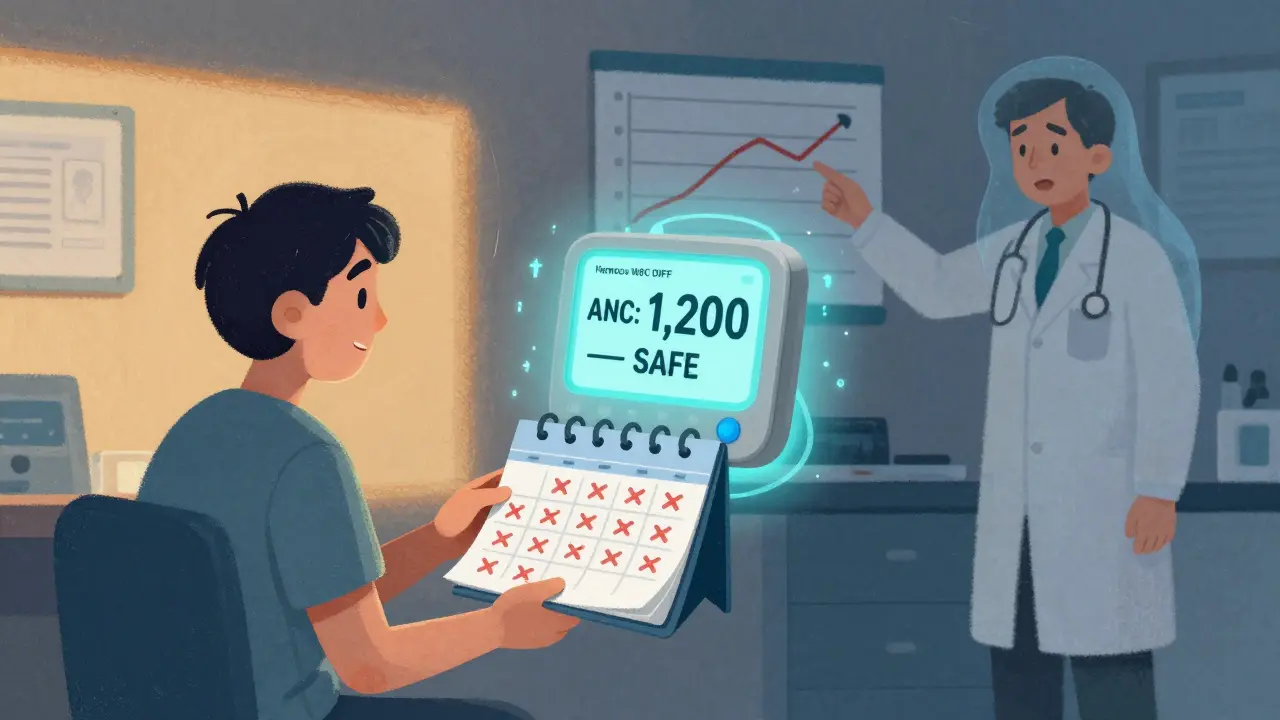
- Weekly ANC (absolute neutrophil count) tests for the first six months.
- Every two weeks for months 7-12.
- Monthly after that.
If your ANC drops below 1,000/μL, treatment stops. Not 500. Not 300. 1,000. The European Hematology Association updated its guidelines in May 2023 because research showed that acting at 1,000 catches 78% of cases before infection hits. Waiting until 500 is too late for many.
But here’s the problem: compliance is poor. A 2020 study found that only 68% of U.S. psychiatrists followed the weekly monitoring rule. Patients miss appointments. Labs take days to return results. Rural areas lack access. That’s why new tools are emerging-like the Hemocue WBC DIFF device. It gives results in five minutes, not two days. In trials, it improved adherence by over 30%.
What Happens If You Get It?
Stop the drug. Immediately. That’s the first and most critical step. Recovery usually starts within days and completes in 1-3 weeks after stopping the medication. But while your body rebuilds its neutrophils, you’re vulnerable.
If you have a fever above 38.3°C (101°F) with an ANC under 500, you’re in a medical emergency. The Infectious Diseases Society of America says you need broad-spectrum antibiotics right away-especially ones that cover Pseudomonas aeruginosa, a common killer in neutropenic patients. Without treatment, death rates hit 10-20%. With prompt care, they drop below 5%.
Some patients never fully recover their neutrophil count. Others bounce back fine. It depends on how fast you acted. That’s why awareness saves lives.
New Tools: Genetic Testing and AI Alerts
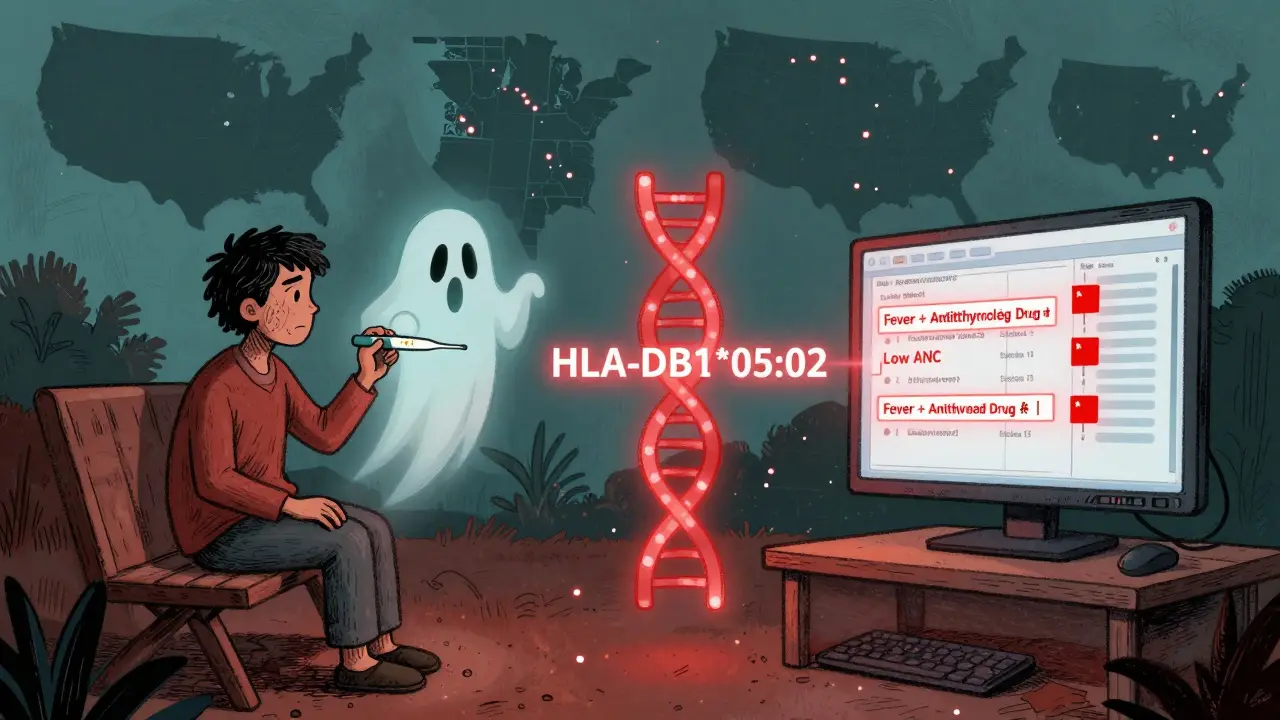
The future is getting smarter. In January 2023, the FDA approved the first genetic test for clozapine risk: the HLA-DQB1*05:02 assay. If you carry this gene variant, your risk of agranulocytosis is 14.3 times higher. It’s not perfect-but it helps identify who needs the tightest monitoring before even starting the drug.
Hospitals are also testing AI systems that scan electronic records for red flags: a drop in ANC, a recent prescription change, a fever report. A 2022 JAMIA study showed these systems cut missed cases by 47%. That’s not science fiction. It’s happening now.
By 2028, the Personalized Medicine Coalition predicts 40% of high-risk medications will require genetic screening before use. That’s a big shift. But it’s necessary. Because we can’t keep losing people to preventable reactions.
The Real Problem: Access and Awareness
Here’s the ugly truth: people in rural areas, low-income communities, and developing countries are dying at 2.3 times the rate of those with easy access to labs and specialists. The World Health Organization reports only 32% of low- and middle-income countries have formal monitoring systems for high-risk drugs.
And it’s not just about labs. It’s about education. Patients don’t know what to watch for. Primary care doctors don’t always connect the dots between a new medication and a fever. A 2022 study found that 73% of patients blamed their delayed diagnosis on “lack of awareness among providers.”
If you’re on clozapine, propylthiouracil, or trimethoprim-sulfamethoxazole, ask your doctor: “What’s my ANC? What’s the threshold to stop the drug? What symptoms mean I need to go to the ER?” Write them down. Keep a log. Don’t wait for them to tell you. You’re your own best advocate.
Why This Matters Beyond the Lab
This isn’t just about blood counts. It’s about trust in medicine. People stop taking life-saving drugs because they’re scared of side effects. Others keep taking them because they don’t know the signs. Both are dangerous.
Clozapine works when nothing else does. For someone with treatment-resistant schizophrenia, it’s the only hope. But without monitoring, that hope turns to risk. The goal isn’t to avoid the drug. It’s to use it safely.
Pharmaceutical companies have paid out hundreds of millions in lawsuits over this. The FDA has issued over 27 safety warnings since 2010. And yet, people still die. Because monitoring isn’t automatic. It’s not built into every system. It’s not always taught in medical school.
But it can be. And it must be.



Bobbi-Marie Nova
January 15, 2026 AT 17:16Nicholas Gabriel
January 15, 2026 AT 20:22Cheryl Griffith
January 16, 2026 AT 02:19kanchan tiwari
January 16, 2026 AT 14:47swarnima singh
January 17, 2026 AT 18:46Kasey Summerer
January 18, 2026 AT 03:20Isabella Reid
January 20, 2026 AT 00:08Jody Fahrenkrug
January 20, 2026 AT 14:42