
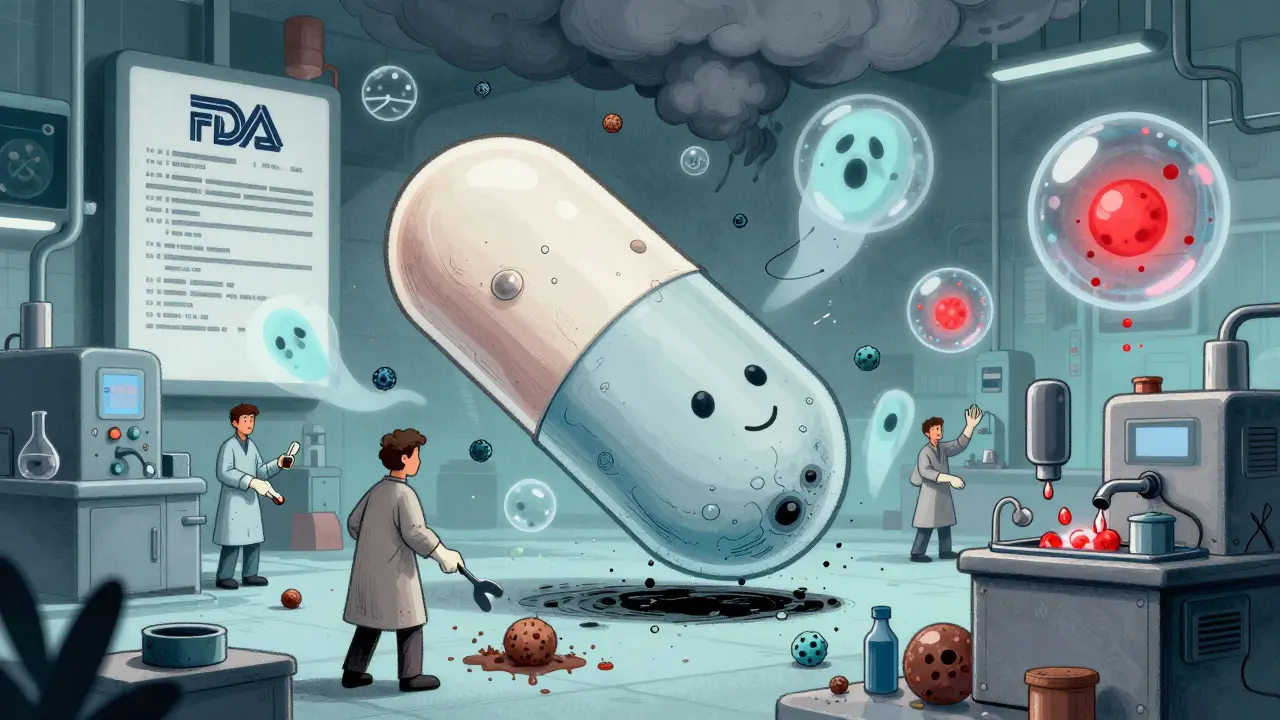
When you pick up a generic pill at the pharmacy, you expect it to work just like the brand-name version. But what if that pill was contaminated? Not with dirt or dust you can see, but with invisible chemical residues or microbes that could make you sick or render the drug useless? This isn’t science fiction. It’s a daily risk in generic drug manufacturing - and it’s why contamination controls aren’t optional. They’re the difference between a safe medicine and a dangerous one.
What Exactly Is Adulteration in Generic Drugs?
The FDA defines a drug as adulterated if it’s been made, packed, or stored under unsanitary conditions that could cause contamination. For generic drugs, this often means cross-contamination - when residue from one drug gets into another. Imagine a machine that made blood pressure medication, then got used for an asthma inhaler without being cleaned properly. Tiny amounts of the first drug could end up in the second. Even a few nanograms per square centimeter can be enough to trigger a reaction in sensitive patients. That’s why the European Medicines Agency set a limit of 1 nanogram per cm² for high-potency drugs. It’s not arbitrary. It’s based on real toxicology data.
One of the biggest wake-up calls came in 2020 with the Valsartan recall. Nitrosamine contaminants - cancer-causing chemicals - showed up in blood pressure meds made by 22 different generic manufacturers. The fallout? Over $1.2 billion in lost product, according to IQVIA. It wasn’t a one-off. In fiscal year 2022, contamination-related violations made up 37.2% of all FDA Warning Letters issued to drug makers. That’s almost four in ten. If you’re making generics, contamination control isn’t about being perfect. It’s about surviving.
How Clean Is Clean Enough?
Generic drug factories don’t look like hospitals. But they’re built like them. Cleanrooms are divided into zones, each with strict particle limits. For the most critical steps - like filling injectable drugs - you need ISO Class 5 (Grade A). That means no more than 3,520 particles larger than half a micron in every cubic meter of air. That’s less than a grain of sand in a basketball. For less sensitive areas, ISO Class 7 and 8 are used. But cleanliness isn’t just about air. It’s about surfaces, tools, and people.
Every piece of equipment must be cleaned to a standard: no more than 10 colony-forming units (CFU) of microbes on a 25cm² surface. For chemical residues, it’s 10 parts per million (ppm). That’s like finding one drop of ink in a swimming pool. To prove this, manufacturers use swabs, rinse samples, and modern rapid microbiological methods. These give results in 24-48 hours instead of the old 5-7 day wait. Speed matters. A batch stuck waiting for test results costs money. A batch that’s contaminated costs lives.
Human Error Is the Biggest Threat
Here’s the uncomfortable truth: most contamination doesn’t come from broken machines. It comes from people. Dr. Michael Gamlen, a top industry consultant, says 83% of contamination events trace back to human factors. Think of it: a worker forgets to change gloves. A cleaning checklist isn’t signed. A gown gets torn during a 12-hour shift. Compliance drops 40% after eight hours, according to a study at an AstraZeneca facility. That’s not laziness. It’s fatigue. It’s pressure. It’s systems that don’t account for real human limits.
One generic manufacturer switched to reusable isolation gowns to cut costs - and saw a 30% spike in gowning violations. The fix? $185,000 in upgraded air showers to blow off particles before workers entered clean zones. Another company used color-coded equipment and cut mix-ups by 65%. Simple. Cheap. Effective. The lesson? You can’t out-engineer human error. You have to design around it.

Technology Is Changing the Game
Old-school contamination checks relied on manual sampling. A technician would swab a surface, send it to a lab, and wait days for results. By then, the batch was already shipped. Today, real-time particle counters like the MetOne 3400+ monitor air quality continuously. A 2022 ISPE study found these systems cut contamination incidents by 63%. Why? Because they catch transient events - a door left open, a sudden movement - that manual checks miss 78% of the time.
ATP bioluminescence systems give surface cleanliness results in five minutes instead of hours. They’re 95% as accurate as traditional lab cultures. And they’re changing how validation is done. Instead of waiting for batch results, you know in real time if a cleaning cycle worked. Companies using these tools saw 40% faster regulatory approvals, based on 158 facility inspections from 2020 to 2022.
But not every tool is worth the cost. ULPA filters are 99.999% efficient - better than HEPA - but they increase energy use by 25-40%. For low-risk pills, that’s overkill. A 2023 technical bulletin warned that over-engineering containment can cost $2.8 million a year for a medium-sized plant. The goal isn’t perfection. It’s proportionate risk control.
The New Rules Are Coming - And They’re Strict
In September 2023, the FDA released draft guidance requiring all solid oral dosage forms to have health-based exposure limits (HBELs) by 2025. That means every drug, even low-potency generics, must have a scientifically proven safe threshold for cross-contamination. Setting these limits isn’t easy. It requires toxicology data, exposure modeling, and detailed risk assessments. The Generic Pharmaceutical Association estimates it will cost $1.2 million per facility to comply.
Meanwhile, the EU’s Annex 1 update (2022) demands continuous environmental monitoring, unidirectional airflow, and segregated production lines for high-risk products. Facilities that haven’t upgraded since 2020 are already behind. A 2022 EY benchmark found it takes 18-24 months to fully implement these changes. And 35-45% of that time is spent just validating the new systems.
And it’s not just the FDA. The EMA sent 41% of generic drug applications back in 2022 with deficiency letters tied to contamination controls. If you’re not ready, your product won’t get approved. And if you’re already shipping, you’re on the radar for inspections. The FDA has announced a 27% increase in inspection frequency for facilities with past violations.
Who’s Winning and Who’s Falling Behind?
The contamination control market is worth $4.7 billion and growing fast. Three types of players dominate:
- Specialists like Dycem, with their CleanZone mats - proven to reduce foot-borne contamination by 72% - hold 22% of the market.
- Integrated providers like Freyr Solutions offer end-to-end validation services and control 35% of the market.
- Equipment makers like Thermo Fisher are expanding into monitoring systems and hold 18%.
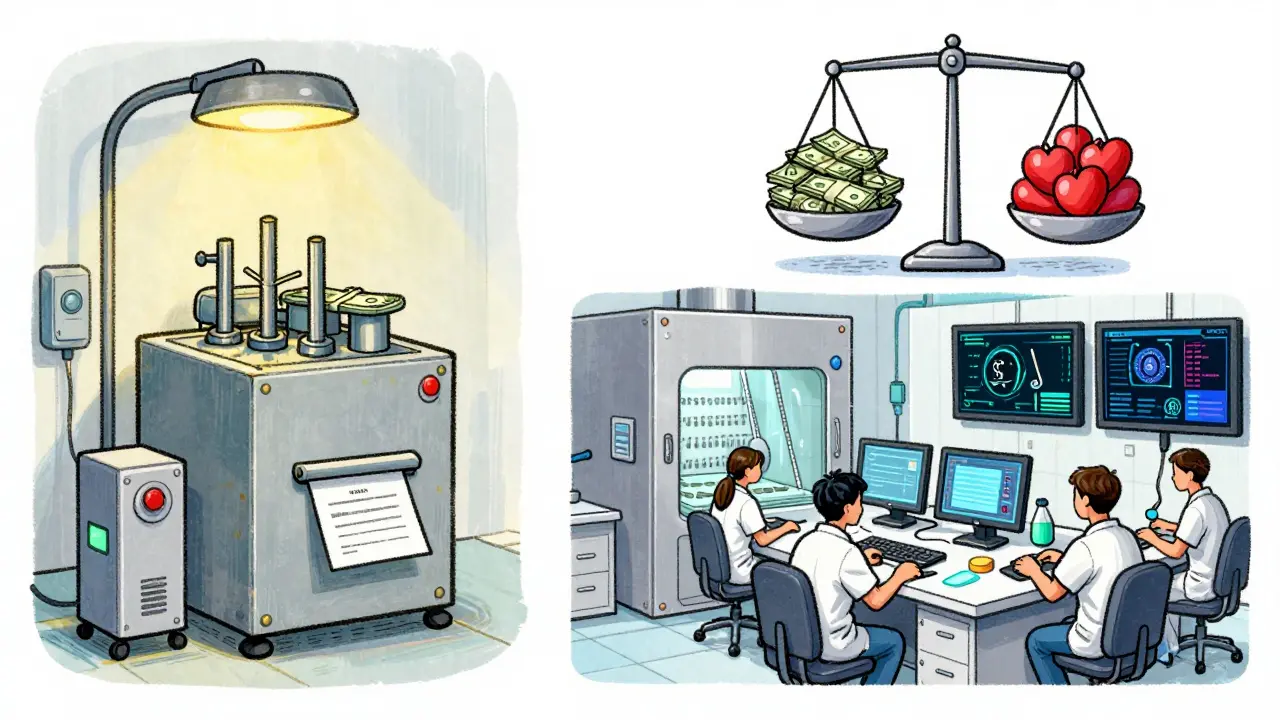
Big manufacturers - the top 50 - use real-time monitoring in 89% of cases. But small facilities? Only 37% do. Why? Cost. Installing a full system runs $500,000 to $2 million. For a small generic maker, that’s a huge gamble. But the alternative - a recall, a warning letter, a lost license - is worse.
One case study in Pharmaceutical Engineering showed that facilities using a “one batch at a time” model had 53% fewer cross-contamination incidents. No switching between products. No cleaning between runs. Just one drug, one line, one clean cycle. It’s slower. It’s less efficient. But it’s safer.
What Can You Do Today?
You don’t need to spend millions to start. Here’s what works:
- Color-code your equipment. Red for one drug, blue for another. Cut mix-ups by two-thirds.
- Use Dycem mats. They’re cheap, easy to install, and reduce contamination from shoes by over 70%.
- Train your staff daily. Not once a year. Daily. Fatigue is your enemy.
- Start with real-time monitoring. Even one particle counter in your critical zone gives you data you never had before.
- Review your cleaning validation. If it takes more than 48 hours to get results, you’re behind.
The future of generic drugs isn’t about who makes the cheapest pill. It’s about who can prove it’s safe. The regulators aren’t going to stop checking. The patients aren’t going to stop demanding quality. The only question is whether you’re building systems that protect people - or just hoping for the best.
What is the biggest cause of contamination in generic drug manufacturing?
Human error is the leading cause, accounting for 47% of contamination events according to a 2023 PDA survey of 217 generic manufacturers. This includes improper gowning, inadequate cleaning, failure to follow procedures, and fatigue during long shifts. Equipment cleaning failures follow at 29%, and raw material contamination at 18%.
How often do generic drug manufacturers face contamination-related FDA warnings?
In fiscal year 2022, contamination-related violations accounted for 37.2% of all Warning Letters issued by the FDA to pharmaceutical manufacturers. This makes it the single largest category of enforcement action, more than labeling errors or documentation failures.
What are ISO cleanroom classifications used for in generic drug production?
ISO 14644-1 classifications define air cleanliness levels. ISO Class 5 (Grade A) is used for aseptic filling operations, allowing no more than 3,520 particles ≥0.5μm per cubic meter. ISO Class 7 (Grade C) serves as a background environment for less critical steps, and ISO Class 8 (Grade D) is used for non-sterile preparation areas. These standards ensure contamination levels are controlled based on product risk.
What is the significance of the 1 nanogram per cm² limit?
This is the maximum allowable cross-contamination threshold for high-potency drugs set by the European Medicines Agency (EMA) in 2014. It’s based on health-based exposure limits (HBELs) derived from toxicology data. Even trace amounts of certain drugs - like steroids or cancer therapies - can cause serious harm if ingested by someone not prescribed them. This limit forces manufacturers to implement extreme containment measures.
Will the 2025 FDA HBEL requirement affect small generic manufacturers?
Yes. The FDA’s draft guidance requires all solid oral dosage forms to have health-based exposure limits by 2025. This applies to every manufacturer, regardless of size. The Generic Pharmaceutical Association estimates implementation costs at $1.2 million per facility. Smaller companies without financial resources or technical expertise may struggle to comply, putting their operations at risk.
Can contamination be detected only through end-product testing?
No. In fact, the FDA considers reliance on end-product testing alone a violation of CGMP under 21 CFR 211.110(a). Dr. Janet Woodcock, former FDA CDER Director, explicitly stated that contamination control must be built into the process - not tested after the fact. Real-time monitoring, environmental sampling, and validated cleaning procedures are required to prevent contamination before it occurs.
How do AI systems help reduce contamination?
AI-powered systems like Honeywell’s Forge Pharma analyze real-time sensor data to predict contamination risks before they happen. In a 2023 Merck generics pilot, the system reduced false alarms by 68% and flagged subtle environmental trends missed by human operators. This allows for proactive intervention - like pausing production or adjusting airflow - rather than reacting after contamination occurs.
Richard Harris
March 17, 2026 AT 07:14Kandace Bennett
March 17, 2026 AT 17:00Shruti Chaturvedi
March 19, 2026 AT 10:56Katherine Rodriguez
March 19, 2026 AT 11:06Devin Ersoy
March 21, 2026 AT 09:18Scott Smith
March 23, 2026 AT 07:00Sally Lloyd
March 23, 2026 AT 15:19Adam M
March 25, 2026 AT 07:26Noluthando Devour Mamabolo
March 25, 2026 AT 08:26Leah Dobbin
March 25, 2026 AT 08:30Ali Hughey
March 27, 2026 AT 06:46Alex MC
March 27, 2026 AT 23:25rakesh sabharwal
March 28, 2026 AT 03:17