
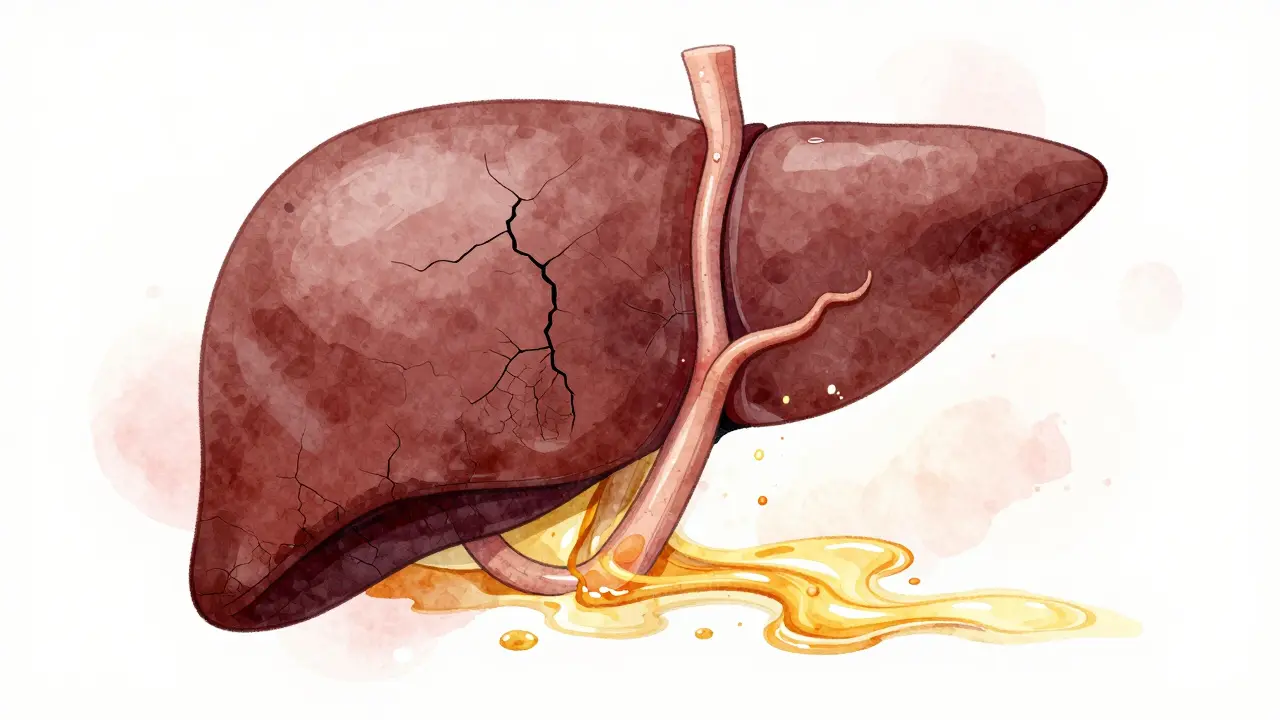
Primary Sclerosing Cholangitis (PSC) isn't just another liver condition. It's a rare, slow-burning disease that quietly destroys the bile ducts inside and outside the liver. Imagine tiny pipes carrying bile from your liver to your intestines - over time, these pipes get scarred, narrowed, and blocked. Bile can't flow. It backs up. And that’s when the real damage starts: liver inflammation, fibrosis, and eventually, cirrhosis. Unlike more common liver diseases, PSC doesn’t show up on routine blood tests unless you’re specifically looking for it. Most people don’t know they have it until they’re already years into the disease.
What Exactly Happens in PSC?
PSC attacks the bile ducts. Not just one or two - the whole network. Inside the liver (intrahepatic) and outside (extrahepatic), the ducts become inflamed. Then they scar. Then they narrow. Normal bile ducts are 3 to 8 millimeters wide. In PSC, strictures shrink to under 1.5 mm. That’s like turning a highway into a footpath. Bile builds up, poisoning liver cells. Over time, this leads to permanent scarring - cirrhosis. The disease doesn’t stop. It keeps creeping forward. There are four stages: early inflammation, then fibrosis around the ducts, then bridges of scar tissue connecting areas, and finally, full-blown cirrhosis. Once cirrhosis sets in, liver function declines fast.
What causes this? No one knows for sure. But we do know it’s not caused by alcohol or viruses like hepatitis. It’s autoimmune - meaning the body’s own immune system attacks the bile ducts. Genetics play a big role. People with the HLA-B*08:01 gene variant are over twice as likely to develop PSC. And nearly 70% of patients also have inflammatory bowel disease, especially ulcerative colitis. That’s not a coincidence. Researchers now believe the gut-liver axis is key. Something in the gut - maybe bad bacteria, maybe a leaky intestine - triggers an immune response that targets the bile ducts. Dr. Konstantinos Lazaridis at Mayo Clinic calls it a "perfect storm" of genes, gut bugs, and immune chaos.
Who Gets PSC? And Why Is It So Hard to Diagnose?
PSC mostly hits men between 30 and 50. The male-to-female ratio is 2:1. It’s rare - only about 1 in 100,000 people have it globally. But in Sweden, it’s more common: 6.3 per 100,000. Most cases are in people of European descent. In the U.S., there are roughly 25,000 diagnosed cases. Yet many more go undiagnosed.
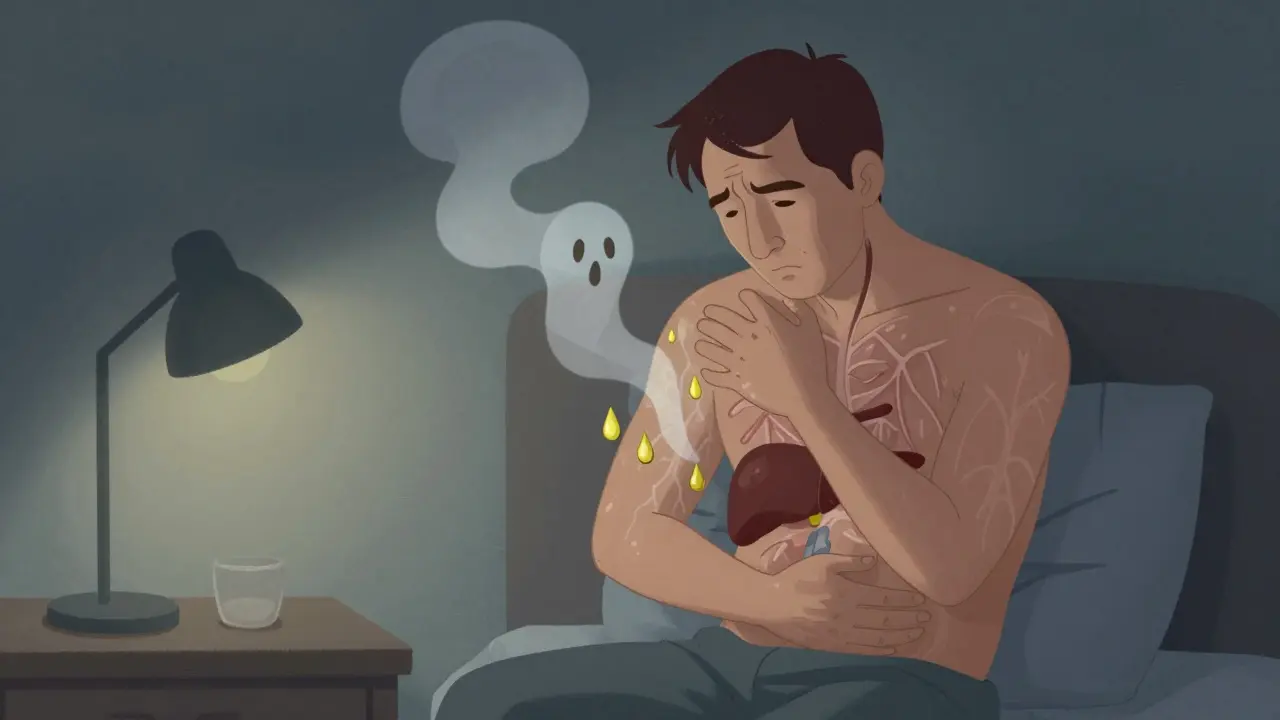
Why? Because symptoms are vague. Fatigue? Common. Itchy skin? Lots of things cause that. Abdominal discomfort? Everyone gets that sometimes. Patients often wait 2 to 5 years before getting a correct diagnosis. One Reddit user described the itching as "coming from my bones," especially at night. That’s not just skin deep - it’s the bile backing up into the bloodstream. By the time jaundice (yellow skin) shows up, the disease is advanced.
Diagnosis requires imaging. MRCP (magnetic resonance cholangiopancreatography) is the go-to test. It shows the narrowed ducts like a map of blocked roads. ERCP (endoscopic retrograde cholangiopancreatography) can confirm it, but it’s invasive and risky. Blood tests help, but they’re not definitive. ALP (alkaline phosphatase) is usually high - that’s a clue. But no single blood marker confirms PSC. That’s why specialists are needed. Community doctors often miss it.
There’s No Cure. But There Are Ways to Manage It
Here’s the hard truth: there is no medication that stops or reverses PSC. No pills can unblock the ducts or stop the scarring. Liver transplant is the only cure - and it works well. Over 80% of patients survive five years after transplant. But transplants aren’t always an option right away. You have to wait until the liver fails. So management is about slowing damage and controlling symptoms.
For years, doctors prescribed ursodeoxycholic acid (UDCA). It seemed logical - it’s a bile acid that might help flow. But multiple studies now show it doesn’t improve survival. High doses (28-30 mg/kg/day) might even increase risks. The European Association for the Study of the Liver (EASL) now says: don’t use it routinely.
So what actually helps?
- Itching (pruritus): This is the most common and unbearable symptom. Rifampicin (150-300 mg daily) works for half of patients. Naltrexone (50 mg daily) helps those with opioid-related itching. Colesevelam, a bile acid binder, is also used.
- Vitamin deficiencies: Because bile isn’t flowing, fat-soluble vitamins (A, D, E, K) aren’t absorbed. Quarterly blood tests and supplements are essential.
- Cholangitis: If you get fever, right upper pain, and jaundice, you might have an infection in the bile ducts. That’s an emergency - antibiotics and drainage are needed.
- IBD monitoring: If you have ulcerative colitis, you need a colonoscopy every 1-2 years. Your risk of colorectal cancer is 10-15% over your lifetime.
Regular monitoring is non-negotiable. Liver enzymes (ALT, AST, ALP) should be checked every 3 months. MRCP scans every year to track duct changes. And you need a specialist - not a general hepatologist. Patients treated at dedicated PSC centers report 85% better symptom control.
The Cancer Risk You Can’t Ignore
PSC doesn’t just lead to liver failure. It increases your risk of bile duct cancer - cholangiocarcinoma. That’s rare in the general population. But in PSC patients, the risk is 1.5% per year. Over 10 years, that’s a 15% chance. Once cholangiocarcinoma develops, survival drops sharply. Only 10-30% live five years after diagnosis. That’s why imaging and surveillance are so critical. No one can predict who will get cancer. So everyone with PSC needs regular scans - even if they feel fine.
What’s on the Horizon?
Hope isn’t just a word here - it’s in clinical trials. Several drugs are being tested. Obeticholic acid (OCA), from Intercept Pharmaceuticals, reduced liver enzymes by 32% in a phase 3 trial. But the FDA is holding off due to safety concerns. Cilofexor, a non-steroidal FXR agonist, showed a 41% drop in ALP in phase 2. It’s already been granted orphan drug status in Europe. Other candidates target PPAR pathways - a different angle to reduce inflammation and fibrosis.
Real-world data is helping too. The PSC Partners Seeking a Cure registry now tracks over 3,100 patients across 12 countries. That’s giving researchers a clearer picture of how the disease progresses in real life - not just in labs.
Experts predict we’ll have at least two disease-modifying drugs approved within five years. That’s not a guess - it’s based on current trial momentum. These won’t cure PSC, but they might slow it down enough to delay transplant for years.
Living With PSC: The Emotional Toll
It’s easy to focus on the biology. But the human side matters just as much. Patients report feeling invisible. Doctors say "there’s nothing we can do." That’s not just frustrating - it’s devastating. A 2023 survey found 74% of patients felt doctors had "nothing to offer beyond symptom management." That’s why peer support is vital. Online communities like PSC Partners and Reddit’s r/liverdisease are lifelines. People share tips on managing itching, finding specialists, and coping with fatigue that makes working or parenting impossible.
And yes - fatigue is real. Not laziness. Not depression. It’s a biological consequence of bile buildup and chronic inflammation. One patient on HealthUnlocked said, "I can’t play with my kids after school. I just sit down and close my eyes." That’s the daily reality for many.
Access to care is uneven. In the U.S., 72% of patients live within 100 miles of a PSC center. In rural Europe? Only 35%. That gap in care means delays, misdiagnoses, and worse outcomes.
Final Thoughts: You’re Not Alone
PSC is rare. It’s complex. It’s scary. But it’s not hopeless. While there’s no cure yet, the field is moving faster than ever. Transplants save lives. New drugs are coming. And patient-led research is changing the game.
If you or someone you know has PSC, find a specialist. Get on a monitoring schedule. Take vitamins. Watch for signs of infection. Join a support group. And hold on - because the next five years might bring the biggest breakthroughs in PSC history.


tatiana verdesoto
March 2, 2026 AT 01:44Darren Torpey
March 3, 2026 AT 06:33Lebogang kekana
March 3, 2026 AT 07:25Jessica Chaloux
March 3, 2026 AT 07:57Mariah Carle
March 5, 2026 AT 03:41Justin Rodriguez
March 6, 2026 AT 18:49Raman Kapri
March 8, 2026 AT 01:23Tildi Fletes
March 8, 2026 AT 07:45Siri Elena
March 9, 2026 AT 17:04Levi Viloria
March 11, 2026 AT 09:36