

If you’re taking medication for osteoporosis and also use magnesium supplements, you could be unknowingly making your treatment less effective - or even useless. This isn’t a theoretical concern. It’s a real, well-documented interaction that affects millions of people. The problem? Magnesium and common osteoporosis drugs like bisphosphonates don’t play nice together in your gut. And if you take them too close together, your body absorbs almost none of the bone-strengthening medicine.
Why Magnesium and Bisphosphonates Don’t Mix
Bisphosphonates - drugs like Fosamax (alendronate), Actonel (risedronate), and Boniva (ibandronate) - are the most commonly prescribed pills for osteoporosis. They work by slowing down the cells that break down bone, helping to keep your skeleton strong. But here’s the catch: these drugs are poorly absorbed to begin with. Under perfect conditions, only about 0.6% to 12% of the pill actually makes it into your bloodstream. Now add magnesium. Whether it’s from a supplement, an antacid like Milk of Magnesia, or even a laxative, magnesium ions bind tightly to the bisphosphonate molecules in your stomach and intestines. This creates a chemical bond that turns the drug into an insoluble sludge - something your body can’t absorb. Studies show this single mistake can slash bisphosphonate absorption by 40% to 60%. That means you might as well be swallowing chalk. The National Institutes of Health and the FDA both confirm this. Merck’s own clinical trials from the 1990s showed the same thing. And it’s not just a minor issue. The American Society for Bone and Mineral Research calls this a "common but correctable" reason for treatment failure. In fact, one 2021 study found that patients who got the timing right saw 8.2% more improvement in bone density over two years than those who didn’t.What’s the Right Timing?
The rule is simple: don’t take magnesium within two hours before or after your bisphosphonate. Here’s how to get it right:- Take your bisphosphonate first thing in the morning, on an empty stomach, with a full glass of water.
- Wait at least 30 minutes before eating, drinking anything else, or taking other medications.
- Then wait another 90 minutes - so a total of two full hours after taking the bisphosphonate.
- Now it’s safe to take your magnesium supplement.
It’s Not Just Supplements
Many people don’t realize that magnesium is hiding in places they wouldn’t expect. Antacids like Maalox, Mylanta, and Milk of Magnesia are loaded with it. A single tablespoon of Milk of Magnesia contains 800mg of magnesium - more than most supplements. Laxatives, especially those labeled "magnesium-based," are another hidden source. Even some bottled waters, like San Pellegrino, contain noticeable amounts of magnesium (about 51mg per liter). If you’re taking any of these regularly, you’re still at risk. You don’t need to stop using them - just separate them by two hours from your osteoporosis pill. And if you’re unsure whether a product contains magnesium, check the ingredients. Look for: magnesium hydroxide, magnesium citrate, magnesium oxide, or magnesium chloride.Who’s Most at Risk?
Older adults are the most vulnerable group. Many take multiple medications daily - sometimes five or more. It’s easy to mix up the order. A 2022 survey by the National Osteoporosis Foundation found that 37% of people taking both magnesium and bisphosphonates didn’t even know there was a problem. And 22% admitted they took them at the same time. People with restless legs syndrome are another high-risk group. Magnesium is often recommended for this condition, and many take it at night. But if they’re also on a daily bisphosphonate, they might be taking both right before bed - a dangerous combo. And here’s the kicker: many doctors don’t mention this interaction during the initial prescription. Pharmacists are better trained on it now, thanks to updated guidelines and mandatory alerts in electronic systems like Epic and Cerner. But if you’re not getting clear, written instructions, you’re flying blind.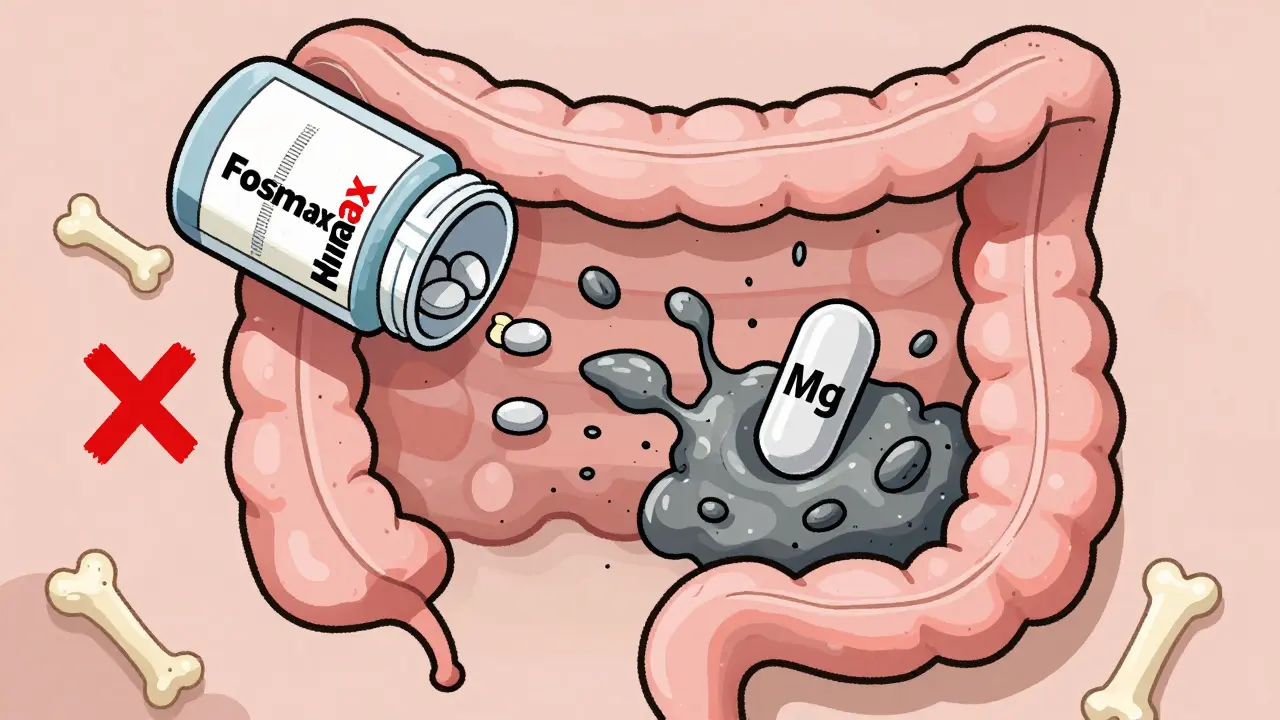
How to Stay on Track
Simple strategies make a huge difference:- Use a pill organizer with four compartments - morning, midday, afternoon, evening - not just AM/PM. This helps you space out the timing.
- Keep a written log. Write down what you took and when. Even a sticky note on your bathroom mirror works.
- Set phone alarms. One for your bisphosphonate, another for your magnesium, two hours apart.
- Ask your pharmacist for a "timing wheel" - a simple plastic disc that shows the correct window between meds. Studies show these boost adherence from 32% to 67%.
What About IV Osteoporosis Drugs?
If you’re on an intravenous bisphosphonate like Reclast (zoledronic acid), you don’t need to worry. These drugs go straight into your bloodstream - bypassing your gut entirely. Magnesium supplements won’t interfere. But if you’re on a pill, the timing rule still applies.What About Food Sources of Magnesium?
Some people wonder: "What if I eat spinach, almonds, or black beans? Do I need to avoid those?" The answer is no. Dietary magnesium from food doesn’t cause the same problem. The issue is concentrated, supplemental doses - the kind you take in pill form. Your body handles magnesium from food differently, and it’s released slowly, so it doesn’t overwhelm the absorption process. The American College of Rheumatology has been clear on this: there’s no evidence that eating magnesium-rich foods interferes with bisphosphonates. So keep your salads and nuts - just avoid the pills unless timed correctly.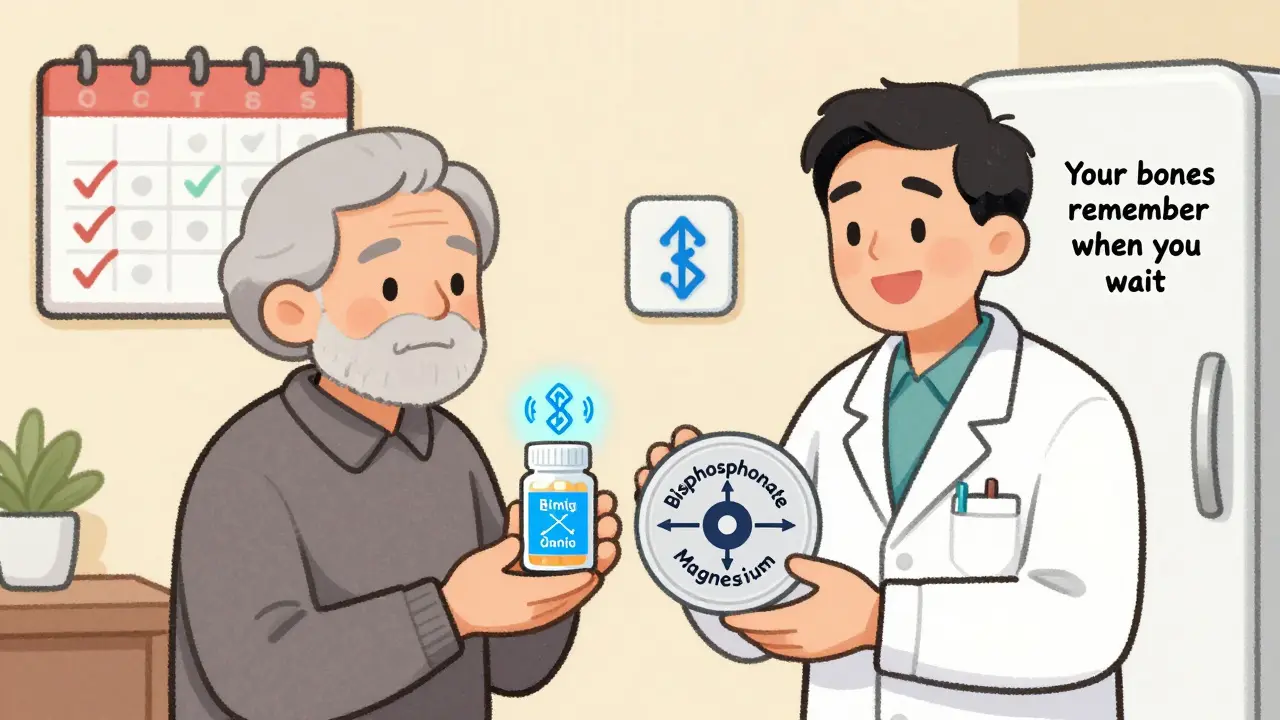




Melissa Taylor
December 16, 2025 AT 11:05Thank you for laying this out so clearly. I’ve been taking magnesium for sleep and bisphosphonates for osteoporosis and had no idea they clashed. I just set two alarms-one at 7 AM for the pill, another at 9:30 AM for the magnesium. My bones will thank me.
RONALD Randolph
December 17, 2025 AT 23:09THIS IS NON-NEGOTIABLE. The FDA has been warning about this for DECADES. People still take antacids with their Fosamax like it’s a coffee creamer. It’s not rocket science. Two hours. Separate. Or your bones turn to dust. Period.
Lisa Davies
December 19, 2025 AT 01:07OMG YES!! I just found out last month that my Milk of Magnesia was sabotaging my Fosamax 😭 I switched to a magnesium glycinate and now take it at bedtime. My doctor didn’t mention it either-so glad I read this. 🙌
Raj Kumar
December 19, 2025 AT 03:10so i was taking my mg at night with my other meds and didn’t know it was a problem. i just changed my routine now. thanks for the heads up. also, san pellegrino? who knew??
John Brown
December 19, 2025 AT 03:40My mom took bisphosphonates for years and never knew this. She broke her hip last year. If only someone had told her. This is the kind of info that should be on every prescription bottle. Thanks for sharing.
Jocelyn Lachapelle
December 20, 2025 AT 23:54I started using a pill organizer with four slots and it changed everything. Morning meds, midday, afternoon, night. No more guessing. Simple. Works.
Christina Bischof
December 22, 2025 AT 10:12Just read this while taking my magnesium. I’ve been taking it two hours after my bisphosphonate for months now. Still worth repeating. This stuff matters.
Sai Nguyen
December 22, 2025 AT 10:34Western medicine overcomplicates everything. In India we just take what works. Magnesium and calcium together for years. No problems. Maybe your bodies are too weak.
Jake Sinatra
December 23, 2025 AT 20:12While the two-hour separation is clinically sound, it’s worth noting that the pharmacokinetic window for bisphosphonate absorption is highly variable between individuals. Factors like gastric pH, motility, and even meal composition can influence efficacy beyond mere mineral interference. A one-size-fits-all rule may be convenient, but precision medicine demands more nuance.
Nupur Vimal
December 25, 2025 AT 06:44You’re all missing the point. Magnesium is a scam. The real problem is that big pharma doesn’t want you to heal naturally. Just eat more spinach and stop taking pills. You’re all being manipulated.
Michelle M
December 26, 2025 AT 01:25It’s funny how we treat our bodies like machines that need perfect timing, when in reality, biology is messy. But I get it-when you’re trying to prevent fractures, you take the control you can get. Still, I wonder if we’re over-engineering prevention.
Cassie Henriques
December 27, 2025 AT 06:53As a pharmacist, I can confirm: the interaction is real and under-recognized. I’ve seen patients with zero bone density improvement despite perfect adherence-until we asked about their nightly Mg citrate. The moment they separated them? BMD jumped 6% in 12 months. This isn’t theory-it’s clinical fact.
John Samuel
December 28, 2025 AT 17:51The elegance of this solution-two hours apart-is almost poetic. It’s not about restriction; it’s about rhythm. Like breathing in and out. The pill arrives like a quiet guest. The magnesium waits like a patient friend. When harmony is restored, the body remembers how to heal. Thank you for this clarity.
Mike Nordby
December 29, 2025 AT 13:33One of the most important posts I’ve read this year. I’m sharing this with my entire senior group at the community center. We’re all on these meds. Someone needs to know this. Thank you for the thorough breakdown and the actionable steps.