
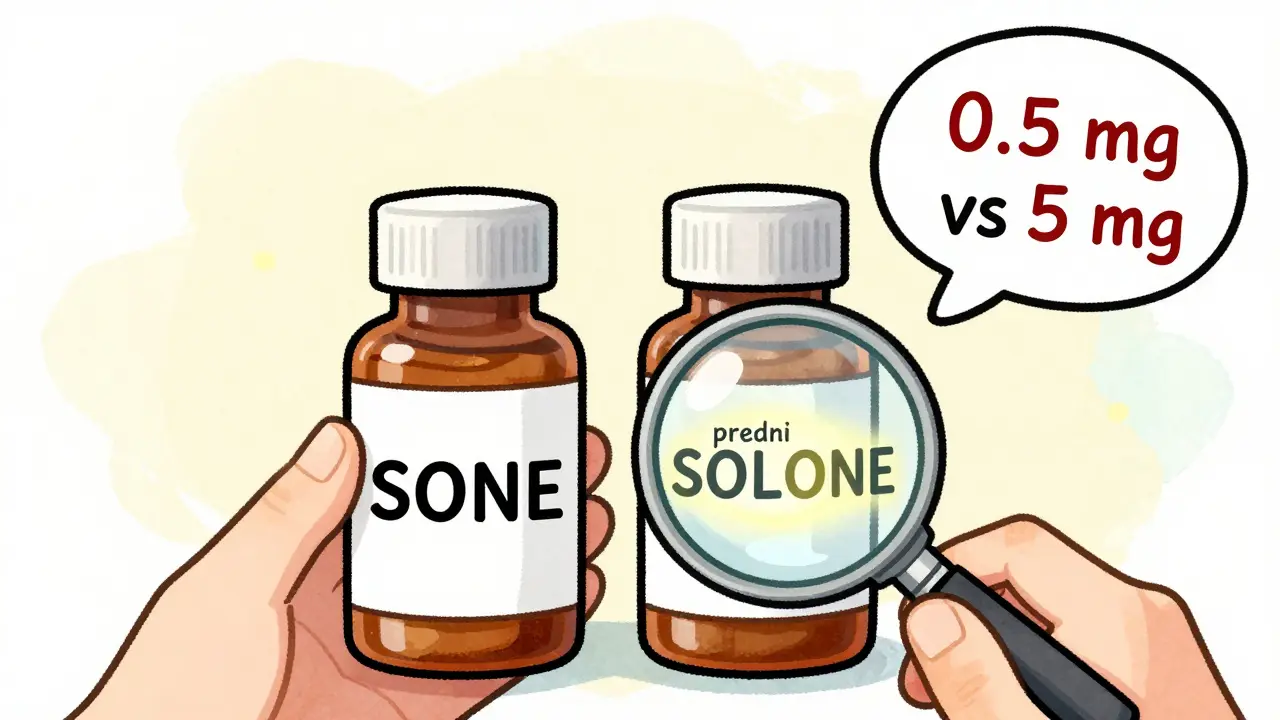
Every year, thousands of people in the U.S. are harmed because someone misread a medication label. It’s not always a mistake by a doctor or pharmacist. Sometimes, it’s because the medication name, strength, or dosage form wasn’t checked clearly enough. And when that happens, the consequences can be deadly. A dose meant to be 0.5 mg becomes 5 mg. A pill meant to be swallowed is mistaken for a patch. A vial of insulin labeled 100 units/mL is confused with 10 units/mL. These aren’t rare errors. They happen more often than you think.
Why Medication Verification Matters
The Institute of Medicine estimates that at least 1.5 million preventable adverse drug events occur each year in the U.S. That’s more than car accidents or medical device failures. About 7,000 of those cases result in death. Most of these errors happen because someone didn’t verify the basics: what the drug is, how strong it is, and how it’s meant to be taken.
The FDA, ISMP, and other safety groups have spent decades building rules to stop this. But rules only work if people follow them. And too often, people skip steps because they’re rushed, distracted, or think they’ve seen the drug before. You can’t assume. You can’t guess. You have to check.
Step 1: Confirm the Drug Name
Drug names can be confusing. Look-alike, sound-alike names like Hydralazine and Hydroxyzine or Prednisone and Prednisolone are common culprits. One letter off, one syllable wrong, and you’re giving the wrong drug.
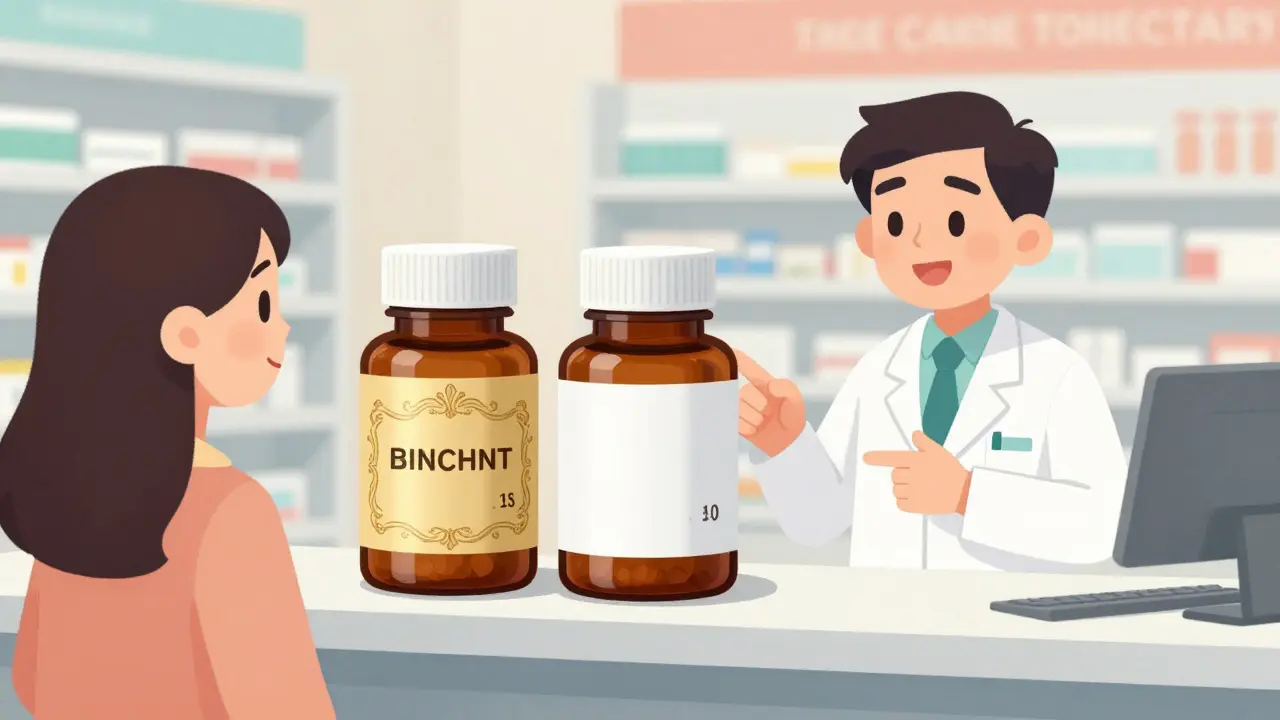
Always compare the name on the prescription with the name on the vial or bottle. Don’t rely on memory. Don’t assume the label is correct. If the name is handwritten, ask for clarification. If it’s electronic, read it aloud to yourself before proceeding.
Use Tall Man lettering to spot differences. This means capitalizing the parts of the name that differ: predniSONE vs. predniSOLONE. Many EHR systems now do this automatically. If they don’t, do it in your head. It’s a simple trick that cuts confusion by 76%.
Step 2: Verify the Strength
Strength is where most errors happen. The FDA found that 34% of medication errors between 2013 and 2017 involved incorrect strength. And 61% of those errors occurred because the provider didn’t cross-check the strength against the original order.
Always write out the strength with a space between the number and unit: 10 mg, not 10mg. That one space prevents 12% of errors, according to ISMP. Why? Because 10mg can look like 100 mg if the ‘0’ smudges.
Never use abbreviations. Never write ‘U’ for unit - use ‘unit’. Never write ‘μg’ - use ‘mcg’. These have caused hundreds of fatal overdoses. A nurse in Sydney once caught a 100-fold overdose because she noticed the label said ‘Heparin 5,000 units/mL’ but the order read ‘50 units/mL’. She paused. She checked. She saved a life.
For injectables, avoid ratios like ‘1:10,000’. Convert them. Epinephrine 1:10,000 is actually 0.1 mg/mL. If you see a ratio, stop. Recalculate. Ask for confirmation. The ISMP documented 236 errors between 2010 and 2015 because of this.
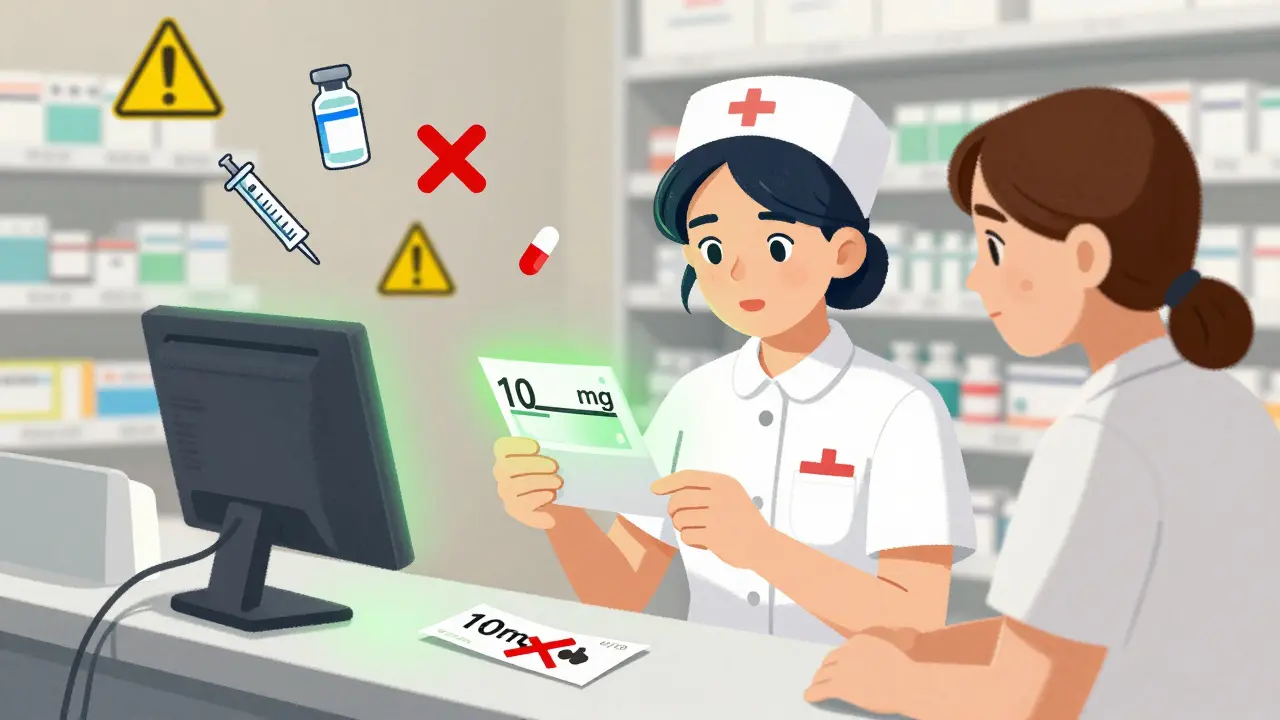
Step 3: Identify the Dosage Form
Is it a tablet? A capsule? A liquid? A patch? A suppository? The dosage form tells you how to take it - and how not to.
One Reddit user shared a horror story: a patient was given oral morphine tablets, but the label didn’t say ‘oral’. The caregiver crushed them and mixed them into a drink - not knowing they were meant to be swallowed whole. The result? A fatal overdose.
Another common mistake: confusing topical creams with oral gels. A cream labeled ‘0.1% hydrocortisone’ is safe on the skin. But if someone mistakes it for an oral suspension and swallows it, the dose is way too high.
Always verify the dosage form on the prescription, the label, and the physical package. If the form is missing, don’t proceed. If it’s unclear, call the prescriber. A 2011 study by First DataBank found that 87% of name confusion errors happened because the strength or dosage form was left out.
Three Critical Points to Check
Verification isn’t a one-time task. It happens at three key moments:
- When you receive the order - Is the drug name complete? Is the strength written clearly? Is the dosage form specified?
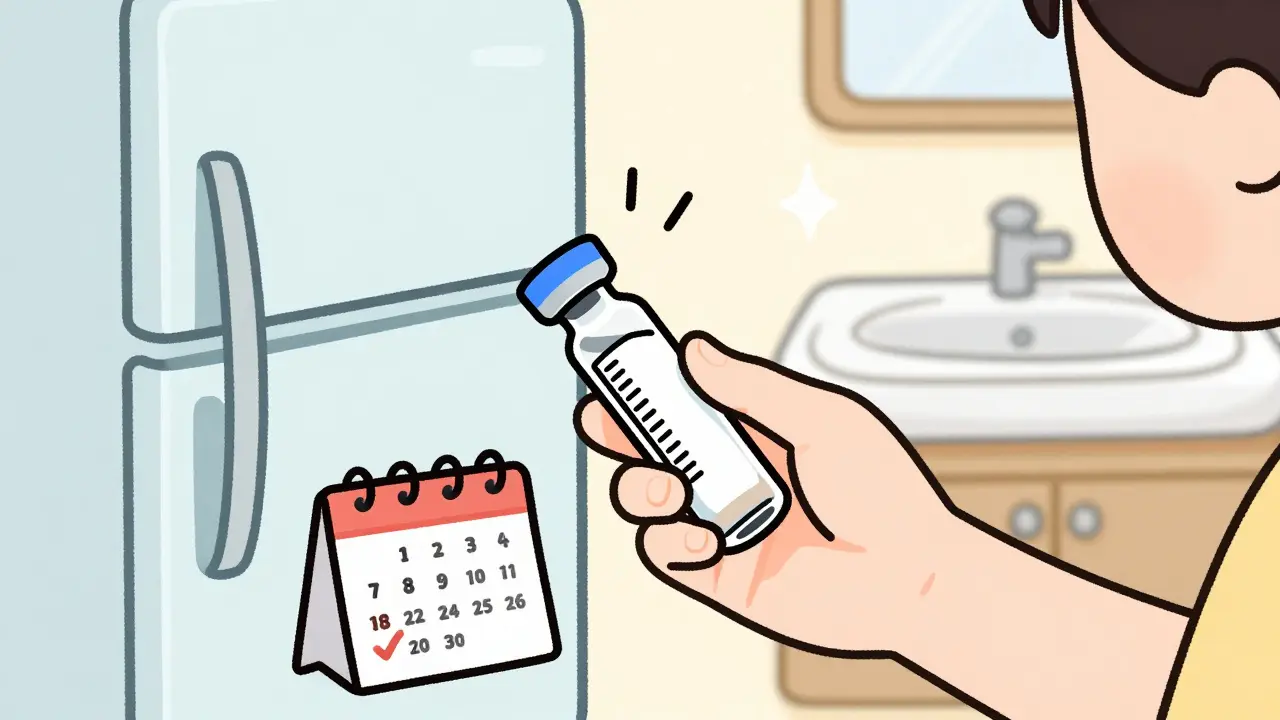
- When you prepare the medication - Compare the prescription to the actual product. Read the label aloud. Check expiration. Look for damage.
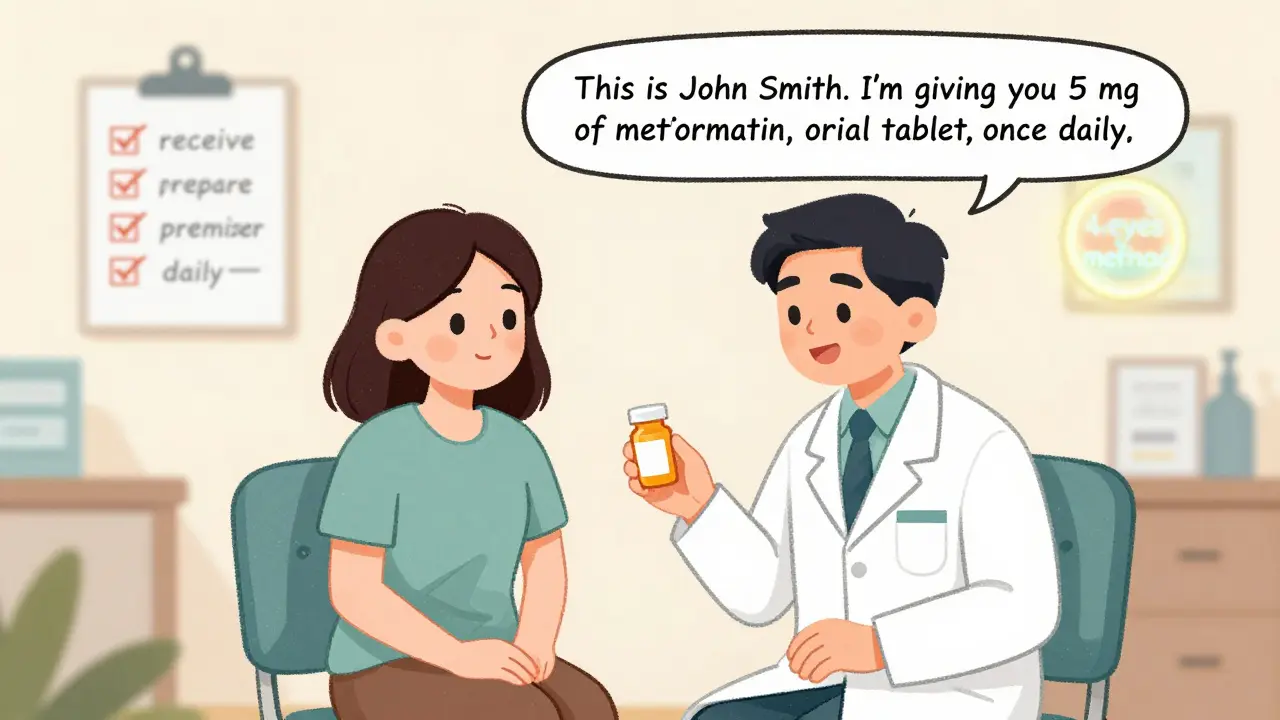
- Right before administration - Confirm the patient’s name, the drug, the strength, the form, and the route. Use the ‘read-back’ method: say it out loud to the patient or colleague. ‘I’m giving you 5 mg of metformin, oral tablet, once daily.’
A Mayo Clinic study showed that using this ‘four-eyes’ method - where two people verify high-risk drugs - reduced errors by 94% over 18 months. You don’t need a team. But you do need to pause. And speak.
What to Watch Out For
Some pitfalls are easy to miss:
- Leading zeros: Always write 0.5 mg, not .5 mg. Missing the zero can make it look like 5 mg.
- Trailing zeros: Never write 5.0 mg. That could be misread as 50 mg. Write 5 mg instead.
- High-alert medications: Insulin, heparin, opioids, potassium chloride - these need extra checks. Always have a second person verify them.
- Electronic system alerts: Don’t ignore them. But don’t trust them blindly either. A 2020 study found that 18% of errors happened because clinicians over-relied on system approvals and missed clear mismatches.
- Label design: Faded ink, small font, poor contrast - 23% of errors are linked to bad labels. If you can’t read it easily, don’t use it.
What Works Best
The most effective systems combine human care with smart tools:
- Barcode scanning: Hospitals using it cut dispensing errors by 83%. It’s not perfect, but it’s a strong safety net.
- RxNorm normalization: This system standardizes drug names across EHRs. It resolves 92.3% of naming discrepancies.
- Spelling correction: Systems that auto-correct typos like ‘Lopressor’ to ‘Lopressor’ (not ‘Lopressor’) prevent confusion.
- Training: A 2022 study found that just 4 hours of initial training + quarterly 30-minute refreshers reduced errors by 63%.
Community pharmacies with barcode scanners have far fewer errors than those that don’t. Hospitals with mandatory verification at all three points have 3.7 times fewer errors than those that don’t.
What’s Changing Now
In February 2024, the FDA proposed new rules requiring all digital drug labels to include machine-readable data for name, strength, and dosage form. This means future apps and systems will be able to auto-check prescriptions against official databases.
AI is also stepping in. Google Health’s 2023 pilot used computer vision to scan medication labels and caught 99.2% of mismatches. But the FDA hasn’t approved AI for this use yet. So for now, human eyes are still the gold standard.
States with mandatory verification laws for high-risk drugs have 29% fewer errors. As of January 2024, 18 U.S. states have these rules. More are coming.
Final Rule: Never Skip the Check
Medication safety isn’t about fancy tech. It’s about discipline. It’s about slowing down. It’s about asking: Is this exactly what was ordered?
Even if you’ve given this drug 100 times before. Even if the system says it’s fine. Even if you’re tired. Even if the patient says, ‘I know what this is.’
Check the name. Check the strength. Check the form. Say it out loud. Confirm it with another person if you can.
Because the difference between a safe dose and a deadly one? Sometimes, it’s just a space. Or a zero. Or one clear, careful check.
What should I do if a medication label looks unclear?
Stop. Don’t use it. Contact the prescriber or pharmacist for clarification. Never guess. If the name, strength, or form is missing, smudged, or hard to read, request a new label or prescription. The FDA reports that 23% of medication errors are linked to poor label design. It’s better to delay than to risk harm.
Why is it dangerous to write 'U' for units?
The letter 'U' can be mistaken for '0' or '4', especially in handwriting. This led to 10-fold dosing errors with insulin and heparin. For example, '10U' could be read as '100' or '104'. The ISMP banned 'U' in 2003. Always write 'unit' in full. This simple change has saved countless lives.
Can I rely on electronic health record alerts to catch errors?
No. While EHR alerts help, they’re not foolproof. A 2020 study found that 18% of errors occurred because clinicians ignored alerts due to 'alert fatigue'. Always verify the information yourself, even if the system says it’s correct. Technology supports - it doesn’t replace - human judgment.
What’s the best way to verify medication before giving it to a patient?
Use the 'read-back' method: Say aloud the patient’s name, the drug name, the strength with units, the dosage form, and the route. For example: 'This is John Smith. I’m giving you 5 mg of metformin, oral tablet, once daily.' Ask the patient to repeat it back if they’re alert. This simple step catches 89% of errors in positive user reports.
Are there any medications that require extra verification?
Yes. These are called 'high-alert medications' and include insulin, heparin, opioids, potassium chloride, and concentrated electrolytes. They can cause serious harm if given incorrectly. Always have a second person verify these drugs. Many hospitals require dual signatures for these medications. Never skip this step.
What should I do if I notice a pattern of confusing drug names at my workplace?
Report it. Many hospitals use Tall Man lettering (e.g., predniSONE vs. predniSOLONE) to visually separate similar names. If your facility doesn’t use it, suggest it. ISMP data shows this reduces confusion errors by 76%. Also, ask for a review of your EHR’s drug library to ensure it’s using RxNorm standards and auto-corrects common typos.

Alex Ogle
February 8, 2026 AT 03:23Been a nurse for 18 years. Seen too many near-misses because someone skipped the read-back. Once, a med pass got messed up because 'Hydralazine' was typed as 'Hydroxyzine' in the system. No one caught it until the patient started seizing. We had to crash cart it. That’s when I started reading everything out loud-even when I was the only one in the room. It’s weird, yeah, but it works. Now I do it with every med, every time. No exceptions. Even if I’m tired. Even if the system says it’s fine. I say it. Out loud. To myself. And I mean it.
It’s not about trust. It’s about habit. And habits save lives.
Brandon Osborne
February 9, 2026 AT 00:58You people are too soft. This isn’t about 'read-backs' or 'Tall Man lettering.' This is about accountability. Someone gets killed because you didn’t check? That’s not an error-that’s negligence. And if you’re too lazy to verify a damn label, you shouldn’t be holding a syringe. I’ve seen nurses scroll through their phones while prepping meds. No joke. That’s not incompetence. That’s a public hazard. We need mandatory re-certification every 6 months. And if you mess up twice? You’re done. No second chances. Lives aren’t apps you can undo.
Stop treating medicine like a buffet. It’s not.
Simon Critchley
February 9, 2026 AT 14:13Let’s get technical. The 76% reduction with Tall Man lettering? That’s from ISMP’s 2019 meta-analysis. But here’s the kicker-it only works if the EHR actually renders it. A lot of legacy systems still spit out 'prednisone' and 'prednisolone' in all lowercase. No differentiation. No visual cue. And guess what? The AI doesn’t care. It’s just parsing strings. So unless your vendor uses RxNorm with UMLS mappings, you’re still playing Russian roulette.
Also, 'mcg' vs 'μg'? That’s not a style choice. That’s a WHO recommendation from 2006. And yet, 41% of community pharmacies still use the micro symbol. Why? Because it’s easier to type. But it’s not worth the risk. One misplaced glyph = 10x overdose. It’s math. Not magic.
Tom Forwood
February 9, 2026 AT 14:20Yo, I work in a rural clinic in Nebraska. We don’t have barcode scanners. We don’t have AI. We have a printer that jams every other day and a pharmacist who’s 72 and still reads labels with a magnifying glass. And you know what? We’ve had zero fatal errors in 5 years. Why? Because we talk. We say it out loud. 'This is 5 mg, oral, metformin.' The patient hears it. The nurse hears it. The dog hears it. We even make the family repeat it back if they’re there. It’s dumb. It’s slow. But it works.
Tech is great. But human voice? That’s the original safety net.
John McDonald
February 10, 2026 AT 13:37Love this breakdown. Seriously. I’ve been pushing for a 'med check pause' policy at my hospital. Just 15 seconds before you hand over any high-alert med. No rushing. No multitasking. Just stop. Breathe. Read it. Say it. Confirm.
We tried it as a pilot last month. 14 near-misses caught. Zero errors delivered. And the staff? They’re not mad anymore. They say it feels safer. Like the system finally has their back. I’m not saying it’s perfect. But it’s a start. And sometimes, that’s all you need.
Also, shoutout to the nurse who caught that heparin mix-up. That’s the kind of hero we don’t celebrate enough.
Chelsea Cook
February 10, 2026 AT 20:23Oh wow. A whole article about checking meds and not one mention of how much we’re overworked? 🙄
Yeah, I’ll 'read it aloud' while triaging 12 patients, answering 3 pagers, and my coffee just exploded in the microwave. Tell me again how 'discipline' fixes a 12-hour shift with zero breaks. Oh wait-I forgot. You’re not the one holding the syringe. You’re the one writing the checklist.
Also, 'AI hasn’t been approved'? Bro, I’ve seen 3 different systems auto-fill '100 units' as '1000 units' and not flag it. But sure, let’s just trust the human eye. Right. 😌
Andrew Jackson
February 11, 2026 AT 04:52The erosion of professional standards in American healthcare is a national disgrace. The fact that we now require 'read-backs' and 'two-person verification' as standard operating procedure is not progress-it is admission of systemic collapse. In my youth, we trusted the training. We trusted the process. We trusted the oath. Now, we treat every nurse like a child who cannot be left alone with a bottle of pills.
And yet, we have the audacity to call this 'safety.' It is not safety. It is humiliation. It is the death of professional dignity. If you cannot be trusted to read a label, you should not be in the profession. Period.
Joseph Charles Colin
February 13, 2026 AT 01:43Just to clarify the RxNorm point: it’s not just about standardization-it’s about semantic interoperability. RxNorm CUIs (Concept Unique Identifiers) map brand names, generic names, strengths, and forms into a unified ontology. When EHRs use RxNorm, they’re not just matching text-they’re matching clinical intent. So 'Lopressor 10 mg' and 'metoprolol tartrate 10 mg' are treated as the same entity. That’s why it resolves 92.3% of naming discrepancies.
But here’s the catch: RxNorm is only as good as the data input. If your pharmacy system auto-generates labels from free-text orders? You’re still at risk. The fix isn’t just tech. It’s clean, structured data entry. And that requires training. And discipline. And yes-sometimes, a second pair of eyes.
Kathryn Lenn
February 14, 2026 AT 06:02Let’s be real. This whole 'check every label' thing? It’s a distraction. The real issue? Pharma companies design labels to be confusing. Look at insulin vials-they all look identical. Why? Because they want you to need a second person. A third person. A fourth. Because if you could just read it yourself, you’d realize they’re charging $400 for something that costs $3 to make.
And don’t get me started on EHR alerts. They’re not there to save you. They’re there to cover the hospital’s butt in court. 'We had an alert!' Yeah, and it was 17 notifications deep in a scrollable list labeled 'Possible Drug Interaction (1/1000 chance).'
Stop pretending this is about safety. It’s about profit. And control.
John Watts
February 16, 2026 AT 04:46Just got back from a trip to Ghana. Saw a nurse there give insulin without a syringe-just a tiny dropper. No labels. No EHR. No barcode. Just her, a patient, and a handwritten note.
She got it right. Every time.
Why? Because she talked to the patient. Asked them to describe how they felt. Checked their eyes. Asked them to repeat the name. Then she gave it.
Technology is cool. But connection? That’s the real algorithm.
Maybe we’re overcomplicating this.
Chima Ifeanyi
February 17, 2026 AT 22:15Let’s analyze the data. The 94% error reduction from dual verification? That’s from a Mayo Clinic study with 12,000 patients over 18 months. But here’s the bias: they excluded all non-English-speaking patients. Also, they didn’t control for shift length or nurse-to-patient ratios. And yet, this is cited like gospel.
Meanwhile, in Nigeria, we have one pharmacist for every 10,000 people. No barcode scanners. No EHR. No 'read-backs.' We use color-coded caps, verbal confirmation, and community trust. And our medication error rate? Lower than the U.S. average.
So maybe the problem isn’t the lack of process. Maybe it’s the over-reliance on process. Maybe we’re drowning in protocols because we’ve lost confidence in the people.
Just saying.