
Generic Drug Approval: How Safe, Cheap Medicines Reach the Market
When you pick up a generic drug, a medication that contains the same active ingredient as a brand-name drug but is sold without the brand name. Also known as non-brand medication, it is the backbone of affordable healthcare in the U.S. and beyond. The process that lets these drugs reach pharmacy shelves is called generic drug approval, the rigorous evaluation by the FDA to prove a generic version is therapeutically identical to its brand-name counterpart. This isn’t just paperwork—it’s a system designed to save patients billions every year while keeping innovation alive.
Behind every approved generic is a strict set of tests. The FDA doesn’t just check the ingredients. They require proof that the generic delivers the same amount of medicine into your bloodstream at the same speed as the brand. This is called bioequivalence, the scientific standard that ensures a generic works the same way in your body as the original. No guessing. No shortcuts. If it doesn’t match within tight limits, it doesn’t get approved. And it’s not just about the pill itself—manufacturing sites are inspected just like brand-name facilities. You’re not getting a lesser product. You’re getting the same drug, sold without the marketing cost.
The Hatch-Waxman Act, a 1984 U.S. law that created the modern framework for generic drug approval. changed everything. Before this law, generic makers couldn’t rely on the brand’s safety data. They had to repeat expensive clinical trials just to prove the drug worked. Hatch-Waxman let them use the brand’s research, as long as they proved bioequivalence. That’s why generics are so much cheaper—and why new drugs keep getting developed. The system balances two goals: rewarding innovation and making treatment accessible.
Some people worry generics aren’t as good. But the truth? The FDA approves over 90% of generic applications. Millions of people take them every day with zero issues. Even hospitals and the VA rely on them. And if you’ve ever taken a generic version of Lipitor, Zoloft, or Metformin—you’ve already benefited from this system. There’s no hidden catch. The active ingredient is identical. The side effects are the same. The only difference? The price tag.
But approval doesn’t mean all generics are the same. There are authorized generics, the exact same pills as the brand, made by the same company, just sold under a different label. Then there are traditional generics—same active drug, different fillers, different shape, sometimes made overseas. Both are legal. Both are safe. But they’re not always identical in how they feel. That’s why some people stick with one brand of generic. And why your pharmacist might ask if you want to switch.
What you’ll find in the posts below are real stories and facts about how this system works—and where it sometimes breaks down. You’ll see how patent laws delay generics, how supply chain flaws affect availability, and why some people get better results with one generic over another. You’ll also learn about authorized generics that are literally the same as the brand, and how drug interactions can still matter even when the name changes. This isn’t theory. It’s what’s on your prescription right now.
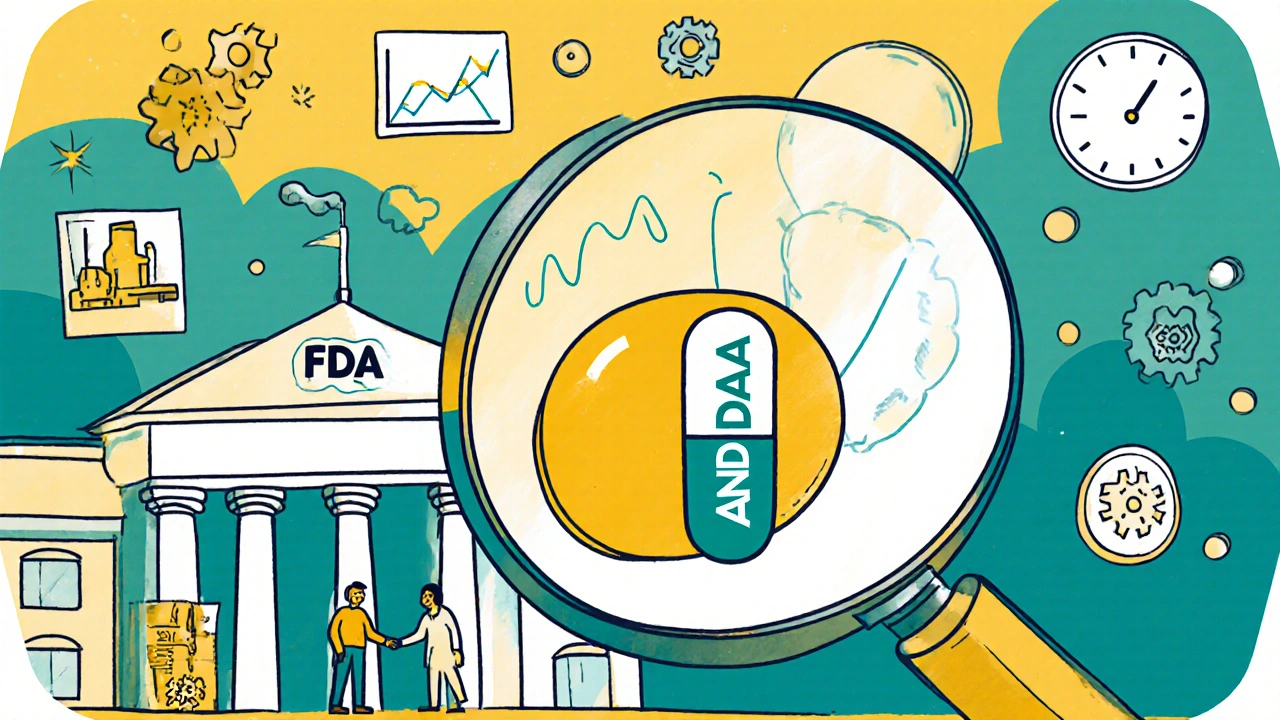
FDA’s Abbreviated New Drug Application Process Explained: How Generic Drugs Get Approved
The FDA's ANDA process lets generic drugs reach the market faster and cheaper by proving they're bioequivalent to brand-name drugs. Learn how it works, why it saves billions, and what happens behind the scenes.