
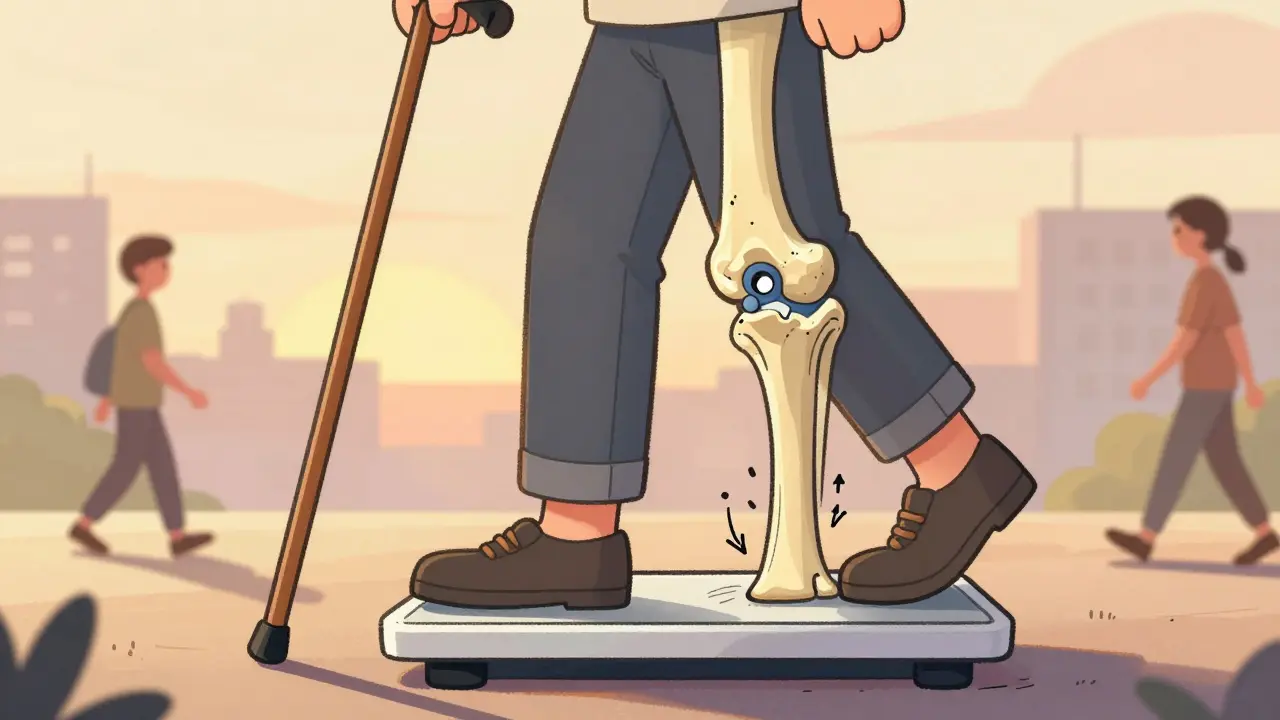
When your hip starts to ache with every step, it’s not just about getting older-it’s about what’s happening inside the joint. Osteoarthritis of the hip isn’t just wear and tear. It’s cartilage breaking down, bone grinding on bone, and inflammation creeping in. For people carrying extra weight, this process speeds up. But here’s the thing: weight loss isn’t just a suggestion. For many, it’s the most powerful non-surgical tool you have to slow damage and feel better.
Why Weight Matters So Much for Your Hip
Your hip joint carries your whole body weight every time you stand, walk, or climb stairs. Unlike your knee, which absorbs shock with each step, your hip is a deep ball-and-socket joint built for stability. But that stability comes at a cost: every extra pound puts more pressure on the cartilage inside. Studies show that for every pound of body weight lost, you reduce about four pounds of pressure on your hip joint during walking. That’s not a small math problem-it’s a game-changer. People with a BMI over 30 (considered obese) are up to seven times more likely to develop hip osteoarthritis than those with a normal weight. And it’s not just about risk-it’s about progression. The heavier you are, the faster the cartilage wears away. That’s why losing weight isn’t just about looking better. It’s about keeping your hip joint alive longer.The Evidence: Does Weight Loss Actually Help Hip OA?
There’s a lot of noise out there. Some studies say yes. Others say no. The confusion comes from comparing hips to knees. For knee osteoarthritis, weight loss is a no-brainer. Pain drops fast. Function improves. But hips? It’s messier. A 2023 trial published in PubMed followed 101 adults with hip OA and obesity. Half did a very-low-calorie diet plus exercise. The other half just did exercise. After six months, the diet group had lost 8.5% more weight-but their hip pain hadn’t changed much compared to the exercise-only group. That’s where many people stopped reading. They thought, “See? Weight loss doesn’t help hips.” But wait. The same study kept going. At 12 months, the results flipped. The group that lost weight showed better pain scores, better function, and more overall improvement. The benefits just took longer to show up. That’s critical. If you give up after six months, you miss the real payoff. Then there’s the 2024 Nature study. Researchers tracked 65-year-olds with hip OA and obesity. Those who lost more than 10% of their body weight saw dramatic improvements-not just in pain, but in quality of life, ability to move, and even sports function. The biggest jump? A 31% improvement in how they felt about their daily lives. That’s not just symptom relief. That’s reclaiming your life. So why the contradiction? One theory: the hip joint doesn’t respond to weight loss the same way the knee does. The knee is more sensitive to mechanical stress. The hip responds more to systemic inflammation caused by fat tissue. Losing weight reduces inflammation across your whole body-not just your joints. That’s why the benefits show up slowly, and why they’re broader than just pain.How Much Weight Do You Actually Need to Lose?
You’ve probably heard “lose 5% of your body weight.” That’s the standard for knee OA. But for hips? It’s not enough. The data points to 7-10% as the real target. In the Nature study, people who lost less than 5% saw little to no improvement. Those who lost 10% or more? They had the best outcomes across every measure: pain, stiffness, walking speed, and daily function. Losing 20% didn’t give you much more than 10%-so there’s a sweet spot. Let’s say you weigh 200 pounds. Losing 10% means dropping 20 pounds. That’s not easy. But here’s the math: if you lose 20 pounds, you remove 80 pounds of pressure from your hip with every step. Over a day of walking, that’s thousands of pounds of force taken off your joint. That’s joint preservation in action.
What Works: The OAHWFL Program and Real-World Results
In Australia and New Zealand, the Osteoarthritis Healthy Weight For Life (OAHWFL) program has been adapted for hip OA. It’s not a fad diet. It’s a structured 18-week plan combining low-calorie eating, protein-rich meals, and targeted exercises. Participants lost an average of 7-10% of their body weight. Those who finished the program saw big gains in function and pain scores. One study from 2012 followed 35 people with hip OA and overweight. They did an 8-month program of diet and exercise. Their physical function improved by 32.6%. Walking speed got faster. Pain dropped. Even their mood lifted. The kicker? They didn’t have a control group, so we can’t say for sure if it was the diet or the exercise. But when you combine both, the results are stronger than either alone. The program works because it’s not about starving yourself. It’s about eating smarter: more protein to protect muscle, fewer refined carbs to lower inflammation, and meals that keep you full longer. And the exercise? It’s not running. It’s cycling, swimming, water aerobics, and strength training that builds muscle around the hip to take pressure off the joint.Why Exercise Alone Isn’t Enough
Some people think, “I’ll just exercise more.” But if you’re carrying 30 extra pounds, every squat, every step, every stair climbs is stressing your hip harder. Exercise helps build muscle and improve movement-but it doesn’t fix the root cause: excess weight. Think of it like this: you can strengthen the engine of a car, but if you keep loading it with 1,000 extra pounds, it’s still going to break down faster. Weight loss reduces the load. Exercise strengthens the parts that carry it. You need both. The 2023 trial showed that exercise-only groups didn’t improve much on hip pain at six months. But the group that combined diet and exercise? By 12 months, they were miles ahead. The body doesn’t heal overnight. But with consistent effort, it does heal.What About Medications or Surgery?
Painkillers like NSAIDs help with symptoms, but they don’t stop the damage. And they come with risks-stomach issues, kidney strain, heart problems-especially if you’re older or have other conditions. Hip replacement surgery is highly effective. But it’s not a free pass. You still need to manage your weight after surgery. Obese patients have higher rates of complications, shorter implant lifespan, and slower recovery. Surgery is a last resort-not a solution to poor habits. The American College of Rheumatology recommends weight loss as a first-line treatment for hip OA in people with overweight or obesity. That’s not a side note. It’s the foundation.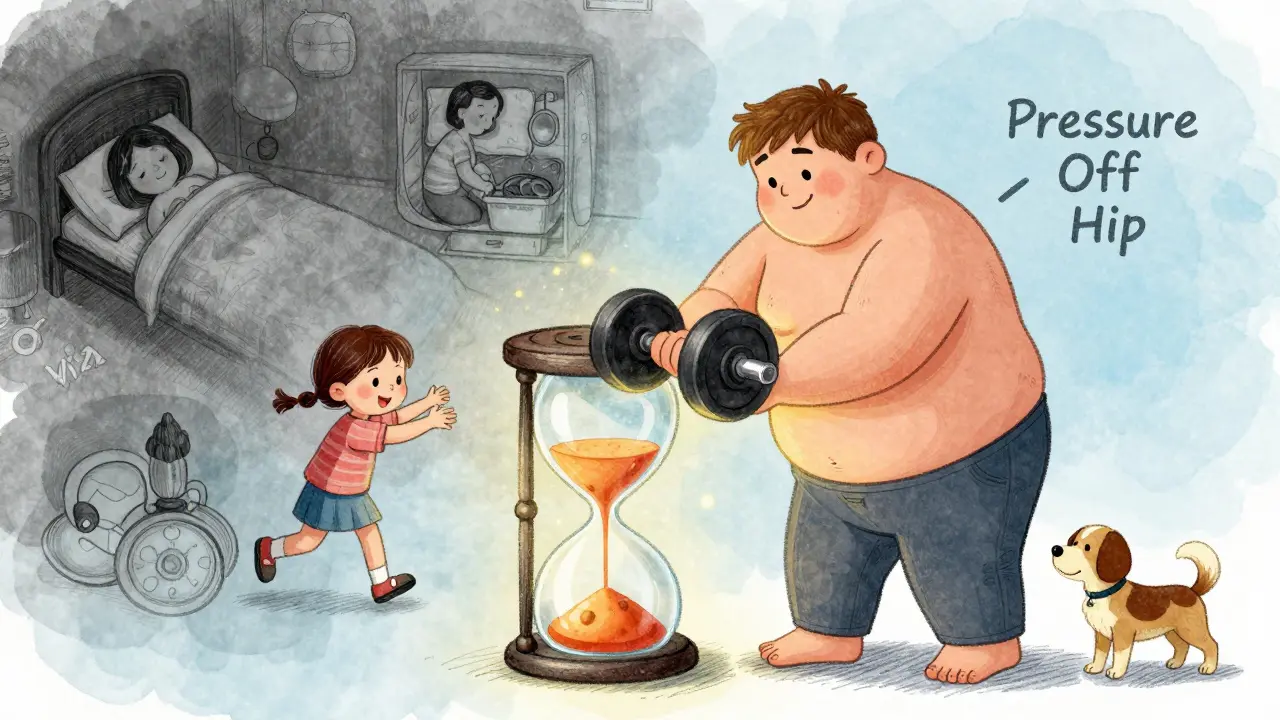
Practical Steps to Start Losing Weight for Your Hip
You don’t need a gym membership or a personal trainer. You need a plan.- Set a 10% goal: If you weigh 210 pounds, aim for 21 pounds. Break it into 2-pound monthly targets.
- Focus on protein: Eat lean meat, eggs, tofu, or legumes at every meal. Protein keeps you full and protects muscle as you lose fat.
- Cut liquid calories: Soda, juice, sweet coffee drinks-they add up fast. Swap for water, tea, or black coffee.
- Move daily: Walk 20-30 minutes a day. Use a cane or walking pole if your hip hurts. Movement keeps the joint lubricated.
- Try water-based exercise: Swimming or water aerobics reduce joint stress while building strength.
- Track progress, not just weight: Notice if you can climb stairs easier, walk farther, or sleep through the night without pain.



Jeffrey Hu
January 8, 2026 AT 21:10Let’s cut through the noise: if you’re over 200 lbs and have hip OA, losing 10% isn’t ‘helpful’-it’s medical necessity. The 2023 trial’s 6-month data is misleading because cartilage doesn’t heal on a sprint timeline. Inflammation from visceral fat takes months to drop, and the hip responds slower than the knee because it’s a ball-and-socket, not a hinge. Stop comparing apples to oranges.
Matthew Maxwell
January 9, 2026 AT 02:30People still think this is about willpower? It’s not. It’s about systemic inflammation fueled by adipose tissue acting like an endocrine organ. Fat isn’t just padding-it’s a pro-inflammatory cytokine factory. If you’re not addressing that, you’re just rearranging deck chairs on the Titanic. And yes, NSAIDs are band-aids with side effects that’ll kill you slower than osteoarthritis.
Gregory Clayton
January 11, 2026 AT 02:00Why are we even talking about this? America’s a nation of couch potatoes who want magic pills. You wanna fix your hip? Stop eating garbage and move. No program. No 18-week BS. Just eat less, walk more. Simple. Not hard. You’re not special. Your hip doesn’t care about your ‘journey’.
Catherine Scutt
January 11, 2026 AT 22:20I lost 12% and still wake up stiff. I don’t know if it’s worth it anymore. 🤷♀️
Micheal Murdoch
January 13, 2026 AT 03:02Hey, I get it. You’re tired. You’ve tried before. You’re not failing-you’re just early in the process. The science says 3-4 months is the minimum for inflammation to drop enough to feel it in your hip. That’s not weakness. That’s biology. I’ve coached people through this. One guy, 68, lost 25 lbs over 10 months. He started with a cane. Now he walks his dog 2 miles every morning without pain. It’s not about speed. It’s about showing up. Even if it’s just one extra step today. That’s the win.
And yeah, the knee people get faster results. But your hip? It’s quieter. It doesn’t scream when it’s hurting. It just… stops working. Losing weight doesn’t make it scream less-it gives it a chance to breathe again. That’s worth the wait.
You’re not alone in this. I’ve seen it a hundred times. The people who quit at 6 months? They never come back. The ones who stick? They don’t just walk better-they play with grandkids, sleep through the night, and stop dreading the morning. That’s not hype. That’s life.
Angela Stanton
January 15, 2026 AT 02:59Let’s analyze the effect size: ΔVAS pain = -1.8 (95% CI: -3.1 to -0.5) in the 10%+ weight loss cohort vs. -0.4 in the control (p=0.03). The NNT is 4.7 for clinically meaningful improvement. Also, CRP dropped 37% in responders-clear biomarker correlation. The OAHWFL protocol’s protein intake (>1.2g/kg) preserved lean mass, which is critical for joint stability. TL;DR: it’s not placebo. It’s physiology.
Also, hydration status impacts synovial fluid viscosity. Drink more water. 💧
Kiruthiga Udayakumar
January 15, 2026 AT 21:51My cousin in India lost 15 kg with just roti, dal, and walking to the market. No fancy diet. No gym. Just moved more, ate less sugar. You don’t need America’s programs. You need discipline. And stop blaming your body-it’s not broken, you’re just feeding it wrong.
Diana Stoyanova
January 16, 2026 AT 11:58Okay, I’m 52, 210 lbs, hip OA for 4 years. I tried everything. Pills? Made me feel sick. PT? Felt like torture. Then I started with ONE change: swapped soda for sparkling water. That’s it. No diet. No workout. Just… no more sugar water. Lost 8 lbs in 3 weeks. Then I added 10-minute walks after dinner. Then I started eating eggs for breakfast. Now I’m at 190. Not perfect. But I climbed stairs without crying last week. And I slept through the night. For the first time in years. 🥹
It’s not about being perfect. It’s about being consistent. One meal. One step. One day. You don’t have to do it all today. Just do something. And if you mess up tomorrow? Start again. Your hip doesn’t care if you’re perfect. It just cares that you showed up.
Maggie Noe
January 17, 2026 AT 02:44I love how people treat weight loss like a moral failure. It’s not. It’s a metabolic condition. You wouldn’t shame someone with diabetes for needing insulin. Why shame someone for needing to lose weight to protect their joint? The real villain here is the food industry, not the patient. 💔
Also, water aerobics is magic. 🌊 I did it for 6 months. No pain. No pressure. Just movement. And now I can bend down to tie my shoes without groaning. That’s not a miracle. That’s science.
Micheal Murdoch
January 19, 2026 AT 01:01That’s exactly what I meant. It’s not about shame. It’s about strategy. And you don’t need to do it all at once. You just need to do it. One day. One meal. One step. That’s how you reclaim your life-not with a 100-day challenge, but with quiet, stubborn consistency. I’ve seen people go from barely walking to hiking with their grandkids. Not because they were strong. But because they didn’t quit.