
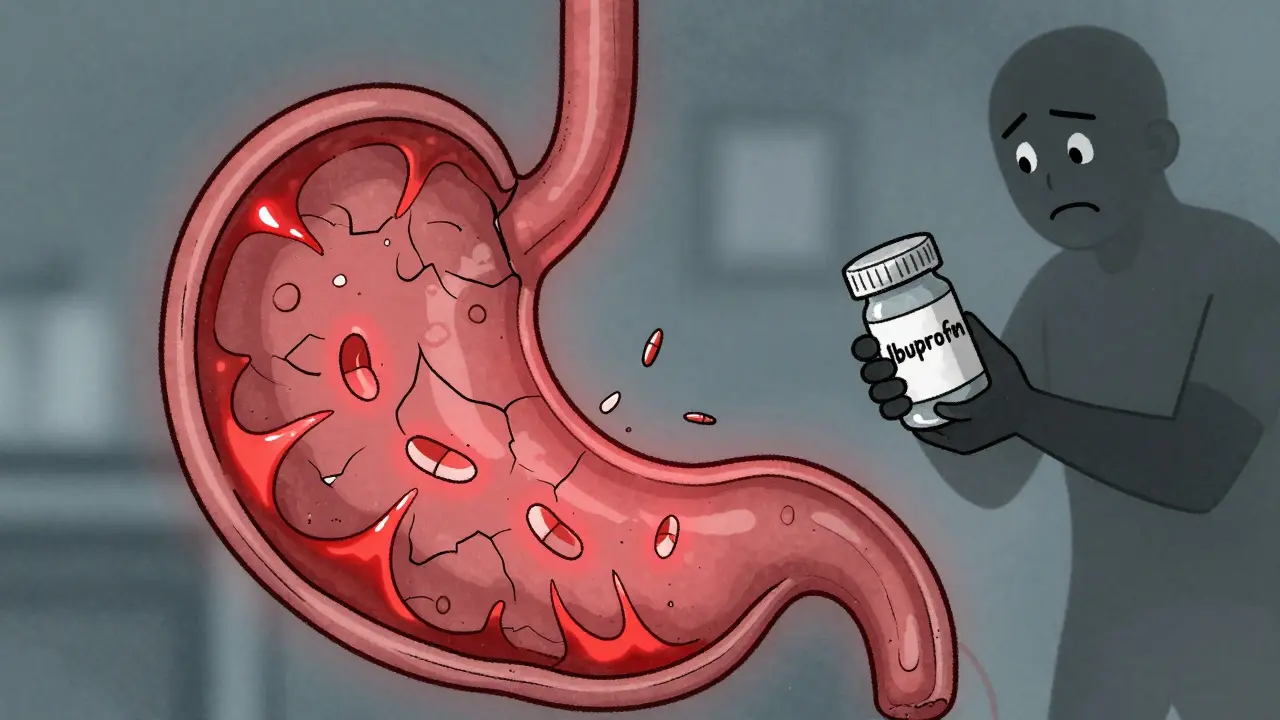
Every year, millions of people reach for ibuprofen or naproxen to ease a headache, sore back, or arthritic knee. These drugs work fast. But what you don’t feel-the silent damage building in your stomach and kidneys-can be deadly. NSAIDs aren’t harmless. They’re powerful tools with serious risks, and most people have no idea how dangerous they can be when used without care.
How NSAIDs Hurt Your Stomach (Even When You Feel Fine)
NSAIDs like ibuprofen, naproxen, and diclofenac block enzymes called COX-1 and COX-2. That’s how they reduce pain and swelling. But COX-1 also helps protect your stomach lining by producing prostaglandins-natural chemicals that keep mucus and blood flow steady. When you block COX-1, you’re removing that shield. The result? Your stomach lining becomes vulnerable to acid, leading to ulcers, bleeding, and even perforation.
Here’s the scary part: half of all NSAID-related stomach damage happens without warning. You won’t feel burning or pain until it’s too late. A 2023 study from the American College of Gastroenterology found that 107,000 Americans are hospitalized each year because of NSAID-induced GI problems, and 16,500 die from them. That’s more than traffic accidents in some years.
Upper GI issues like bleeding or ulcers are common, but lower GI damage-damage to the small intestine and colon-is even more overlooked. Studies show up to 50% of long-term NSAID users have signs of intestinal injury, even if they feel fine. There’s no reliable test to catch this early, and no proven treatment to reverse it. That’s why prevention matters more than ever.
Your Kidneys Aren’t Immune Either
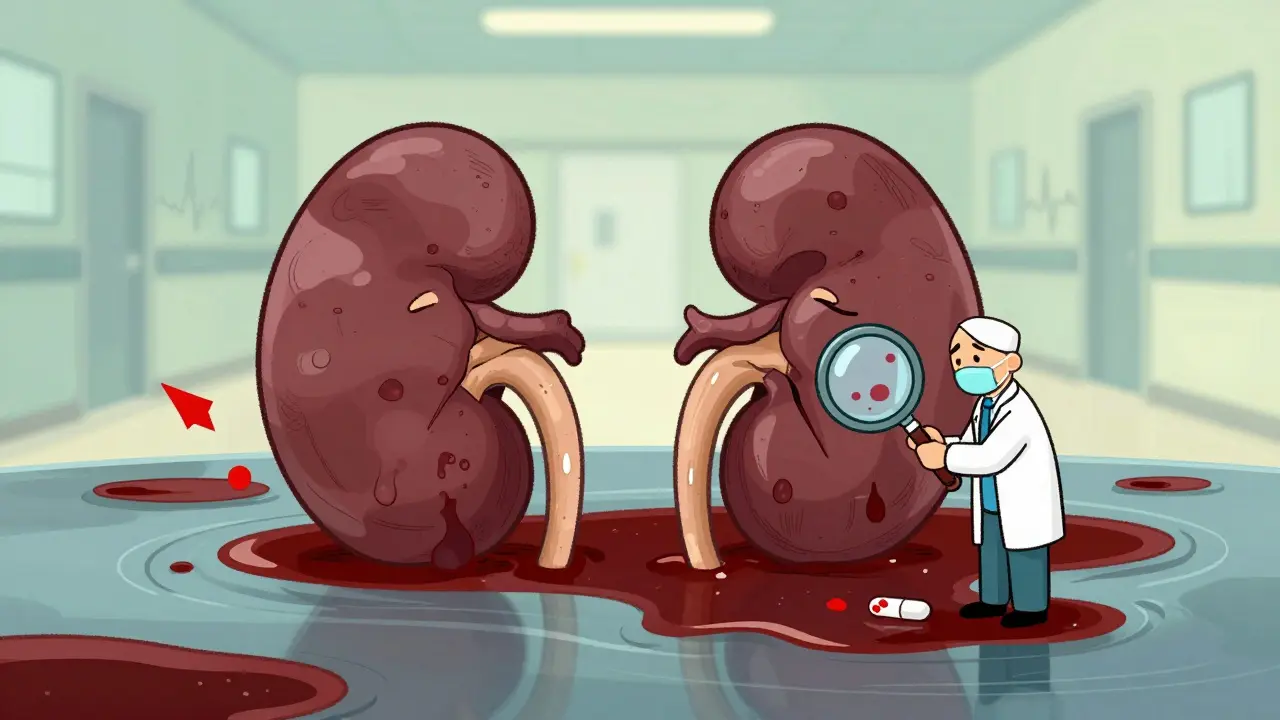
NSAIDs don’t just affect your stomach. They also reduce blood flow to your kidneys by blocking prostaglandins that help keep them working properly. This is especially dangerous if you’re dehydrated, over 65, or already have kidney trouble.
Acute kidney injury can happen in as little as a few days of NSAID use. In fact, 1% to 5% of users develop this condition, according to Kidney International Reports. For people with existing kidney disease, that number jumps dramatically. The FDA now requires a boxed warning on all prescription NSAIDs for patients over 65, and the American College of Cardiology says to avoid them entirely if your eGFR is below 60.
Chronic use can lead to interstitial nephritis, papillary necrosis, or even permanent kidney damage. Many patients don’t realize their kidneys are failing until they’re in crisis. That’s because kidney damage often shows no symptoms until it’s advanced. Fatigue, swelling in the ankles, or reduced urine output are late signs.
Who’s at Highest Risk?
Not everyone faces the same level of danger. Your risk goes up if you:
- Are over 65 (or especially over 75)
- Have had a stomach ulcer or GI bleed before
- Take blood thinners like warfarin or aspirin
- Use corticosteroids (like prednisone)
- Have kidney disease, heart failure, or high blood pressure
- Take multiple NSAIDs at once (including OTC and prescription)
The American College of Gastroenterology has a simple risk calculator. Add up points: 2 for age over 65, 3 for past ulcer, 2 for anticoagulants, 1 for steroids. If you hit 4 or more points, you’re high risk-and need serious protection.
NSAID Types: Not All Are Created Equal
Some NSAIDs are riskier than others. A 2023 meta-analysis showed naproxen carries a 4.2 times higher risk of upper GI bleeding than non-users. Ibuprofen isn’t much better-it’s 2.7 times more likely to cause stomach damage than celecoxib.
Cox-2 inhibitors like celecoxib were designed to spare the stomach. They do reduce GI bleeding risk by about half compared to older NSAIDs. But they’re not magic. They still raise blood pressure and can harm kidneys. And they don’t protect your intestines at all.
Even worse, combining NSAIDs with SSRIs (like fluoxetine or sertraline) triples your bleeding risk. If you’re on antidepressants, talk to your doctor before taking any NSAID.
What Should You Do? Monitoring and Protection
The best way to avoid harm is to avoid NSAIDs when possible. Try physical therapy, heat, or acetaminophen first. If you must use them:
- Use the lowest dose for the shortest time. Even a few days can cause damage.
- Avoid daily use unless absolutely necessary. Each extra week increases complication risk by 3-5%.
- Never mix NSAIDs. Don’t take ibuprofen and naproxen together. Don’t take OTC and prescription at the same time.
If you’re high risk, you need protection. Proton pump inhibitors (PPIs) like omeprazole reduce ulcer risk by 70-90%. But they’re not risk-free. Long-term use with NSAIDs increases your chance of microscopic colitis by over six times. That means chronic diarrhea, weight loss, and inflammation you can’t see.
For kidney safety: get a blood test for creatinine and BUN within 30 days of starting an NSAID, then every 3-6 months if you’re on it long-term. If you’re over 65 or have kidney disease, check every 2-4 weeks.
For stomach bleeding: ask your doctor about fecal occult blood testing every 6 months. It’s simple, cheap, and catches hidden bleeding before it becomes life-threatening.
What Patients Are Really Saying
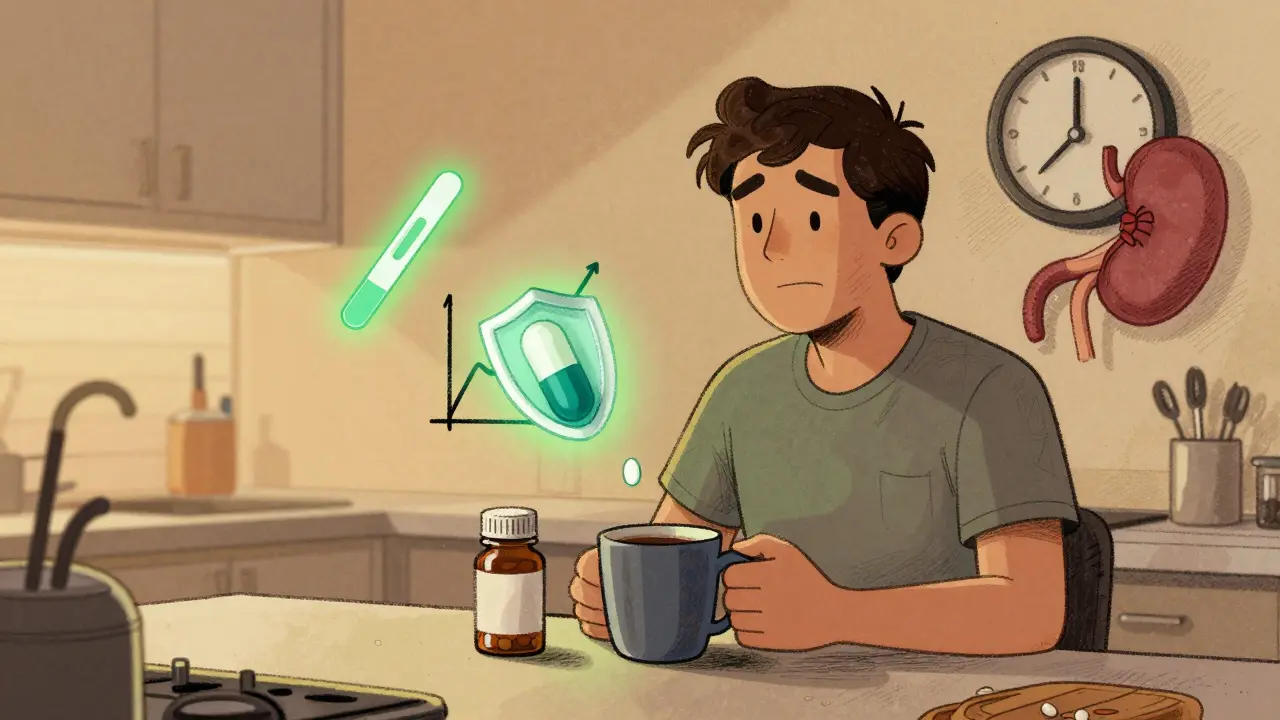
Real people are speaking up. On Reddit, users report diarrhea lasting days after stopping NSAIDs. On WebMD, 42% of negative reviews for ibuprofen mention sudden bleeding with no warning. Drugs.com users on celecoxib report leg swelling-classic signs of kidney strain.
A 2022 survey found 57% of long-term NSAID users quit because of side effects. The top reasons? Stomach pain (43%), fear of kidney damage (28%), and just not trusting the drugs anymore (19%).
These aren’t rare cases. They’re predictable outcomes of poor monitoring.
The Future: Better Tools, But Still No Perfect Solution
New drugs are coming. Naproxcinod, a new NSAID that releases nitric oxide to protect blood vessels, showed 58% fewer stomach ulcers in trials. A new point-of-care test for fecal immunochemical testing (FIT) can now detect NSAID-related bleeding with 92% accuracy-much better than old stool tests.
But the biggest change might be in how we think. Doctors are starting to use AI to scan endoscopy images for early signs of intestinal damage. Pharmacies are rolling out automated alerts when someone fills a high-risk NSAID prescription.
Still, experts warn: without better ways to protect the lower GI tract, hospitalizations from NSAID damage could rise 18% by 2035.
Bottom Line: Don’t Guess. Test. Protect. Limit.
NSAIDs are not safe just because they’re over the counter. They’re not safe just because your friend takes them every day. They’re not safe just because your doctor didn’t warn you.
If you’re using them regularly:
- Get your kidney function checked every few months.
- Ask about a stool test for hidden blood.
- If you’re over 65 or have a history of ulcers, insist on a PPI.
- Stop them as soon as you can. Even a few weeks off can help your stomach and kidneys recover.
The goal isn’t to scare you away from pain relief. It’s to make sure you get relief without risking your life. NSAIDs can help-but only if you treat them like the powerful, dangerous drugs they are.
Terry Free
December 25, 2025 AT 07:42Let me get this straight - you’re telling me people are popping ibuprofen like Skittles and acting shocked when their stomach starts bleeding? Bro. It’s not a mystery. It’s basic pharmacology. COX-1 inhibition = gastric mucosal erosion. You don’t need a PhD to get that. Yet here we are, 2025, and half the population still thinks ‘OTC’ means ‘safe.’ The real tragedy? The doctors who don’t warn them. Not because they’re negligent - because they’re lazy. And the system lets them get away with it.
And don’t even get me started on the kidneys. One weekend of naproxen after a marathon? Boom. Acute kidney injury. No warning. No symptoms. Just a creatinine spike on a lab report two weeks later. And then? ‘Oh, we’ll just prescribe a diuretic.’ No. We should be prescribing education.
Also, combining NSAIDs with SSRIs? That’s not a side effect. That’s a death sentence waiting for a prescription refill. If your psychiatrist doesn’t know this, find a new one.
Stop treating pain meds like candy. Start treating them like they’re a chainsaw you’re holding without gloves.
Sophie Stallkind
December 27, 2025 AT 05:56Thank you for this meticulously researched and clinically grounded exposition. The statistical prevalence of NSAID-induced gastrointestinal and renal complications is both alarming and underreported in public health discourse. I would like to underscore the importance of standardized patient education protocols in primary care settings, particularly for those over the age of sixty-five and those on polypharmacy regimens. The integration of automated risk stratification tools - such as the American College of Gastroenterology’s scoring system - into electronic health records would significantly reduce preventable adverse events.
Furthermore, the recommendation for fecal occult blood testing every six months in high-risk populations is not merely prudent - it is ethically imperative. The absence of routine screening in outpatient practice represents a systemic failure of preventive medicine. I urge all clinicians to adopt these protocols as standard of care.
Mussin Machhour
December 28, 2025 AT 21:19Y’all need to chill. I’ve been taking ibuprofen for my back since 2018 and I’m still standing. No ulcers. No kidney drama. Just a guy who moves his body and takes a pill when it hurts. You’re scaring people with stats like it’s a horror movie.
Look - if you’re 70 and on blood thinners? Yeah, maybe don’t chug naproxen like water. But if you’re 35, active, and take one 200mg tablet once a week? Chill. Your body’s not a glass vase.
Also - acetaminophen isn’t magic. Liver damage from Tylenol kills more people than NSAID stomach bleeds. So stop acting like NSAIDs are the devil. Just use them smart. Don’t overdo it. Drink water. Get a checkup once a year. Done.
Stop fearmongering. Start living.
Also - physical therapy is great. But sometimes you just need to get through the day. Not every pain needs a 10-step plan.
Katherine Blumhardt
December 30, 2025 AT 15:17ok so i just took 3 ibuprofen for my headache and now im scared i might die from a stomach hole?? like what if my intestines just… disappear?? like i dont even know what a prostaglandin is but i think its a lizard that lives in my gut??
also my mom takes celecoxib and she says her legs are puffy like balloons and she’s like ‘oh it’s just water retention’ but what if its my kidneys turning into dust??
why does no one talk about this?? i feel like big pharma is hiding the truth and the doctors are in on it??
also can i just take turmeric??
and also why is there no app that says ‘you took 7 pills this week’ and screams at you??
pls help im 29 and i think i’m dying
Linda B.
December 31, 2025 AT 04:02Let me ask you something - why are we only talking about NSAIDs? What about the NSAID-industrial complex? The FDA? The pharmaceutical lobbyists? The fact that every drug ad on TV shows happy seniors jogging while the fine print says ‘may cause sudden internal bleeding and death’? This isn’t negligence - it’s deliberate.
They want you dependent. They want you taking pills forever. They don’t want you healing. They want you chronic. That’s why they don’t fund research into natural anti-inflammatories. That’s why PPIs are pushed - because they’re more profitable than physical therapy.
And don’t even get me started on the ‘AI endoscopy scans’ - sounds like a distraction. A shiny new tool to keep you coming back. Meanwhile, your gut is rotting.
They’ll sell you a test. Then a pill. Then another test. Then another pill. And you’ll keep paying. And they’ll keep getting rich.
Wake up. This isn’t medicine. It’s a business model.
Winni Victor
January 1, 2026 AT 00:17Oh my god I’m so done with this. Everyone’s acting like NSAIDs are some kind of poison vial you’re holding over your head like a horror movie villain. I’ve had three kidney stones, a torn ACL, and three surgeries. I’ve taken more NSAIDs than I’ve had hot dinners. And guess what? I’m still here. Still walking. Still alive.
Meanwhile, you’re all over here crying about ‘microscopic colitis’ like it’s the plague. Newsflash: your body’s been fighting off worse since you were a toddler.
Also - ‘avoid NSAIDs’? Sure. Just go take your yoga class and drink your bone broth and call it a day. Meanwhile, I’ve got a job, a kid, and a back that screams every morning. I don’t have time for ‘natural remedies.’ I need to function.
Stop making people feel guilty for taking a pill that lets them live. If you’re scared, don’t take it. But don’t guilt-trip the rest of us who know our bodies better than some 2025 algorithm.
Zabihullah Saleh
January 1, 2026 AT 23:42There’s a quiet violence in how we treat pain. We reduce it to a number on a scale - ‘rate your pain 1–10’ - then hand out chemicals to silence the signal without listening to the message.
NSAIDs don’t heal. They mute. And in muting, they allow the body to keep breaking - silently, invisibly - until the damage is too deep to reverse.
Maybe the real question isn’t ‘how to monitor NSAID damage’ - but why we’ve normalized using chemicals to avoid confronting the root causes of pain. Why we’ve outsourced healing to pills instead of rest, movement, community, or even grief.
My grandfather took ibuprofen for 20 years. He died of a GI bleed at 78. He never talked about his pain. He just took the pill. We never asked why he was hurting.
Maybe the medicine we need isn’t in a bottle.
Maybe it’s in the silence we refuse to break.
Bailey Adkison
January 2, 2026 AT 10:25Correction: the 2023 meta-analysis showed naproxen has a 4.2-fold increased risk of upper GI bleeding compared to placebo - not compared to non-users. You’re misrepresenting the data.
Also, the claim that ‘50% of long-term NSAID users have intestinal injury’ is based on capsule endoscopy studies with small sample sizes and selection bias. Most of those patients were already symptomatic or had comorbidities.
And ‘PPIs increase microscopic colitis risk sixfold’? That’s from one observational study. Confounding factors weren’t fully controlled. Don’t present correlation as causation.
Also - ‘avoid NSAIDs’ is bad advice. For many, they’re the only thing that allows function. The goal isn’t avoidance - it’s risk mitigation. Which you partially got right.
Fix your citations. Then come back.
Michael Dillon
January 3, 2026 AT 01:16Bro. I’ve been on naproxen for 5 years. Got a kidney check last month. All good. Fecal test? Negative. PPI? Nah. I don’t need it. I’m 42, work out, drink water, and don’t take 3 pills a day.
Stop making people paranoid. You’re not helping. You’re scaring folks into avoiding pain relief entirely - which leads to worse outcomes. Depression. Inactivity. Weight gain. More inflammation.
Yes, NSAIDs have risks. So does breathing. So does driving. So does eating sugar.
Don’t be the guy who won’t drive because someone died in a crash. Be the guy who wears a seatbelt.
Use the lowest dose. Get checked. Don’t mix. Don’t overdo it.
That’s it.
Stop the fear porn. We’re not all dying.