

Antidepressant Treatment Comparison Tool
Find Your Best Treatment Match
Answer a few questions about what matters most to you. We'll show you which antidepressants might be best suited for your needs.
Recommended Options
Comparison Details
| Medication | Sexual Side Effects | Weight Gain | Onset of Action | Cost (Monthly) | Key Considerations |
|---|---|---|---|---|---|
| Exxua (gepirone) | 2-3% | Minimal | 7-10 days | $300-$500 | Zero sexual dysfunction 7-10 days |
| Zuranolone | 0% | None | 2-5 days | $9,450 (14-day course) | No sexual dysfunction 2-5 days Dizziness (25%) |
| Auvelity | 15-20% | Lower than duloxetine | 4-7 days | $300-$500 | 15-20% sexual side effects 4-7 days $300-$500/month |
| SPRAVATO | 10-15% | Minimal | 24-48 hours | $880 per dose | 10-15% sexual side effects 24-48 hours Dissociation (45-55%) |
For decades, antidepressants have been a lifeline for millions - but they’ve also come with a heavy price: sexual problems, weight gain, drowsiness, and nausea that made some people quit before they even felt better. Now, a new wave of medications is changing that. These aren’t just tweaks of old drugs. They work differently, kick in faster, and - most importantly - leave behind the side effects that made people dread treatment.
Why the old drugs weren’t working for everyone
Traditional SSRIs like sertraline, escitalopram, and fluoxetine still make up most prescriptions. But here’s the problem: between 30% and 70% of people on these drugs report sexual side effects - things like loss of libido, trouble getting aroused, or delayed orgasm. About 1 in 10 gain 10 pounds or more in six months. And nearly half get stomach issues early on. For many, these side effects were worse than the depression itself.It’s not that SSRIs don’t work. They do - eventually. But it takes 4 to 8 weeks to feel any real change. By then, some people have already given up. Others stick with it, only to live with constant discomfort. That’s why the search for better options wasn’t just about science - it was about dignity.
The breakthroughs: How the new ones work
The new antidepressants don’t just tweak serotonin levels. They target completely different brain pathways. That’s what makes them faster and gentler.SPRAVATO (esketamine) - approved in 2019 - is a nasal spray that blocks NMDA receptors. It doesn’t increase serotonin. Instead, it resets neural circuits linked to mood. In clinical trials, patients saw improvement in as little as 24 hours. But it comes with a catch: 45% to 55% of users feel detached from reality for a few hours after dosing. That’s why it’s only given in certified clinics, with a 2-hour monitoring period after each treatment.
Zuranolone (Zurzuvae) - approved in 2023 for postpartum depression and now also for general major depression - works by calming overactive brain signals through GABA receptors. It’s a 14-day course, taken once daily with food. People often feel better within days. Side effects? Dizziness in 1 in 4, sleepiness in 1 in 5. But no sexual dysfunction. No weight gain. And no daily pills for months.
Auvelity (dextromethorphan/bupropion) - approved in 2022 - combines two existing drugs in a new way. Dextromethorphan blocks NMDA receptors, while bupropion slows down how fast the body breaks it down. This combo hits the brain’s mood centers quickly. Most users report feeling better in under a week. Weight gain is 15% to 20% lower than with older drugs like duloxetine. And sexual side effects? Far less common.
Exxua (gepirone) - the first new chemical antidepressant approved since 2013 - targets serotonin receptors more precisely than SSRIs. It avoids overstimulating areas linked to sexual function. In trials, only 2% to 3% of users reported sexual side effects - compared to 30% to 50% on SSRIs. It also works in under 10 days for many. One Reddit user wrote: “After 15 years on SSRIs with terrible side effects, switching to Exxua was life-changing.”
Side effect comparison: What you actually get
Here’s how the newer options stack up against the old standbys, based on 2025 data from The Lancet and FDA reports:
| Medication | Sexual Side Effects | Weight Gain (6 months) | Onset of Action | Common Other Side Effects |
|---|---|---|---|---|
| SSRIs (e.g., sertraline, citalopram) | 30-70% | 10-15 lbs average | 4-8 weeks | Nausea, insomnia, fatigue |
| Exxua (gepirone) | 2-3% | Minimal | 7-10 days | Mild headache, dizziness |
| Zuranolone | 0% | None | 2-5 days | Dizziness (25%), sleepiness (20%) |
| Auvelity | 15-20% | Lower than duloxetine | 4-7 days | Headache, dry mouth |
| SPRAVATO | 10-15% | Minimal | 24-48 hours | Dissociation (45-55%), dizziness |
Notice the pattern? The new drugs either eliminate or drastically cut sexual side effects. Weight gain is rare or nonexistent. And they work in days, not weeks. That’s not a small improvement - it’s a revolution.
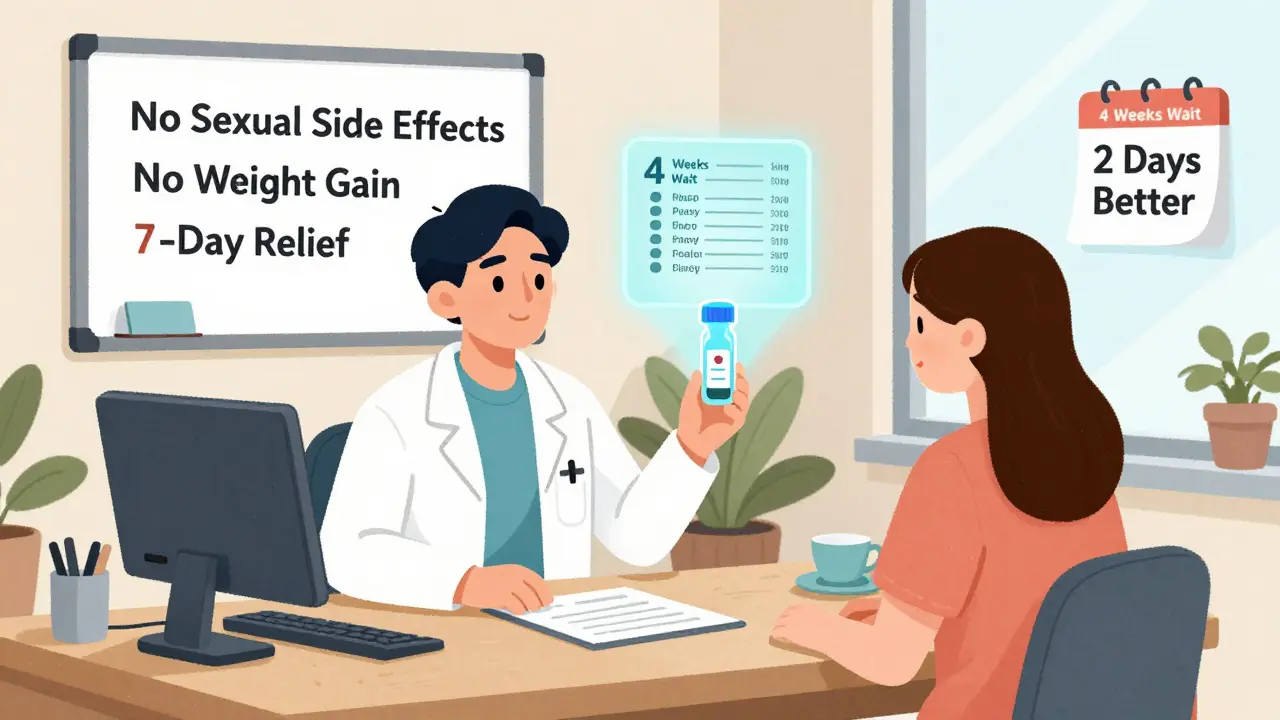
Cost and access: The hidden barriers
These drugs aren’t cheap. And insurance doesn’t always cover them.
A single dose of SPRAVATO costs around $880. A full 14-day course of Zuranolone runs about $9,450. Auvelity and Exxua are priced closer to brand-name SSRIs - roughly $300 to $500 per month. Meanwhile, generic fluoxetine costs $4 for a 30-day supply.
Insurance often blocks access. SPRAVATO requires prior authorization in 92% of commercial plans. Zuranolone is frequently denied unless you’ve tried at least two older drugs first. And even when approved, you need to go to a certified clinic for SPRAVATO - there are only about 1,243 nationwide. In rural areas, that’s a 100-mile drive.
Doctors are catching up, but slowly. Only 38% of primary care physicians feel confident prescribing Zuranolone. Psychiatrists need extra training - 10 to 15 hours just to safely give SPRAVATO. For most people, the first step is still an SSRI. But for those who’ve tried and failed, the new options are no longer just experimental - they’re realistic.
Who benefits most?
These drugs aren’t one-size-fits-all. They’re better suited for specific situations.
- Postpartum depression? Zuranolone is the only FDA-approved treatment with a 70% response rate in new mothers - and it’s a 14-day course, not lifelong.
- Treatment-resistant depression? SPRAVATO and Auvelity show 50-65% response rates, compared to 30-40% for SSRIs.
- Weight concerns or metabolic issues? Exxua and Zuranolone won’t add pounds. Agomelatine (an older but underused option) can even cause weight loss.
- Need fast relief? SPRAVATO works in 24 hours. Zuranolone in 2-5 days. That’s critical for people with suicidal thoughts.
- Can’t tolerate sexual side effects? Exxua is the clear winner. Zero sexual dysfunction in most trials.
One big caveat: these drugs are designed for acute treatment. Zuranolone is only for 14 days. SPRAVATO is given weekly for 4-6 weeks. They’re not meant to be taken forever. Afterward, many patients switch to a maintenance drug - but now they have a better starting point.
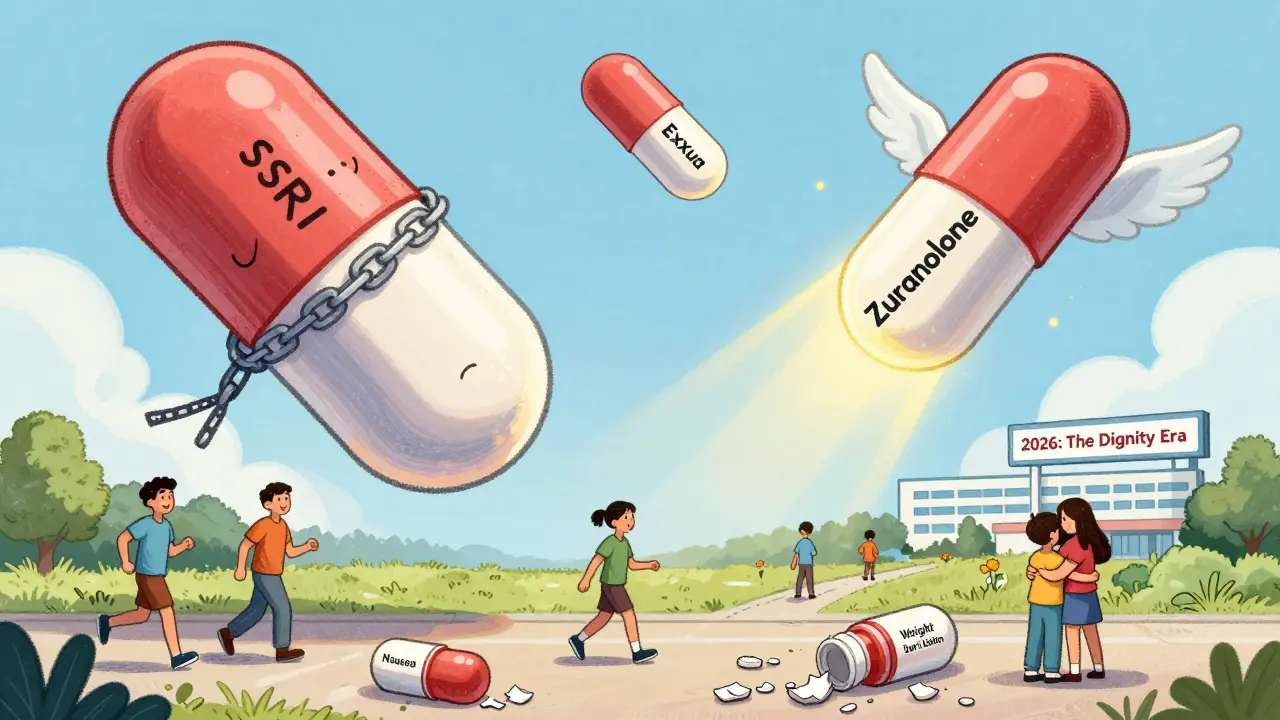
The risks you can’t ignore
None of these are magic bullets. Each has its own red flags.
SPRAVATO’s dissociation isn’t just weird - it can be terrifying. One Reddit user said: “I felt like I was floating outside my body. I had to stop after three doses.”
Zuranolone causes dizziness. For older adults or those with balance issues, that’s a fall risk.
Some antidepressants - even the newer ones - can raise blood pressure. Amitriptyline, venlafaxine, and fluoxetine are known for this. The CDC warned in October 2025 that amitriptyline increased systolic blood pressure by nearly 4 mmHg on average.
And here’s the biggest gap: long-term data. Almost all trials last 8 weeks. We don’t know what happens after 6 months, a year, or five years. Dr. Prasad Nishtala put it bluntly: “We’re prescribing drugs with no idea how they affect people over time.”
The future: Personalized treatment is here
The real breakthrough isn’t any single drug. It’s the shift toward matching the right medication to the right person.
Doctors are starting to use tools that consider your weight, heart health, sleep patterns, and even genetic markers. The NIH just funded a $2.4 million project to develop a genetic test that predicts side effects with 85% accuracy. Imagine: a blood test that tells you whether you’re likely to gain weight on one drug, or have dizziness on another.
Companies like Mayo Clinic and Cleveland Clinic are already using algorithms to guide antidepressant choices. If you have diabetes, they avoid drugs that cause weight gain. If you’re an athlete, they avoid ones that cause drowsiness. If you’re a new mom, they pick Zuranolone.
Dr. Dervla Kelly at King’s College Hospital says it best: “The future isn’t about finding the best antidepressant. It’s about finding the right one for you.”
What to do next
If you’ve been on an SSRI for months and still feel awful - or if the side effects are unbearable - talk to your doctor. Ask:
- “Could a newer medication like Exxua or Zuranolone work for me?”
- “Do I have treatment-resistant depression?”
- “What are my risks for weight gain or sexual side effects with each option?”
- “Is there a way to test if my genes make me more likely to react badly to certain drugs?”
Don’t settle for tolerating side effects. Depression is hard enough. You shouldn’t have to fight your medication too.
The tools are here. The data is clear. The choice is yours - and your doctor’s - to make it better.


Lisa McCluskey
January 29, 2026 AT 18:22Still waiting on insurance to cover it though. $450/month is brutal.
owori patrick
January 30, 2026 AT 19:03Claire Wiltshire
February 1, 2026 AT 09:52Darren Gormley
February 2, 2026 AT 04:03Mike Rose
February 3, 2026 AT 08:36Niamh Trihy
February 4, 2026 AT 19:09Sarah Blevins
February 5, 2026 AT 03:46Yanaton Whittaker
February 5, 2026 AT 20:50Kathleen Riley
February 7, 2026 AT 19:32Beth Cooper
February 9, 2026 AT 03:54