
Naloxone Co-Prescribing Eligibility Checker
Why This Matters
Naloxone co-prescribing isn't about assuming misuse—it's about preparedness for the unexpected. Over half of opioid overdoses happen when someone else is present. This tool helps identify if you qualify for naloxone based on CDC guidelines.
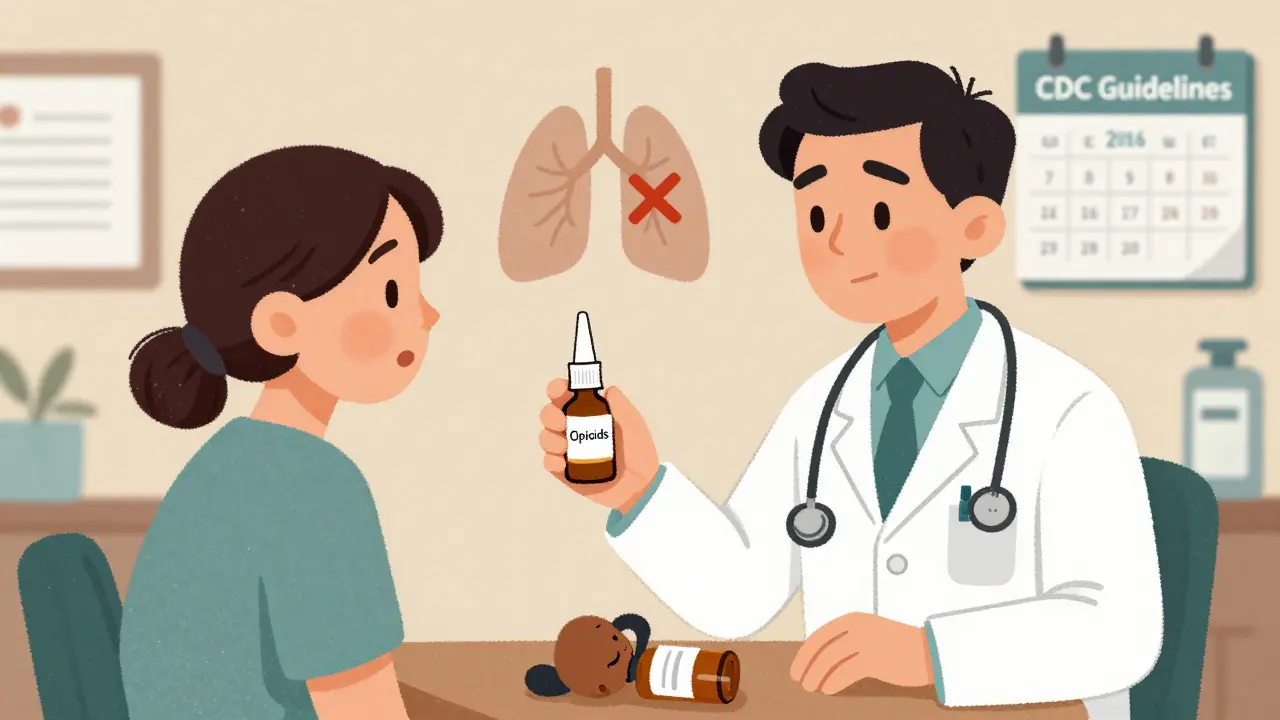
When a doctor prescribes opioids for chronic pain, they’re not just giving you medicine-they’re handing you a risk. Even when taken exactly as directed, opioids can slow your breathing to a dangerous level. That’s where naloxone co-prescribing comes in. It’s not about assuming you’ll overdose. It’s about preparing for the unexpected.
What Is Naloxone Co-Prescribing?
Naloxone co-prescribing means giving you naloxone at the same time as your opioid prescription. Naloxone isn’t a painkiller. It’s an antidote. If someone overdoses-whether it’s you, a family member, or a friend-naloxone can bring them back to life in minutes. It works by kicking opioids off brain receptors that control breathing. No opioids? No respiratory depression. No death.This isn’t new science. Naloxone has been around since the 1960s. But it wasn’t until 2016 that the CDC officially recommended doctors offer it to patients on higher-dose opioids. Since then, it’s become a standard part of safe prescribing-especially when risk factors are present.
Who Needs Naloxone With Their Opioid Prescription?
You don’t have to be using street drugs to be at risk. The CDC says you should be offered naloxone if you’re on:- 50 morphine milligram equivalents (MME) or more per day
- Any opioid dose and also take benzodiazepines (like Xanax or Valium)
- Any opioid dose and have a history of substance use disorder
- Any opioid dose and have sleep apnea, COPD, or other breathing problems
- Any opioid dose and have recently been released from jail or prison
Why these groups? People on 50 MME/day have double the overdose risk of those on 20 MME/day. Add in a benzodiazepine? Risk triples. People leaving incarceration often have lost their tolerance-so a dose they used to handle can now kill them.
And it’s not just about you. Over half of opioid overdoses happen when someone else is around. A spouse, a child, a friend-they’re the ones who find you. They’re the ones who need naloxone to act fast.
How Does Naloxone Work in Real Life?
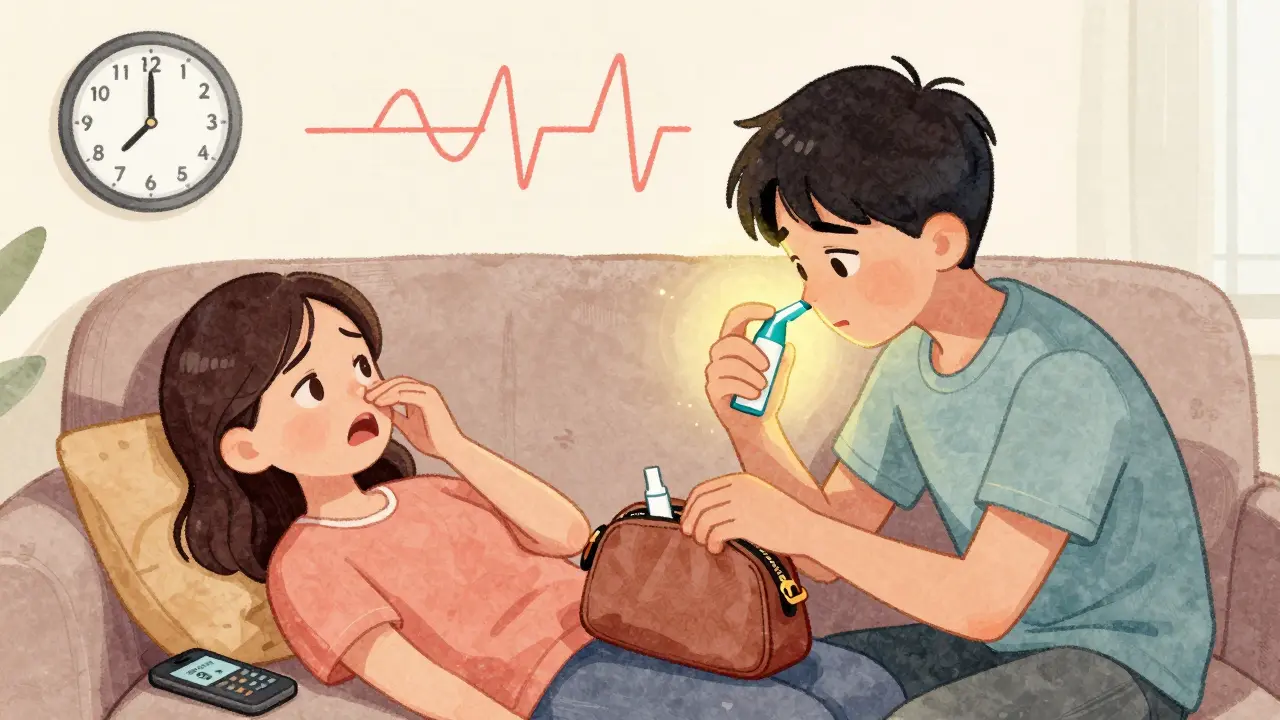
Naloxone comes in two main forms: nasal spray and injection. The nasal spray-like Narcan® or Kloxxado™-is the most common now. You don’t need training. You just tilt the head back, insert the nozzle, and press the plunger. That’s it.It works in 2 to 5 minutes. But here’s the catch: it wears off in 30 to 90 minutes. Opioids can last longer. So even if someone wakes up, they need emergency help. Naloxone buys time. It doesn’t replace calling 911.
One patient in Ohio told her story: Her son, 16, found her oxycodone pills and took them. She gave him the naloxone spray her doctor gave her. He woke up within minutes. Paramedics arrived, he was stabilized, and he survived. She didn’t feel judged. She felt saved.
Why Don’t More Doctors Prescribe It?
It sounds simple. But in practice, it’s not. A 2021 survey found 68% of primary care doctors felt uncomfortable bringing up overdose risk. They worry patients will feel accused. Or think they’re being labeled an addict.Patients say the same thing. One Reddit user shared: “I told my doctor I didn’t need it. I’m not a drug user.” He later found out his cousin overdosed on pills he’d left on the counter. He now keeps naloxone in his glovebox.
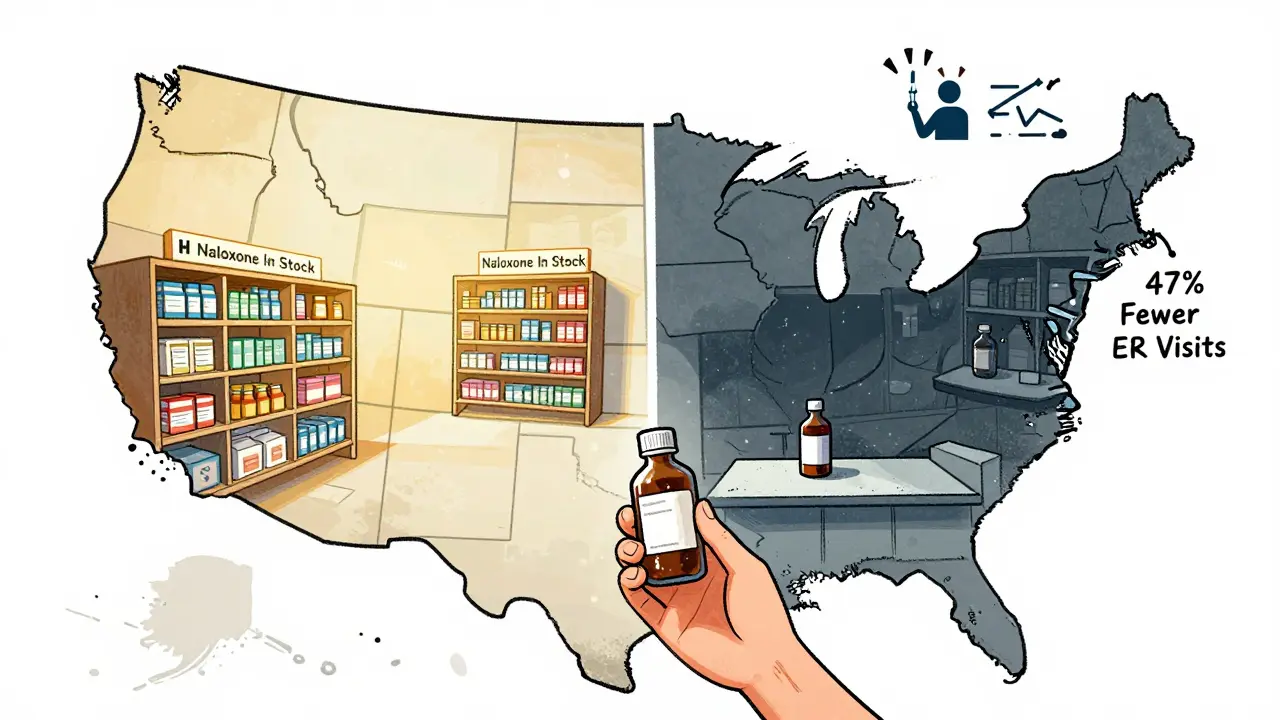
Stigma is real. But so is the data. A 2019 study showed that when naloxone was co-prescribed in primary care, emergency visits for opioid overdoses dropped by 47%. Hospitalizations fell by 63%.
Doctors who do it well use phrases like: “This is like an EpiPen for your breathing. You hope you never need it. But if you do, it’s life-saving.”
What’s the Cost? Is It Covered?
Generic naloxone nasal spray costs $25 to $50 at most pharmacies. Brand-name Narcan® runs $130-$150 without insurance. But since the SUPPORT Act of 2018, most insurance plans-including Medicare and Medicaid-cover it with little to no copay.Some states even let pharmacists give out naloxone without a prescription. In 49 states, pharmacists can dispense it under a standing order. That means you can walk in, ask for it, and walk out with it-no doctor visit needed.
Still, access isn’t equal. Urban pharmacies stock it 85% of the time. Rural pharmacies? Only 42%. That gap kills.
State Laws Are Changing Fast
As of 2024, 24 states require doctors to offer naloxone with certain opioid prescriptions. But the rules vary:- California: Must offer if dose exceeds 90 MME/day
- New York: Must offer to anyone prescribed any opioid
- Florida: Only recommends, no mandate
Some states are going further. The CDC updated its guidelines in 2023 to include anyone who’s had a non-fatal overdose in the past year-even if they’re on low doses. That’s a big shift. It means naloxone isn’t just for high-dose users anymore. It’s for anyone who’s already had a close call.
What’s Next for Naloxone?
The federal government is investing heavily. The NIH’s HEAL Initiative is spending $1.5 billion through 2025 on overdose prevention. A third of that is going to better naloxone delivery-like longer-lasting versions and easier-to-use devices.One new formulation in Phase III trials could last 24 hours instead of 90 minutes. That means one dose could protect someone for a full day. That’s huge.
Also, the FDA approved the first generic nasal spray in 2023. Prices are already dropping 40%. More people will have access. More lives will be saved.
What Should You Do?
If you’re prescribed opioids:- Ask: “Should I have naloxone too?”
- Don’t wait until it’s too late.
- Keep it where someone can find it-your purse, your car, your bedside table.
- Teach one person how to use it. Your partner. Your sibling. Your neighbor.
If you’re a caregiver or family member:
- Know the signs: Unresponsive, slow or no breathing, blue lips, pinpoint pupils.
- Call 911 first. Then give naloxone.
- Stay with them until help arrives. They might need more than one dose.
Naloxone isn’t a cure for addiction. It’s not a replacement for treatment. But it’s the most reliable safety net we have right now. And it’s not expensive. It’s not complicated. It’s not judgmental. It’s just life-saving.
Every time someone uses naloxone to bring a person back from the edge, it’s not luck. It’s preparation. And preparation starts with one question: “Can I get naloxone with this prescription?”
Is naloxone only for people who use street drugs?
No. Naloxone is for anyone prescribed opioids-even if they take them exactly as directed. Overdoses happen to people on prescription painkillers all the time, especially when combined with other medications like benzodiazepines or if they have breathing problems. It’s not about drug use. It’s about risk.
Can I get naloxone without a prescription?
Yes, in most states. As of 2024, 49 states allow pharmacists to dispense naloxone under a standing order. You can walk into a pharmacy and ask for it. No doctor’s note needed. Some states even let you buy it over the counter like allergy medicine.
Does naloxone work on fentanyl?
Yes, but sometimes you need more than one dose. Fentanyl is much stronger than older opioids, so it can overwhelm a single dose of naloxone. If someone doesn’t wake up after the first spray, give a second dose after 2-3 minutes. Always call 911-even if they wake up.
Will using naloxone encourage more opioid misuse?
No. Multiple studies show that having naloxone available doesn’t lead to more drug use. People who receive it are just as likely to reduce their opioid use or seek treatment. Naloxone doesn’t enable-it saves. It gives people a second chance to get help.
How long does naloxone last once it’s opened?
Most nasal sprays last 18 to 24 months if stored at room temperature. Check the expiration date on the box. Don’t throw it out if it’s expired-it’s still better than nothing. Keep it in your car, bag, or medicine cabinet. Don’t wait until an emergency to find out it’s gone bad.
What if I’m scared to ask my doctor about naloxone?
You’re not alone. Many patients feel the same way. Try saying: “I’ve heard naloxone can save lives. Can you tell me if I should have it with my prescription?” That’s all it takes. Good doctors will respect you for asking. It shows you’re thinking ahead-and that’s smart.
Shelby Price
February 4, 2026 AT 11:37Just got my first naloxone spray today at the pharmacy. No prescription needed. $18 with my insurance. Felt weird asking for it, but then I remembered my cousin almost didn’t make it last year. Best $18 I’ve ever spent. 🙏
rahulkumar maurya
February 5, 2026 AT 09:12How quaint. The modern medical establishment has finally caught up to the fact that people on opioids might, hypothetically, overdose. One might argue this should’ve been standard practice since the 1990s, when Big Pharma began its campaign of deception. But no-we wait until thousands are dead before implementing basic harm reduction. How progressive.
And yet, the real tragedy isn’t the lack of naloxone-it’s the lack of systemic will to treat addiction as a health issue rather than a moral failing. You hand someone a spray and call it a day? That’s not care. That’s damage control with a side of virtue signaling.
Meanwhile, in countries that decriminalize drugs and provide supervised injection sites, overdose deaths have plummeted. But here? We’d rather have you keep your pills and pray than actually address the root cause. Naloxone is a band-aid on a hemorrhage. And we’re patting ourselves on the back for it.
Don’t get me wrong-I’m glad it exists. But let’s not pretend this is a solution. It’s a consolation prize for a system that refuses to change.
Nathan King
February 7, 2026 AT 01:58While the implementation of naloxone co-prescribing is commendable from a public health standpoint, it is imperative to recognize that this intervention operates within a broader framework of pharmacological risk mitigation. The CDC’s 2016 guidelines represent a paradigm shift from punitive to preventive models of opioid prescribing, aligning with the principles of evidence-based medicine.
That said, the persistent underutilization of naloxone among primary care providers stems not from negligence, but from systemic barriers: inadequate training, reimbursement constraints, and the lingering stigmatization of substance use disorders within clinical environments. The fact that 68% of physicians report discomfort in broaching the subject speaks to a deeper cultural deficit in medical education.
Furthermore, the efficacy of naloxone is not binary-it is contingent upon timely administration, proper storage, and patient/caregiver literacy. Thus, while co-prescribing is a necessary step, it is insufficient without concurrent investment in community education and access infrastructure.
It is also worth noting that the 47% reduction in emergency visits cited in the 2019 study is statistically significant (p < 0.01), reinforcing the utility of this intervention as a scalable, cost-effective public health strategy.
Harriot Rockey
February 7, 2026 AT 09:04My mom got prescribed oxycodone after her knee surgery last year. She was so scared to ask for naloxone because she thought the doctor would think she was a junkie 😅 But when I told her about the story in the article-the 16-year-old son who saved her? She cried. Then she went to the pharmacy the next day and got two sprays.
One’s in her nightstand. One’s in my car. I taught my roommate how to use it. We even made a little cheat sheet with emojis: 🚨👃➡️🫁➡️📞
It’s wild how something so simple can feel so heavy. But it’s also beautiful. We’re not just saving lives-we’re normalizing the idea that care isn’t about judgment. It’s about being ready.
PS: My mom now tells everyone she knows to ask for it. She says, ‘If you wouldn’t drive without a seatbelt, why wouldn’t you carry this?’ 💪
Zachary French
February 7, 2026 AT 18:46Ohhhh so now we’re giving out lifesaving antidotes like candy? Next they’ll be handing out defibrillators with Tylenol. This is the slippery slope, folks. One day you’re prescribed a painkiller, the next you’re being handed a nasal spray like you’re at a CVS clearance rack. What’s next? A pamphlet on CPR with your blood pressure meds?
And don’t get me started on the whole ‘no judgment’ narrative. People who need naloxone aren’t the ones who ask for it-they’re the ones who get it shoved into their hands by a doctor who’s terrified of liability. It’s not empowerment. It’s liability-driven paternalism.
Also, let’s not pretend naloxone isn’t a gateway. If you’re carrying it, you’re implicitly acknowledging you’re at risk. And if you’re at risk… well, maybe you shouldn’t be on opioids at all? Just sayin’.
And don’t even get me started on fentanyl. One spray? Please. That’s like bringing a water pistol to a wildfire. We’re all just pretending this is a solution while the real problem-addiction-gets ignored.
Keith Harris
February 8, 2026 AT 14:00Oh, so now we’re giving out Narcan like it’s free samples at Costco? I’ve got news for you: if you’re on opioids long enough to need this, you’re already on the path to destruction. This isn’t prevention-it’s enabling wrapped in a glossy CDC pamphlet.
And don’t tell me about ‘risk factors.’ My cousin was on 30 MME, had no other meds, no history, and still OD’d. Why? Because he was bored. Because he was lonely. Because he didn’t know how to live without numbing himself. Naloxone doesn’t fix that. It just lets him do it again tomorrow.
And the fact that we’re now mandating this? That’s the real tragedy. We’re not helping people-we’re institutionalizing failure. We’re saying: ‘Here, take your poison, and here’s the antidote. Now go ahead, we’ll be here to revive you.’
Meanwhile, real treatment? Rehab? Therapy? Counseling? Those cost money. And nobody wants to pay for that. So we give out nasal sprays and call it compassion. Pathetic.
Kunal Kaushik
February 10, 2026 AT 10:43I’m from a small town in Rajasthan. We don’t have much here, but last year, a local pharmacist started giving out naloxone for free. No questions asked. Just a little box with a spray and a note: ‘If someone you love stops breathing, use this.’
My uncle took opioids for back pain after a fall. He never thought he’d need it. But last month, his neighbor’s son took his pills by accident. Used the spray. Kid woke up. They’re all okay now.
I didn’t know this was possible in the U.S. too. It’s not about drugs. It’s about love. We all need someone to be ready for us, even if we’re not ready to ask.
Mandy Vodak-Marotta
February 11, 2026 AT 02:03Okay, so I’m gonna be real. I’m a nurse. I’ve seen this play out too many times. A guy comes in after an overdose. Family is hysterical. They say, ‘We didn’t know he was taking so much!’ or ‘He said he only took one!’ And then you find out he had three prescriptions, two bottles of Xanax, and a bottle of naloxone… that expired six months ago.
Here’s the thing: people don’t need to be told they need naloxone. They need to be shown. Like, actually shown. Not just handed a pamphlet and told to ‘ask your doctor.’
I started keeping spare sprays in my car. I give them to patients when I see them in the ER. I leave them with the nurses who say, ‘I don’t know how to use this.’ I show them. I do it with them. I say, ‘This is what it looks like when someone’s gone. And this is what it looks like when you bring them back.’
And you know what? People cry. Then they take it. Then they tell their friends. Then their friends tell their cousins. And suddenly, it’s not weird anymore. It’s just… normal.
So yeah. Ask your doctor. But also, go to the pharmacy. Buy it. Keep it. Teach someone. Don’t wait for permission. You don’t need a doctor to be a lifesaver.
pradnya paramita
February 11, 2026 AT 08:32From a pharmacokinetic perspective, the co-prescription of naloxone represents a clinically rational polypharmaceutical strategy to mitigate opioid-induced respiratory depression. The pharmacodynamic antagonism of μ-opioid receptors by naloxone is well-characterized, with an onset of action within 2–5 minutes via intranasal delivery, and a half-life of approximately 60–90 minutes.
However, the clinical efficacy of this intervention is contingent upon the pharmacokinetic mismatch between naloxone and the co-administered opioid. For instance, in cases involving fentanyl or carfentanil, the duration of action of the opioid may exceed that of naloxone, necessitating repeated dosing or continuous monitoring.
Additionally, the stability of naloxone formulations is affected by environmental factors: exposure to temperatures above 30°C may reduce potency, and photodegradation can occur in transparent packaging. Hence, storage recommendations are not merely advisory-they are pharmacologically critical.
Furthermore, the implementation of standing orders by pharmacists aligns with the WHO’s 2022 guidelines on harm reduction, which classify naloxone distribution as a Tier 1 intervention in opioid overdose prevention. The cost-effectiveness ratio, at approximately $1,200 per life-year saved, surpasses most preventive public health interventions.
Janice Williams
February 13, 2026 AT 06:37Let’s be clear: this isn’t compassion. It’s institutional cowardice. Doctors don’t want to have hard conversations. So instead of addressing addiction, they hand out a spray and call it a day. It’s not care-it’s containment.
And don’t tell me about ‘low-dose’ users. If you’re on opioids long enough to need naloxone, you’re already in the danger zone. This isn’t about safety. It’s about liability. Hospitals don’t want lawsuits. So they give you a tool to survive… and then send you right back to the same doctor who got you here.
Also, the fact that we’re now mandating this in 24 states? That’s not progress. That’s legal coercion. You’re not saving lives-you’re making people feel guilty for needing pain relief.
And let’s not forget: naloxone doesn’t cure addiction. It just keeps people alive long enough to keep using. That’s not a win. That’s a cycle.
Prajwal Manjunath Shanthappa
February 13, 2026 AT 16:24Oh, here we go again. The ‘Naloxone Is a Human Right’ brigade. Let me guess-you also think we should give out free condoms with every prescription for statins? Or free EpiPens with every antibiotic? Because, you know, allergies happen. And anaphylaxis is scary. And we shouldn’t ‘judge’ people for having food allergies!
But here’s the truth: if you’re on opioids, you made a choice. You chose to numb your life. And now, because you’re too afraid to face it, we’re going to give you a magic spray so you can keep numbing?
And let’s not forget: the real victims here are the families who lose loved ones to overdoses… because they were too busy watching Netflix to notice their kid was choking on pills they left on the counter.
So no. I don’t want to ‘normalize’ this. I want to stop it. Before it starts.
Wendy Lamb
February 14, 2026 AT 22:41My dad’s on opioids for chronic back pain. He’s 72. He doesn’t use street drugs. He doesn’t even drink. But he has sleep apnea. So his doctor gave him naloxone. No big deal. Just like the inhaler for his asthma.
I asked him why he didn’t say no. He said, ‘Because I love you. And if something happens, I don’t want you to have to watch me die.’
That’s it. That’s all it is. It’s not about drugs. It’s about love.
Antwonette Robinson
February 16, 2026 AT 13:05Wow. A whole article about a spray that doesn’t even work on fentanyl properly. And we’re treating this like it’s the second coming? Give me a break. If you’re on opioids and think a nasal spray is going to ‘save’ you, you’re not prepared-you’re delusional.
Also, ‘teach someone how to use it’? Really? You think your neighbor is going to remember how to use a spray after you ‘showed’ them once? Please. Half the people I know can’t use a microwave correctly.
And yet, here we are, making this into a movement. Like it’s some kind of social justice win. Meanwhile, actual treatment centers are still closed, and nobody’s talking about why people get addicted in the first place.
It’s not prevention. It’s performance.