
Medication Preferences Checklist
Your Medication Preferences Checklist
This checklist helps you identify your medication preferences so you can clearly communicate them to your healthcare proxy. This ensures your care aligns with your values when you can't speak for yourself.
Pain Management
Antibiotics & Medications
Specific Examples
Communication Preferences
Imagine you’re in the hospital after a stroke. You can’t speak. The doctors ask your family: Should we give her this new painkiller? What about the blood thinner? Should we keep her on antibiotics? But no one knows what you would’ve wanted. That’s not a hypothetical. It happens every day. And it’s preventable.
What Is a Medical Power of Attorney?
A Medical Power of Attorney (also called a Healthcare Proxy or Durable Power of Attorney for Health Care) is a legal document that lets you pick someone you trust to make medical decisions for you if you ever can’t speak for yourself. It doesn’t kick in while you’re awake and able to talk. It only activates when you’re unconscious, severely confused, or otherwise unable to communicate.This isn’t just about being on a ventilator or in a coma. It’s also about everyday decisions: whether to take a new antibiotic, whether to stop a medication that’s causing side effects, or whether to accept a treatment that might extend your life but reduce its quality. The person you choose - your agent - becomes your voice when you lose yours.
In Australia, this document is recognized under state-based legislation. While the exact name and form may vary slightly between New South Wales, Victoria, and other states, the core function is the same: to ensure your medical care follows your values, not someone else’s assumptions.
Why Medication Decisions Are the Most Common Point of Conflict
Most people think advance directives are only about life support. But the biggest messes happen over medication decisions.Studies show that in ICUs, nearly half of all conflicts between families and medical teams involve drugs - not machines. Was your mom okay with strong painkillers even if they made her drowsy? Did you want to avoid antibiotics if they didn’t improve quality of life? Should your agent refuse blood thinners if there’s a risk of bleeding?
A 2023 study in the Journal of Pain and Symptom Management found that patients with a named healthcare proxy had 32% fewer medication-related disputes during hospital stays. Why? Because someone who knows you can speak for your real wishes - not what they guess you’d want.
But here’s the problem: 41% of agents admit they’re unsure about medication preferences. One man in Indiana refused blood thinners because he thought his father hated all pills. His father actually hated aspirin - not anticoagulants. The result? A preventable stroke.
How a Medical Power of Attorney Differs from a Living Will
Many people confuse a Medical Power of Attorney with a living will. They’re not the same.A living will tells doctors what treatments you want or don’t want - like no CPR, no feeding tubes. But it’s rigid. What if you develop a new condition not listed in the document? What if a new medication becomes available that could help? A living will can’t adapt.
A Medical Power of Attorney gives your agent the power to make decisions in real time. They can say, “She’d want this antibiotic - she told me she’d fight infections, even if she’s tired.” Or, “No more opioids - she said she didn’t want to be foggy at the end.”
Think of it this way: a living will is a map with a few marked roads. A Medical Power of Attorney is a trusted friend who knows your destination and can navigate detours.
Who Should You Choose as Your Agent?
This isn’t about who’s the most responsible or the oldest child. It’s about who knows you best.Ask yourself:
- Who knows what you’d say about pain, sleep, or being “a burden”?
- Who’s calm under pressure? Not someone who panics in hospitals.
- Who’s willing to stand up to doctors or family members if needed?
- Do they live nearby? Or can they get to the hospital quickly?
Avoid picking someone who might have a conflict of interest - like someone who stands to inherit your estate. In most states, heirs can’t serve as witnesses. In Australia, while not always legally barred, it’s wise to avoid it to prevent future disputes.
And don’t just name one person. Name a backup. Life happens. People move. People get sick. Have a second agent ready.
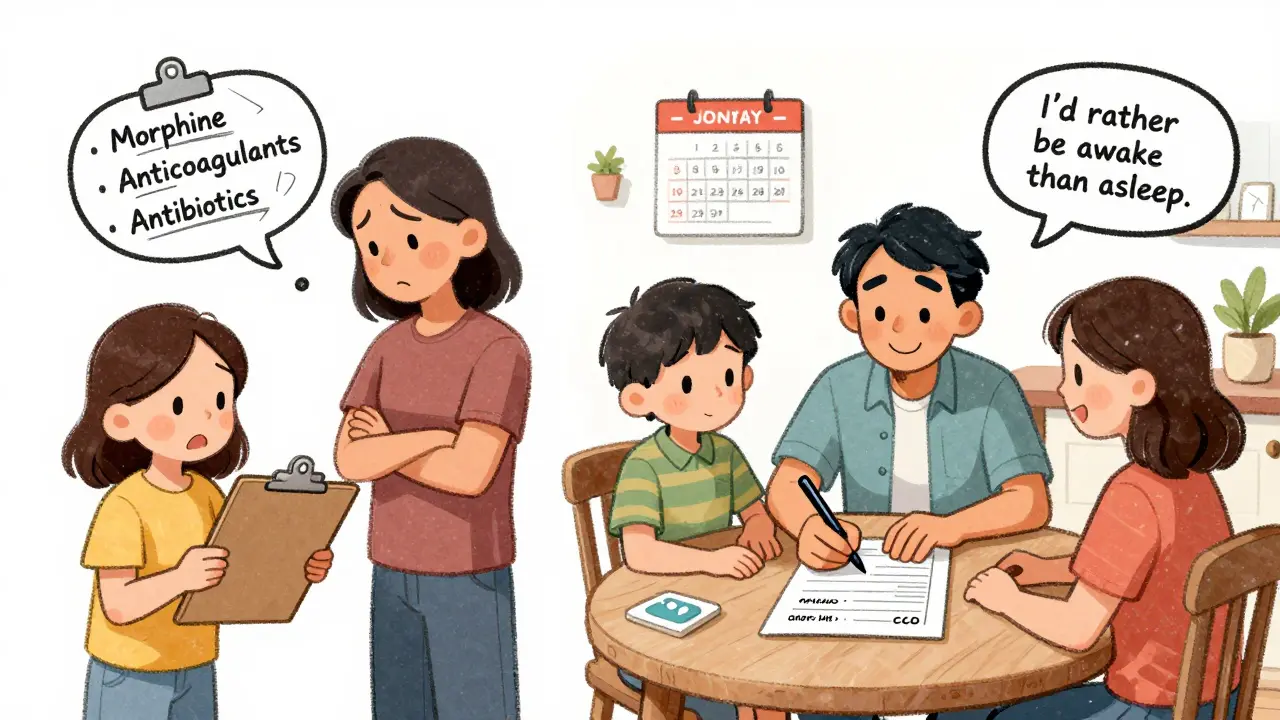
How to Talk About Medication Preferences - Without Making It Awkward
You can’t just sign a form and call it done. The real work happens in conversation.Start simple. Say: “If I ever can’t speak, I want you to make sure I’m not in pain. But I don’t want to be so drugged up I can’t talk to you.”
Then go deeper:
- “Would you give me morphine if I was in pain, even if it made me sleepy?”
- “What if a new drug was offered that might help me live longer but make me confused? Would you say yes?”
- “Do you remember when I said I didn’t want to be in the hospital if I had cancer? Would you honor that even if the doctor says it’s ‘just a few more weeks’?”
Use real examples. Talk about your parents. Talk about your own fears. Say: “I saw Aunt Linda on antibiotics for weeks. She hated how she felt. I don’t want that.”
Don’t wait for a crisis. Have these talks while you’re healthy. Record them. Text them. Write them down. Your agent needs to know your voice - not just your signature.
What the Document Should Include (And What It Shouldn’t)
Your form needs to be clear. But you don’t need a 10-page legal novel.Essential elements:
- Your full name and address
- Your agent’s full name, phone, and address
- Your backup agent
- Signature, date, and witnesses or notary (requirements vary by state)
Optional but powerful:
- A short paragraph about your values: “I value being alert and connected to family over living longer if I’m confused.”
- A list of specific medications you’d refuse or accept: “I do not want antipsychotics unless I’m violent or a danger to myself.”
- Instructions about pain management: “I want pain relief, even if it means I sleep more.”
Avoid vague language like “no extraordinary measures.” What does that mean? Is a pill extraordinary? Is oxygen? Be specific. Write in your own words.
Where to Get the Form - And What to Do After Signing
You don’t need a lawyer. Most states and territories offer free, official forms online.In Australia, check your state’s Department of Health website. NSW Health, Victoria’s Department of Health, and Queensland Health all have downloadable forms. You can also use free tools like PREPARE (developed by UCSF) - it’s a video-based guide that walks you through conversations about medication and care goals.
After you sign:
- Give copies to your agent, your doctor, and your closest family member.
- Ask your doctor to add it to your medical file.
- Keep a copy in your wallet or phone. Some people use apps like Everplans or DocuBank to store it digitally.
- Review it every year - or after any major health change.
Don’t let it sit in a drawer. It’s only useful if people know it exists.

What Happens If You Don’t Have One?
Without a Medical Power of Attorney, doctors will turn to your next of kin. That’s usually a spouse, then adult children. But what if you’re estranged from your son? What if your partner isn’t legally recognized? What if your siblings disagree?In those cases, the hospital may appoint a court-appointed guardian - a stranger who doesn’t know your values. That process can take weeks. During that time, you might get treatments you’d hate - or be denied ones you’d want.
And here’s the cruel twist: your family will blame each other. Siblings fight. Parents feel guilty. Friends wonder if they should’ve spoken up. All because no one had the hard talk.
Technology Can Help - But Not Replace Conversation
There are apps, digital platforms, and even AI tools that help you draft advance directives. Some can even store your preferences in your electronic health record.But here’s the truth: technology doesn’t replace the conversation. A 2023 report from the Hastings Center found that AI tools improved completion rates - but didn’t improve accuracy of decision-making. People still misinterpreted their own wishes when they didn’t talk them through with someone who knew them.
Use the tools. But don’t stop at the checkbox. Talk. Listen. Repeat.
Final Thought: This Isn’t About Death. It’s About Control.
Planning ahead isn’t morbid. It’s loving. It’s saying: I care enough about you to make sure you’re not stuck making impossible choices under pressure.Medication decisions aren’t just clinical. They’re deeply personal. They’re about dignity. About being heard. About not being a burden.
You don’t need to be old. You don’t need to be sick. You just need to be human.
Take 30 minutes today. Talk to someone you trust. Fill out the form. Give them a copy.
It’s the most powerful gift you can give - not just to them. But to yourself.
Can my agent make decisions about psychiatric medications?
Yes, unless your state or territory has specific restrictions. In Australia, most states allow agents to make decisions about psychiatric medications, but some require additional documentation or court approval if the treatment is involuntary. It’s critical to discuss your views on these medications with your agent - including whether you’d accept antipsychotics for agitation, sedation, or mood stabilization. Write your preferences into the document if possible.
Do I need a lawyer to create a Medical Power of Attorney?
No. All Australian states provide free, legally valid forms through their health departments. You typically need two witnesses (who aren’t your heirs or spouse) or a notary. A lawyer is only necessary if your situation is complex - for example, if you have multiple residences, international assets, or are part of a blended family where relationships are strained.
What if my agent refuses to follow my wishes?
Your agent is legally required to act according to your known wishes. If they refuse, you can challenge their decision in court - but only if you’re still capable of speaking. That’s why it’s vital to choose someone trustworthy and to document your preferences clearly. If your agent acts against your documented wishes, family members or doctors can report them to the relevant health authority. In practice, most agents want to do the right thing - they just need clear guidance.
Can I change my Medical Power of Attorney after I sign it?
Yes. You can revoke or update it at any time as long as you’re mentally capable. Just destroy the old document, complete a new one, and notify everyone who had a copy - your agent, doctor, family. Many people update theirs after a diagnosis, divorce, or major life change. Review it annually, even if nothing’s changed.
Does a Medical Power of Attorney cover financial decisions?
No. A Medical Power of Attorney only covers health care decisions - including medication, surgeries, hospital admissions, and end-of-life care. For financial decisions like paying bills or managing bank accounts, you need a separate document called a Financial Power of Attorney. Don’t assume one covers the other. They’re two different tools.