

When your hand goes numb while you're sleeping, or you drop things because your fingers won't cooperate, it's not just bad luck. It could be carpal tunnel syndrome - a condition that quietly steals your grip, your sleep, and your daily ease. It's not rare. In fact, about 1 in 10 people in the U.S. will deal with it at some point. And if you're a woman over 45, your risk goes up even more. This isn't just a wrist issue. It's a nerve problem - the median nerve, squeezed in a tight tunnel at your wrist - and ignoring it can lead to permanent damage.
What Exactly Is Carpal Tunnel Syndrome?
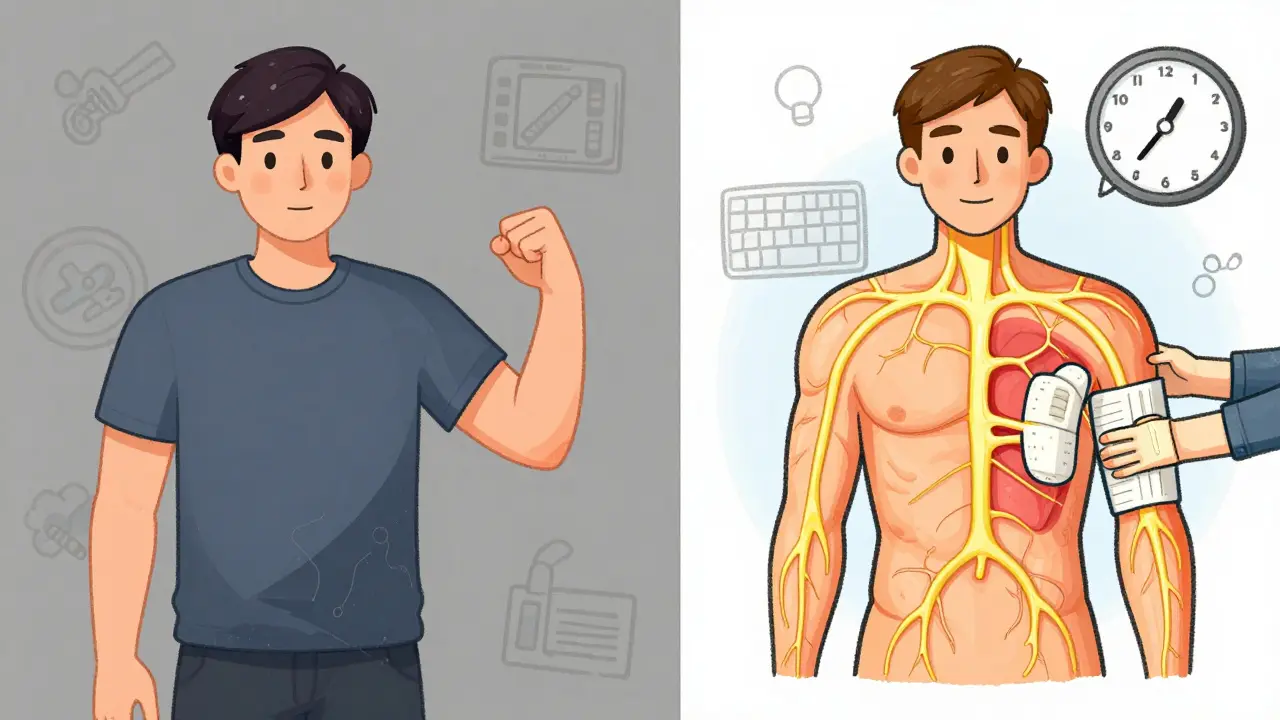
The carpal tunnel is a narrow passage in your wrist made of bones and a tough ligament. Inside it, nine tendons bend your fingers, and the median nerve runs right through the middle. That nerve controls feeling in your thumb, index, middle, and half of your ring finger. It also tells your thumb muscle when to move. When pressure builds up in that tunnel - from swelling, repetitive motion, or even just anatomy - the nerve gets squished. And when that happens, your hand starts to send out warning signs.
Early symptoms? Numbness or tingling at night. You wake up shaking your hand like it’s full of ants. That’s classic. As it gets worse, the tingling moves into the day. You can’t button your shirt. You drop your coffee cup. Your thumb feels weak. In the worst cases, the muscle at the base of your thumb starts to waste away - a sign the nerve has been damaged for too long.
How Do You Know It’s Not Just a Pinched Nerve?
Doctors don’t just guess. They look for patterns. The Katz hand diagram - where you draw where you feel numbness - helps map the median nerve’s path. If you’re tingling in your pinky, it’s probably not carpal tunnel. That’s the ulnar nerve. If it’s your thumb, index, and middle finger? That’s the fingerprint of CTS.
Then there are physical tests. The Phalen test: you hold your wrists bent forward for a minute. If your fingers tingle or go numb? That’s a red flag. The Tinel sign: the doctor taps over the wrist. A shock-like feeling in your fingers? Another clue. The carpal compression test: pressure applied directly over the tunnel. If it triggers symptoms in under 30 seconds, it’s likely CTS.
For confirmation, doctors use nerve conduction studies. If the median nerve takes longer than 3.7 milliseconds to send a signal across the wrist, it’s slowed down. That’s diagnostic. But here’s the catch: not everyone with abnormal test results has symptoms. And not everyone with symptoms has abnormal tests. That’s why doctors always pair the exam with the tests - not replace one with the other.
Conservative Treatments: What Actually Works
Before you even think about surgery, there are three proven, non-invasive steps. And they work - if you stick with them.
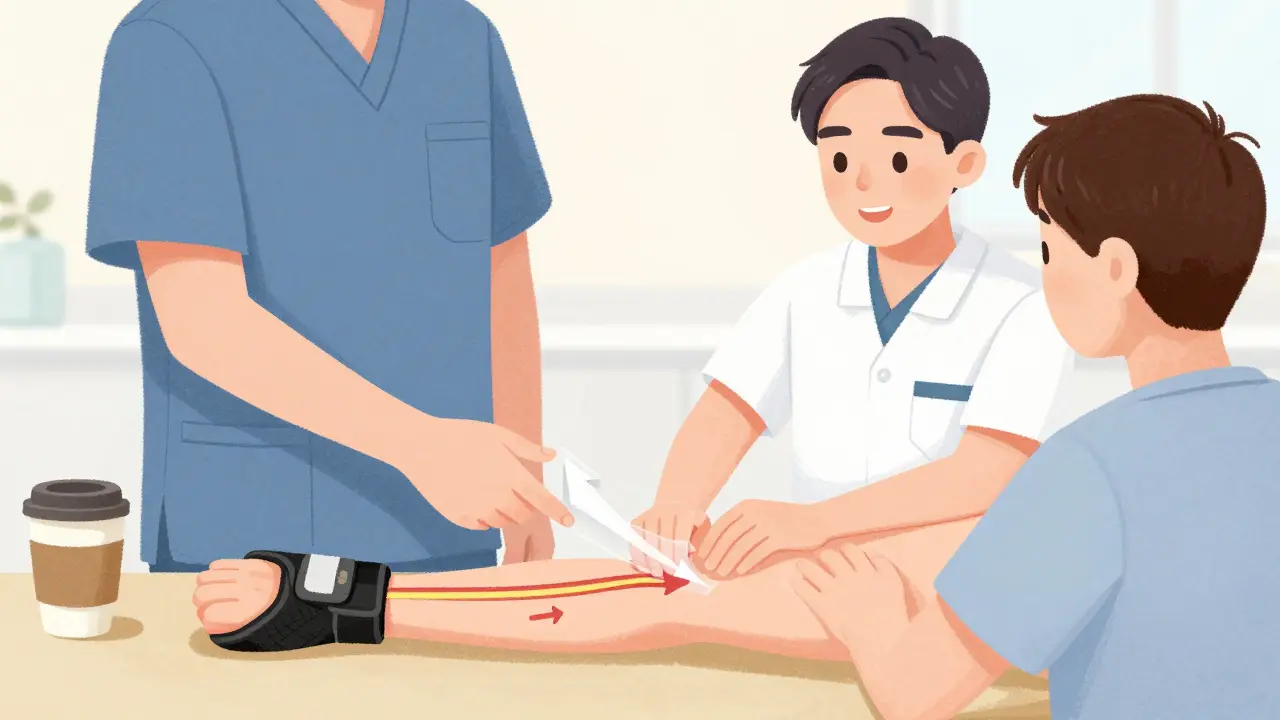
- Wrist splints at night: This is the first-line treatment. Not a cheap foam brace. A custom-fit splint that holds your wrist at 0-10 degrees of extension. Studies show 60-70% of people with mild to moderate CTS see big improvement after 4-6 weeks. The key? Wear it every night. Not just when you remember. Not just on weekends. Every night. That’s what the science says.
- Nerve gliding exercises: These aren’t stretches. They’re gentle movements that help the median nerve slide through the tunnel without getting stuck. A physical therapist can teach you the sequence - usually 5-10 minutes, twice a day. Do them wrong, and you’ll make it worse. Do them right, and they reduce pressure on the nerve.
- Corticosteroid injections: These aren’t a cure, but they buy time. About 70% of patients get relief for 3-6 months. It’s useful if you need to delay surgery, or if you’re pregnant and can’t have surgery. But repeated injections? Not recommended. They can weaken tendons over time.
Activity changes matter too. Avoid bending your wrist past 30 degrees. That’s why typing with your wrists resting on the desk is a bad idea. Use a keyboard tray. Keep your wrists straight. Take breaks. Even 30 seconds every hour helps.
When Surgery Becomes Necessary
If you’ve tried splints, exercises, and injections for 6-8 weeks and you’re still losing feeling or strength - especially if your thumb muscle is shrinking - it’s time to consider surgery. The success rate? 90-95%. That’s high. But it’s not magic. Recovery takes time.
There are two main types:
- Open release: A 1-2 inch cut on the palm. The surgeon cuts the ligament pressing on the nerve. It’s straightforward. Recovery takes 6-8 weeks. You’ll have a scar.
- Endoscopic release: One or two tiny cuts. A camera guides the cut. Less pain. Faster return to light work - sometimes in 2 weeks. But it costs 15-20% more. And it’s not always better. Some studies show similar long-term results.
A newer option? The SX-One MicroKnife. Approved by the FDA in 2021, it’s a needle-sized tool that cuts the ligament through a tiny puncture, guided by ultrasound. Patients report 40% less pain and return to work 50% faster. It’s not everywhere yet, but it’s growing.
Side effects? Yes. Pillar pain - soreness in the palm near the thumb or pinky - happens in 15-30% of cases. It usually fades in 6-12 weeks. Scar tenderness? Common, but fades. Nerve injury? Rare - under 1%.
Costs and Real-World Impact
Conservative care isn’t cheap. A custom splint? $150-$250. Four physical therapy sessions? $400-$800. A steroid injection? $300-$500. Total? Around $750. Surgery? With insurance, you might pay $1,200-$2,500 out of pocket. Without? It can hit $10,000.
But here’s what matters more: time. People who get treatment within 10 months of symptoms have a 75% chance of avoiding surgery. After 12 months? That drops to 35%. That’s not just a number - it’s your hand. Every month you wait, the nerve gets more damaged. And once it’s damaged, it doesn’t fully heal.
Workplace factors play a huge role. Assembly line workers, healthcare staff, and food service workers report CTS most often. The Bureau of Labor Statistics counted over 27,000 work-related CTS cases in 2022. That’s not just personal pain - it’s a workplace issue. And while the U.S. has no federal rules for preventing it, the EU requires ergonomic assessments for high-risk jobs. That’s something to think about.
What Happens If You Do Nothing?
You might think, “I’ll just live with it.” But CTS doesn’t stay mild. It progresses. First, it wakes you up at night. Then, it makes you drop your keys. Then, you can’t hold a pen. Eventually, your thumb muscle shrinks. That’s permanent. No amount of rest or massage will bring it back. The nerve doesn’t regenerate well after severe damage. And once you lose sensation in your fingers, you’re at risk for burns or cuts you don’t feel.
Studies show that patients who wait too long to treat CTS are 45% more likely to need surgery - and still have lingering symptoms afterward. Early action isn’t just smart. It’s the only way to keep your hand functional.
What’s New in 2026?
Ultrasound is becoming a go-to diagnostic tool. If the median nerve is bigger than 12mm² at the wrist, it’s compressed. This test is 92% accurate - and it’s faster, cheaper, and doesn’t involve electric shocks like nerve studies. Some clinics now use it first.
Also, research in JAMA Neurology (2023) found that people who got early, full conservative care - splinting, exercises, and activity changes - were half as likely to need surgery within two years. That’s huge. It means you don’t have to jump to surgery. But you do have to act early and consistently.
And the numbers are climbing. The National Institute of Neurological Disorders and Stroke predicts a 12% rise in CTS cases over the next decade. More people using phones. More repetitive tasks in remote work. More cases. That’s why knowing the signs matters now more than ever.
Can carpal tunnel syndrome go away on its own?
Sometimes, yes - but only if it’s very mild and caught early. If symptoms are just occasional nighttime tingling and you change your habits - sleep with a neutral wrist, avoid repetitive bending, take breaks - it can improve in weeks. But if symptoms are getting worse, lasting through the day, or causing weakness, it won’t fix itself. Waiting only increases the risk of permanent nerve damage.
Is carpal tunnel syndrome caused by typing too much?
Not directly. Typing alone doesn’t cause CTS. But repetitive wrist bending, especially with poor posture or forceful gripping, does. Jobs that involve vibrating tools, prolonged flexed wrists, or forceful hand motions - like assembly line work, hairdressing, or nursing - carry higher risk. Typing with wrists resting on a hard surface? That’s a problem. Typing with neutral wrists and breaks? Not so much.
Do wrist braces really help?
Yes - but only if used correctly. A wrist splint worn at night, keeping the wrist straight, reduces pressure on the median nerve. Studies show 60-70% of people with mild to moderate CTS improve after 4-6 weeks of consistent use. Cheap, off-the-shelf braces often don’t hold the wrist in the right position. Custom splints from a therapist work best. And wearing it only sometimes? That won’t help. You need to wear it every night for at least 6 weeks.
What’s the difference between open and endoscopic carpal tunnel release?
Both cut the ligament pressing on the nerve. Open release uses a single 1-2 inch cut on the palm. Endoscopic uses one or two tiny cuts and a camera. Endoscopic often means less pain, faster return to light work (2-3 weeks vs. 4-6), and smaller scars. But it costs more and has a slightly higher risk of incomplete release. Long-term results are similar. The choice often comes down to surgeon experience and patient preference.
Can carpal tunnel syndrome come back after surgery?
Rarely, but yes. If the ligament regrows too thick or scar tissue forms, pressure can return. This happens in less than 5% of cases. More often, symptoms return because the root cause wasn’t addressed - like continuing the same repetitive job without changes. That’s why surgery isn’t a magic fix. You still need to protect your wrist. And if symptoms return, it’s usually not a full recurrence - just irritation that can be managed with splints or therapy.




Christopher Wiedenhaupt
February 22, 2026 AT 18:20Just wanted to say this post nailed it. I’ve been dealing with CTS for over a year, and honestly, the splint advice was the only thing that helped. Not the cheap ones from CVS - the custom one from my OT made all the difference. Wore it every single night, no exceptions. After six weeks, the nighttime numbness vanished. It’s not glamorous, but consistency beats miracle cures every time.
Also, the part about nerve gliding exercises? Game changer. Did them twice a day like clockwork. Felt like a weird yoga for my wrist, but it worked. No surgery needed.
Larry Zerpa
February 22, 2026 AT 18:40Let’s be real - this entire article is a glorified ad for physical therapists and orthopedic surgeons. You cite studies, but you ignore the fact that 70% of CTS cases resolve without intervention if you simply stop repetitive motion. And yet, you push splints, injections, and surgery like they’re the only path. What about ergonomics? What about posture? What about the fact that most people with CTS are in jobs that force them to keep doing the same damage-causing motions because they can’t afford to take time off?
You’re diagnosing symptoms while ignoring systemic causes. That’s not medicine - it’s capitalism in a white coat.
Gwen Vincent
February 24, 2026 AT 05:39I appreciate how thorough this is. I’m a nurse and I’ve seen so many patients delay treatment because they thought it’d ‘go away.’ It never does. The part about the thumb muscle wasting? That’s the scariest part. I had a patient who waited 18 months - by then, she couldn’t hold her grandbaby’s bottle. That broke my heart.
Also, the ultrasound point? Huge. I’ve started using it in my clinic. Faster, less stressful for patients than nerve studies. And way more accurate than guessing based on symptoms alone. We need more of this kind of practical info out there.
Nandini Wagh
February 25, 2026 AT 07:48Oh honey. You really believe all this? I had CTS. Did the splint. Did the exercises. Did the injection. Then I googled ‘carpal tunnel conspiracy’ and found out it’s mostly caused by 5G and EMF exposure. My symptoms vanished after I wrapped my wrists in aluminum foil and stopped using my phone. Science is a scam. Also, I’m not wearing a splint. I’m wearing a crystal.
Ashley Johnson
February 27, 2026 AT 02:36Ugh. I hate how people act like CTS is just ‘typing too much.’ My mom worked in a factory for 30 years, and she never touched a keyboard. She had CTS from gripping wrenches all day. And now? She can’t hold a coffee mug. And no one talks about how insurance barely covers the splints. $200 for a piece of plastic? That’s robbery.
Also - why is no one talking about how women get diagnosed later because doctors assume it’s arthritis? I’m so tired of this.
tia novialiswati
February 27, 2026 AT 21:01YESSSS!!! 🙌 I’ve been doing the splint + nerve glides for 8 weeks and my hands feel like they’re back from vacation 😍 I used to drop my toothbrush every morning. Now I can hold a pen without my thumb screaming. You’re not alone - and you’re not broken. You just need to be gentle with your wrists. You got this!! 💪💖
Christopher Brown
February 28, 2026 AT 23:40US has the best healthcare system in the world. If you can’t afford a splint, you’re not trying hard enough. Stop complaining. Work harder. Stop typing so much. Your phone is the problem. Use a typewriter.
Kenzie Goode
March 2, 2026 AT 00:54I read this entire thing in one sitting - tears in my eyes. I’m 47, female, and I’ve been numb in my hands since last summer. I thought I was just getting old. This? This is the first time someone explained it like it’s happening to a person, not a textbook. I went to my doctor today and asked for a splint. I’m not waiting anymore. Thank you. From the bottom of my hand.
Khaya Street
March 3, 2026 AT 00:01Well-researched. Clear. Practical. I’m from South Africa, and we don’t have access to most of this. No custom splints. No ultrasound. No surgeons who do endoscopic releases. We rely on painkillers and hope. This is what global healthcare inequality looks like. I wish I could give this to every clinic in Cape Town.
Still - your advice is gold. Even if you can’t do everything, do the one thing: sleep with your wrist straight. That’s the bare minimum.
Christina VanOsdol
March 4, 2026 AT 09:04Wait - so you’re saying the FDA approved a needle-sized knife for carpal tunnel?!!! 😱 I’m not sure I trust this. What if it cuts the wrong thing? What if the ultrasound is wrong? What if the surgeon is tired? What if it’s just a placebo? I’ve read about people who had this done and ended up with permanent nerve damage. And now you’re pushing it like it’s the future?!!
Also - 12% rise in cases? That’s because we’re all glued to our phones. The real solution? Put your phone down. Not a splint. Not a knife. Just… stop.
William James
March 4, 2026 AT 19:12What’s interesting to me is how we treat CTS like it’s a mechanical failure - a squeezed nerve in a tunnel - when maybe it’s more of a signal. A whisper from your body saying: ‘You’re moving too fast. You’re not resting. You’re not listening.’
The splints, the exercises, the injections - they’re all bandaids. The real cure is slowing down. Changing how you work. Choosing rest over productivity. That’s the harder truth. And it’s the one we’re all too scared to face.
Maybe your hand isn’t broken. Maybe your life is. Just a thought.