
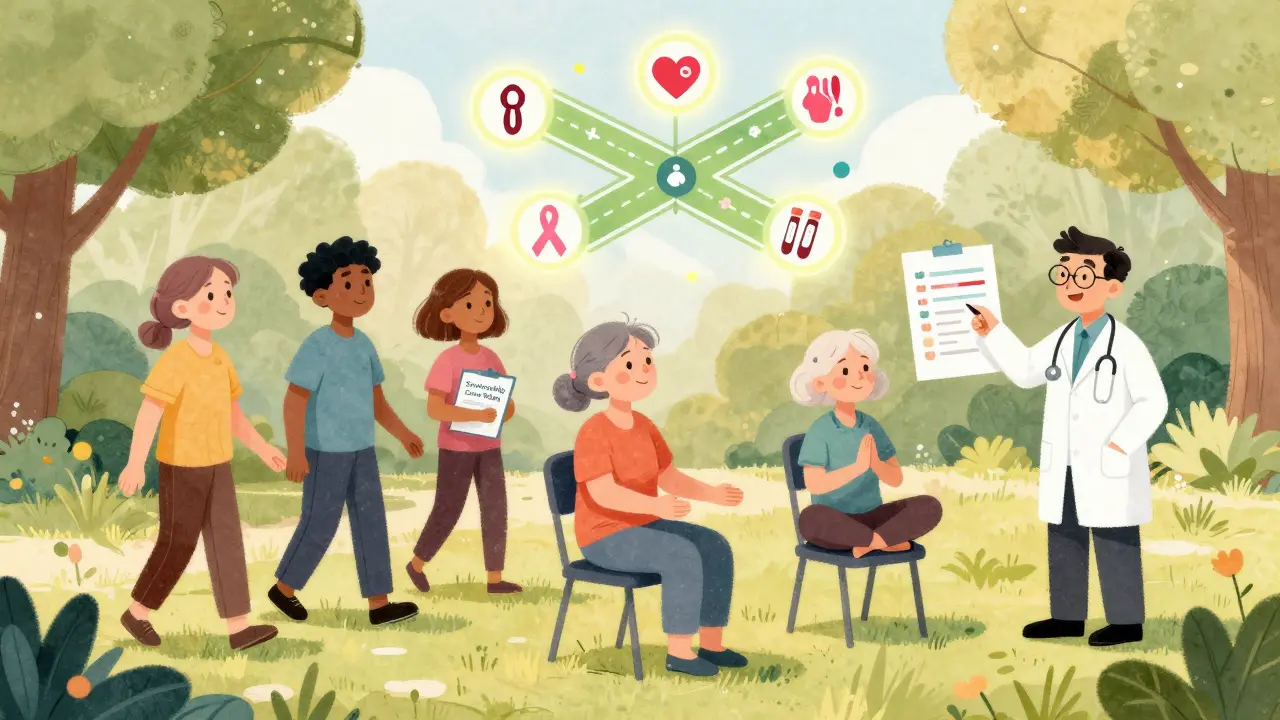
Living beyond cancer doesn’t mean the journey ends when treatment does. For millions of people, the real challenge begins afterward: managing side effects that won’t go away, watching for signs of return, and rebuilding a life that feels whole again. This is cancer survivorship - and it’s not just about staying alive. It’s about living well, for years or even decades after treatment.
Right now, over 16 million people in the U.S. are cancer survivors. By 2030, that number will hit nearly 22 million. Yet most of them don’t get the kind of care they need after treatment. Oncologists focus on curing cancer. Primary care doctors often don’t know what to look for. And survivors? They’re left figuring it out on their own. That’s a dangerous gap.
What Happens After Treatment Ends?
When your last round of chemo or radiation is done, you might expect relief. Instead, many survivors face a new set of problems - some that show up months later, others that creep in years down the road. These are called late effects. They’re not rare. They’re common. And they’re often preventable if you know what to watch for.
Chemotherapy can damage your heart, your lungs, your nerves, even your teeth. Radiation? It can cause thyroid problems, bone loss, or raise your risk of a second cancer in the treated area. Hormone therapy for breast or prostate cancer might lead to early menopause, joint pain, or osteoporosis. Some survivors struggle with memory fog, chronic fatigue, or trouble sleeping. Others deal with nerve damage that makes walking painful or sexual function that never fully returns.
Take breast cancer survivors treated with anthracyclines. About 15-20% will develop heart problems within 10 years. That’s not a small risk. It means regular heart checks - every 6 to 12 months - should be part of their follow-up. Or Hodgkin lymphoma survivors who had chest radiation. Their lifetime risk of developing breast cancer jumps to 30%. That’s why annual mammograms and MRIs are recommended starting eight years after treatment.
Recovery Isn’t Just Physical
It’s not just your body that changes. Your mind, your relationships, your wallet - they all get reshaped.
One in two survivors say they can’t work the way they used to. Fatigue, brain fog, or anxiety make it hard to focus. Sixty-eight percent report work struggles. Over 70% face financial stress. Medical bills pile up. Insurance denies claims. Life insurance becomes impossible to get. And that’s not even counting lost wages or reduced hours.
Relationships shift too. Fifty-seven percent say their connections with family or friends changed - sometimes for the better, often for the worse. Loved ones might not know how to talk about it. Survivors feel guilty for needing help or ashamed they’re not “over it.” Self-esteem drops. One in two survivors say they no longer recognize themselves.
And then there’s the silence. Doctors don’t always talk about these things. You’re told, “You’re cured,” and sent on your way. But what does that even mean? If you still can’t sleep through the night? If you’re terrified every time you feel a new ache? If you’re still in pain after five years?
The Survivorship Care Plan: Your Roadmap Forward
There’s a tool that changes everything: the survivorship care plan. It’s not a fancy brochure. It’s a personalized roadmap made by your care team that answers three big questions:
- What treatment did I get?
- What side effects should I watch for?
- Who do I see next, and when?
Studies show survivors who get one are 27% less likely to have cancer-related complications. They make 40% fewer duplicate tests. They’re 32% less likely to request unnecessary scans. And their quality of life improves by 15-22 points on standard health scales.
Here’s what a good plan includes:
- A summary of your treatments: drugs, doses, radiation fields, surgeries
- Specific risks based on your treatment: heart monitoring, bone density scans, cancer screenings
- A list of symptoms to report right away: chest pain, unexplained weight loss, new lumps
- Who to contact for each issue - oncologist, PCP, rehab specialist
- Lifestyle advice: exercise, diet, sleep, alcohol limits
And here’s the kicker: the Commission on Cancer now requires every accredited cancer center to give this to every survivor. Yet only 78% of centers are fully doing it. You shouldn’t have to beg for this. It’s your right.
Who Should Be in Charge of Your Care?
For too long, the system has been broken. Oncologists are experts at treating cancer. But they’re not trained to manage heart disease, osteoporosis, or depression that lasts for years. Meanwhile, your primary care doctor may never have seen a patient who had radiation to the chest or chemo that damaged nerves.
Seventy-eight percent of older survivors already have a primary care provider who knows their full medical history. Sixty-three percent of them die from causes other than cancer - heart disease, diabetes, falls. So why aren’t we using that relationship?
The answer is coordination. A good survivorship model splits responsibilities:
- Oncology team: Handles cancer surveillance, recurrence checks, high-risk screenings
- Primary care provider: Manages general health - blood pressure, cholesterol, diabetes, vaccines
- Specialists: Cardiologists for heart risks, endocrinologists for thyroid issues, rehab therapists for mobility
Cleveland Clinic found survivors with clear care plans had 40% fewer duplicate tests. That’s money saved. Stress reduced. Time regained.
Exercise Is Medicine - Even After Cancer
One of the most powerful tools you have? Movement. Not marathon training. Just regular activity.
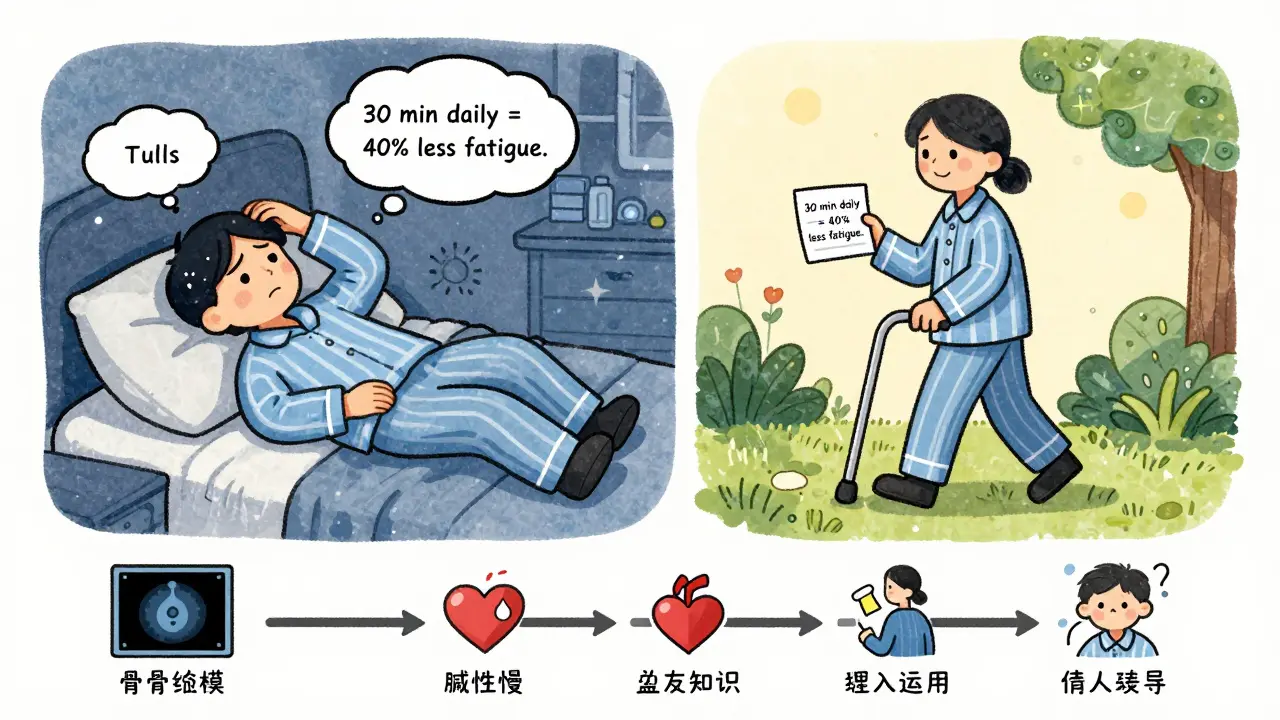
Studies show cancer survivors who walk 30 minutes a day, five days a week, cut fatigue by 40-50%. They improve mobility by 25-35%. Bone density increases by 3-5%. Depression lifts. Sleep improves. And yes - even cancer recurrence risk drops.
You don’t need a gym. You don’t need equipment. Start with walking. Or swimming. Or chair yoga. The Shirley Ryan AbilityLab saw functional ability scores jump 35-45% in just 12 weeks with tailored rehab programs. That’s not magic. That’s science.
And it’s safe. Even for people with bone loss, nerve damage, or heart issues. Just start slow. Talk to your doctor. But don’t wait for permission to move. Movement is healing.

How to Stay Ahead of Recurrence
Recurrence isn’t a surprise. It’s often predictable. That’s why surveillance matters.
For example:
- Colon cancer survivors: Colonoscopy every 1-3 years for 5 years, then every 5 years
- Prostate cancer survivors: PSA tests every 6-12 months for at least 5 years
- Leukemia survivors: Blood counts monitored monthly for the first year, then quarterly
- Childhood cancer survivors: Annual skin checks, hearing tests, and growth assessments into adulthood
And don’t forget second cancers. Survivors are 2-3 times more likely to develop a new cancer. Melanoma after radiation. Lung cancer after smoking history. Thyroid cancer after neck radiation. Your care plan should list which cancers you’re at risk for - and how often you need screening.
What You Can Do Today
You don’t have to wait for a system to fix itself. Here’s what works right now:
- Get your treatment summary. If you don’t have it, ask for it. Write down every drug, dose, radiation site, surgery date. Keep it in a folder. Update it.
- Build your care team. Identify your oncologist, PCP, and any specialists you need. Make sure they talk to each other. Bring your care plan to every appointment.
- Move daily. Walk, stretch, swim. Even 10 minutes helps. Track it. Celebrate it.
- Watch for red flags. Unexplained weight loss, new lumps, persistent pain, dizziness, shortness of breath - don’t ignore them. Call your doctor.
- Ask for help. Financial stress? Talk to a counselor. Emotional strain? Join a support group. You’re not alone. Organizations like Livestrong and CancerCare offer free resources.
What’s Next?
The future of survivorship is personal. Researchers are building risk models that combine your genetics, treatment history, lifestyle, and even your sleep patterns to predict what might happen next. Imagine a digital dashboard that tells you: “Based on your chemo and age, your heart risk is high. Start monitoring now.” That’s not sci-fi. It’s coming.
For now, the best tool you have is knowledge. And action. You survived cancer. Now it’s time to take charge of what comes next.
What are the most common long-term side effects of cancer treatment?
Common long-term effects include fatigue, memory problems (often called "chemo brain"), nerve damage, heart issues, lung damage, early menopause, infertility, osteoporosis, thyroid dysfunction, dental decay, and increased risk of second cancers. The specific risks depend on the type of treatment - chemotherapy, radiation, surgery, or hormone therapy - and where it was given in the body.
How often should cancer survivors get checked for recurrence?
It depends on your cancer type and treatment. High-risk survivors (e.g., those who had aggressive treatments or genetic syndromes) may need checks every 3-6 months. Moderate-risk survivors typically see their oncologist once a year. Low-risk survivors can often be managed by their primary care doctor with occasional oncology input. Always follow your personalized survivorship care plan.
Can primary care doctors manage cancer survivorship care?
Yes - but only if they have the right information. Most primary care providers aren’t trained on cancer-related late effects. That’s why a detailed survivorship care plan is essential. It tells them what treatments you had, what to monitor, and when to refer you back to oncology. With that, PCPs can safely manage your general health while your oncology team focuses on cancer-specific risks.
Is it normal to still feel tired years after treatment?
Yes. Cancer-related fatigue can last for years - even decades. It’s not just being tired. It’s overwhelming exhaustion that doesn’t improve with rest. It’s linked to inflammation, nerve damage, hormone changes, and mental health. Regular physical activity, good sleep hygiene, and stress management can reduce it by 40-50%. If fatigue is severe, talk to your doctor - it might be treatable.
How can I reduce my risk of a second cancer?
Avoid tobacco, limit alcohol, protect your skin from UV exposure, get recommended cancer screenings (like mammograms or colonoscopies), maintain a healthy weight, and stay physically active. Some survivors need extra screenings based on their treatment - for example, chest radiation increases breast cancer risk, so annual mammograms and MRIs may be needed starting 8 years after treatment.

Aisling Maguire
March 1, 2026 AT 17:29Just wanted to say this hit different for me. My mom went through chemo for breast cancer and now she’s got this weird joint pain no one can explain. They told her it’s just "aging" but I know better. She’s on calcium supplements, walks every morning, and does water aerobics - and honestly? It’s made a world of difference. Not cured, but she’s got her spark back.
Ben Estella
March 3, 2026 AT 11:58Let’s be real - this whole survivorship thing is just another way for hospitals to keep billing. You get cured, then they hit you with 12 new tests, specialist referrals, and "lifestyle coaching" that costs more than your original treatment. I’m tired of being guilt-tripped into being a perfect survivor. Sometimes just breathing is enough.
Jimmy Quilty
March 4, 2026 AT 22:38uuhhh soooo… i’ve been reading this and im like… is anyone else worried that the "survivorship care plan" is just a gateway for big pharma to sell us lifelong meds? like… heart checks? bone scans? what if they’re just creating problems to sell solutions? i mean… i had radiation… and now i’m told to get an mri every year? for what? to find something that might never happen? i think we’re being manipulated. also… did you know the FDA approves like 90% of cancer drugs based on animal studies? 🤔
Miranda Anderson
March 5, 2026 AT 16:11I’ve been a survivor for 11 years now - Hodgkin’s, chest radiation, the whole thing. I didn’t know any of this stuff back then. I just thought, "Okay, I’m done. Let’s go back to normal." But normal doesn’t exist anymore. I didn’t realize how much my lungs were affected until I tried hiking last year and couldn’t make it up a small hill. Then I started walking 20 minutes a day. Not because I was told to - because I wanted to feel like myself again. Slowly, it came back. Not all of it. But enough. And yeah, the fatigue? Still there. But now I don’t fight it. I rest. I nap. I accept it. That’s the real victory - not the scan results, but the quiet peace of learning to live with the new normal.
Gigi Valdez
March 7, 2026 AT 06:51The data presented here is compelling, particularly the 27% reduction in complications among those with care plans. However, implementation remains inconsistent across institutions. A standardized, interoperable digital format for survivorship plans - integrated into EHRs - would significantly improve compliance and continuity of care. The current reliance on printed documents is antiquated and vulnerable to loss or miscommunication.
Sneha Mahapatra
March 7, 2026 AT 07:35My heart goes out to everyone reading this. I lost my sister to recurrence three years ago. She never got a care plan. No one told her to watch for thyroid issues after her radiation. She just… faded. I wish I’d known then what I know now. To anyone reading this - please, don’t wait. Ask for your plan. Write it down. Share it. You’re not a burden. You’re not overreacting. You’re fighting for your life - again. And you deserve to be heard. 🌿
bill cook
March 7, 2026 AT 14:03you think you're safe after treatment? you think they're done with you? think again. i got my "survivorship plan" and guess what? it listed 17 different screenings. 17. they're not helping you - they're monetizing your fear. i stopped going. i don't trust the system. they want you dependent. they want you scared. they want your money. i'm done.
Byron Duvall
March 8, 2026 AT 02:05why do we even have survivorship plans? why not just say "you’re cured" and leave it at that? why do we need to be told we might get heart problems 10 years from now? it’s not like we can do anything about it anyway. i got my chemo, i survived, now i’m just trying to live. why does everything have to be a medical project? i don’t want to be a statistic. i want to go fishing.
Katherine Farmer
March 8, 2026 AT 10:42Let’s be honest - this article reads like a pharmaceutical white paper dressed up as patient advocacy. The "survivorship care plan"? A revenue-generating mechanism. The exercise recommendations? Conveniently aligned with wellness industry marketing. And don’t get me started on the unregulated supplements promoted under the guise of "lifestyle advice." Real survivorship is about autonomy - not being handed a 12-page checklist and told to follow it like a robot.
Full Scale Webmaster
March 9, 2026 AT 21:29I’ve been reading this and I’m just… overwhelmed. I’m a 5-year survivor of ovarian cancer. I had surgery, chemo, then maintenance therapy. Now I’m supposed to see an oncologist yearly, a cardiologist every six months, a rheumatologist for joint pain, a physical therapist for nerve damage, a nutritionist, a mental health counselor, AND get annual mammograms because of the radiation? I work two jobs. I have two kids. I don’t have time to be a full-time patient. And don’t even get me started on the insurance denials. I had one claim denied because they said "the mammogram was not medically necessary for a survivor without BRCA mutation." WHAT? I’m supposed to just… ignore the fact that my body is a ticking time bomb? I feel like I’m being punished for surviving. And now I’m supposed to be grateful for a plan that’s impossible to follow? I’m exhausted. And nobody’s talking about this part.
Brandie Bradshaw
March 11, 2026 AT 01:15It’s not enough to say "move daily." That’s like saying "just breathe" to someone with COPD. The assumption that walking 30 minutes a day is accessible ignores mobility impairments, chronic pain, financial barriers to safe spaces, and the reality that fatigue isn’t laziness - it’s a physiological response. I have severe peripheral neuropathy. I can’t walk without pain. My balance is gone. My insurance won’t cover a walker. So now I’m supposed to feel guilty for not exercising? This article is well-intentioned, but it’s written from a place of privilege. Survivorship isn’t about individual responsibility - it’s about systemic support. We need accessible rehab, affordable mobility aids, and real policy change - not motivational posters.
Angel Wolfe
March 12, 2026 AT 03:30So let me get this straight - you survived cancer, and now the system wants you to be even more afraid? They give you a plan, then they tell you to see 10 different doctors, get 15 tests, and avoid sugar, alcohol, and sunlight? Who benefits? Hospitals. Insurance companies. Pharma. And you? You’re just a walking wallet. I’ve seen this before. After 9/11, they told us to be vigilant. Now they’re telling cancer survivors to be vigilant. It’s the same playbook. They scare you, then sell you security. I’m not buying it anymore. I’m done being a target.