

When you take an antiplatelet drug like aspirin, clopidogrel, or ticagrelor, you’re not just preventing a heart attack or stroke-you’re also putting your stomach at risk. These medications stop your blood platelets from clumping together, which is great for keeping arteries clear. But that same effect makes it harder for your body to stop bleeding, especially in the gut. About 1 in 100 people on these drugs will have a serious gastrointestinal bleed within the first month. And for those on dual therapy-say, aspirin plus clopidogrel-that risk jumps by 30 to 50%.
Why Your Stomach Is at Risk
Antiplatelet drugs don’t just target clots in your heart or brain. They work everywhere. Aspirin, the oldest of these drugs, directly irritates the stomach lining. Even enteric-coated versions, designed to dissolve in the intestine instead of the stomach, still release active ingredients into your bloodstream. That means they suppress platelet function systemically, not just locally. So even if the pill doesn’t touch your stomach, your platelets still can’t repair tiny tears in the gastric mucosa. Clopidogrel, prasugrel, and ticagrelor work differently. They block the P2Y12 receptor on platelets, stopping them from responding to signals that trigger clumping. But here’s the catch: platelets aren’t just for clotting. They also help heal ulcers by releasing growth factors. When these drugs blunt platelet activity, ulcers don’t heal as quickly. A 2023 study found clopidogrel users were 80% more likely to develop worsening gastrointestinal injury over 6 to 12 months than those on aspirin alone.Which Antiplatelet Is Safest for Your Gut?
Not all antiplatelet drugs are equal when it comes to stomach safety. Here’s how they stack up:| Medication | Relative GI Bleeding Risk | Key Considerations |
|---|---|---|
| Aspirin (low-dose) | Baseline | Most studied; safest for long-term use in high-risk GI patients |
| Clopidogrel | 1.8x higher than aspirin | Higher ulcer progression; interacts with some PPIs |
| Prasugrel | 2.1x higher than aspirin | More potent, better for stents-but higher bleeding risk |
| Ticagrelor | 30% higher than clopidogrel | Fast-acting, reversible; linked to shortness of breath too |
If you’ve had a prior GI bleed, aspirin monotherapy is usually the best choice for ongoing protection. It’s less likely to cause rebleeding than stronger agents. For people who need more potent therapy-like those with stents-prasugrel or ticagrelor might be necessary, but only if you’re also on a proton pump inhibitor (PPI).
Proton Pump Inhibitors: The Go-To Shield
PPIs like esomeprazole, omeprazole, and pantoprazole are the gold standard for protecting the stomach while on antiplatelet therapy. They cut acid production, giving ulcers time to heal. A 2019 survey of over 1,200 gastroenterologists found that 89% routinely prescribe PPIs to patients with a history of ulcers who are on antiplatelets. Even more-62%-give them to patients with multiple risk factors: age over 65, use of NSAIDs like ibuprofen, or a positive H. pylori test. The standard dose is esomeprazole 40mg once daily. After an endoscopic diagnosis of an ulcer, guidelines recommend continuing the PPI for at least 8 weeks. For those with prior complications-like bleeding ulcers or perforations-some doctors recommend staying on PPIs indefinitely. But here’s the twist: PPIs aren’t perfect. About 15-20% of long-term users develop side effects like bloating, diarrhea, or nutrient deficiencies (especially magnesium and vitamin B12). And there’s been a long-standing debate about whether PPIs reduce clopidogrel’s effectiveness. Early studies suggested that omeprazole might interfere with clopidogrel’s activation in the liver. But more recent data, including a 2023 meta-analysis, show the real-world impact is minimal. Still, many doctors avoid omeprazole and esomeprazole in clopidogrel users and switch to pantoprazole or rabeprazole instead-drugs that don’t block the same liver enzyme.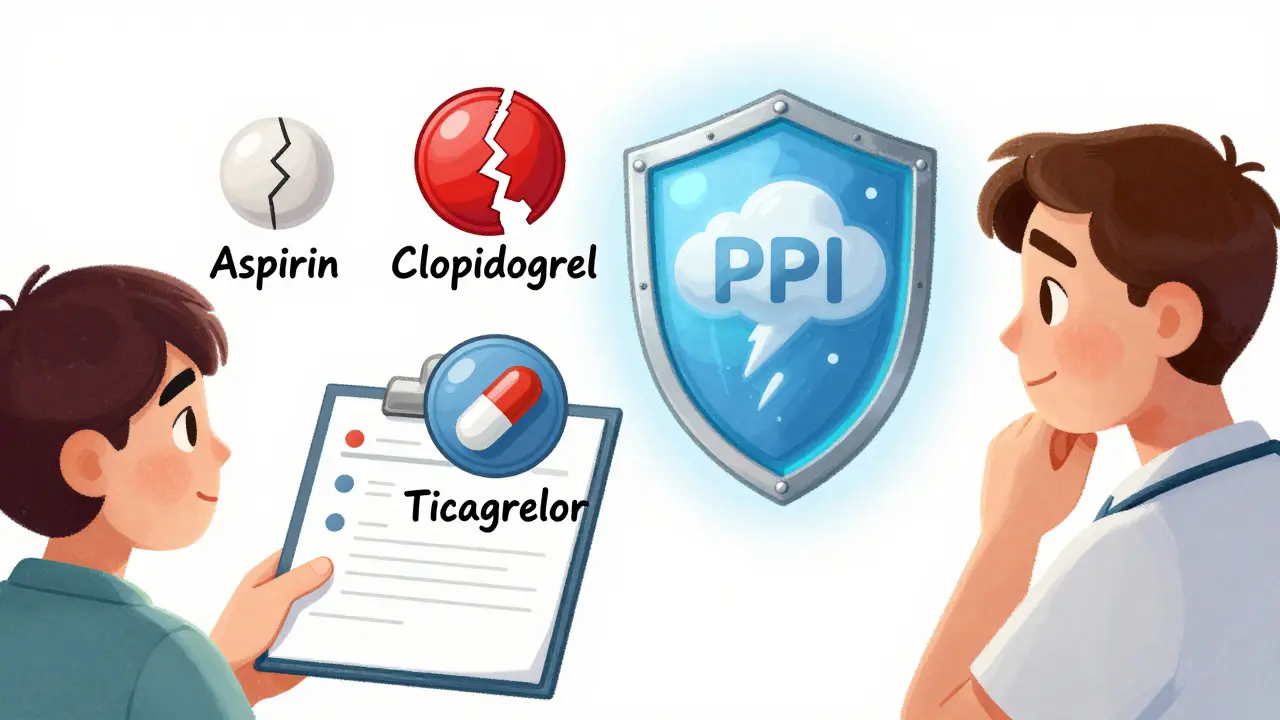
What to Do If You Start Bleeding
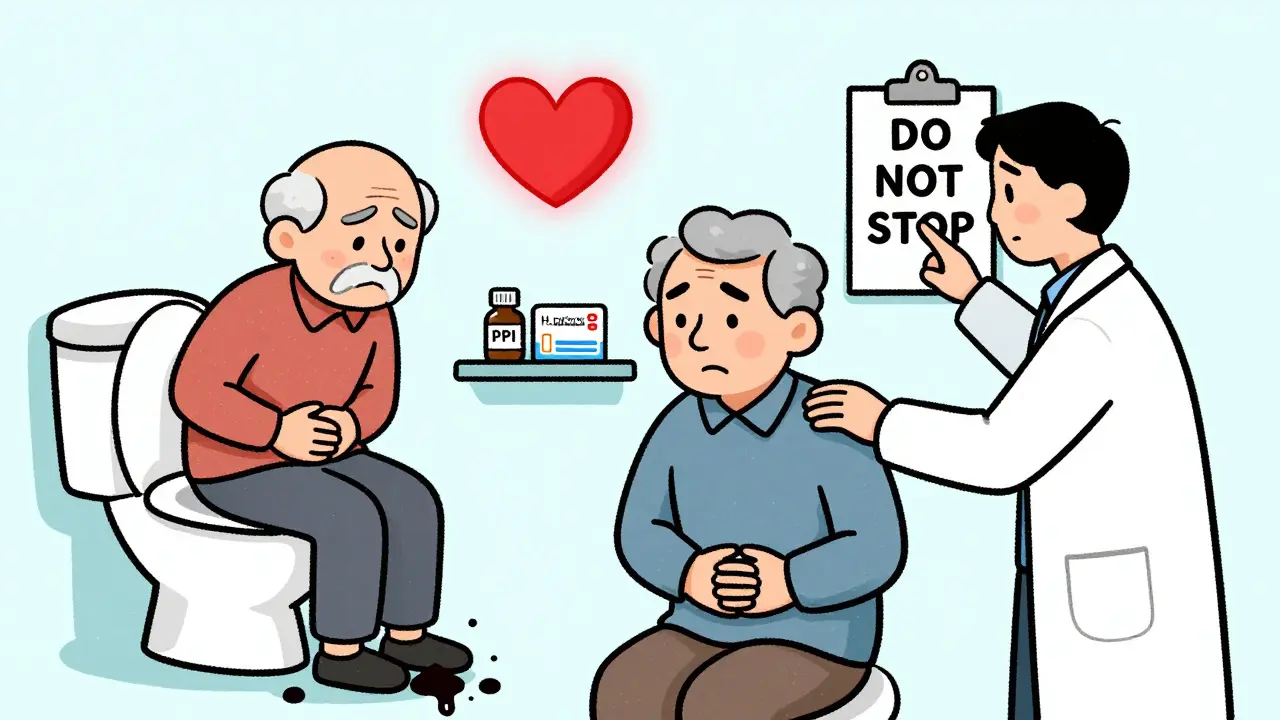
If you notice black, tarry stools, vomit blood, or feel dizzy and weak, don’t wait. Get help immediately. But here’s something most patients don’t know: do not stop your antiplatelet medication on your own. A landmark 2017 trial published in The Lancet showed that stopping aspirin during a GI bleed didn’t improve outcomes-it actually increased the risk of death by 25%. The same holds true for clopidogrel and other P2Y12 inhibitors. The current guidelines from the American College of Gastroenterology and Canadian Association of Gastroenterology (2023) say: keep aspirin going. For clopidogrel, prasugrel, or ticagrelor, pause the drug for 5 to 7 days if bleeding is active and severe. But restart as soon as the bleeding is controlled. One dangerous myth: platelet transfusions. A 2023 study found patients who received platelet transfusions during GI bleeding had a 27% death rate, compared to 12% in those who didn’t. Transfusions can make clots worse and increase inflammation. They’re rarely needed and often harmful in this setting.Who Needs Extra Caution?
Some people are at much higher risk. Use the AIMS65 score to assess your risk before starting or continuing antiplatelet therapy:- Albumin under 3.0 g/dL
- INR over 1.5
- Mental status change
- Systolic blood pressure under 90 mmHg
- 65 years or older
Two or more points means high risk. If you score 2 or higher, you need a PPI and close monitoring. Older adults, especially those on multiple medications, are the most vulnerable. About 30-40% of Americans over 65 are on antiplatelet drugs. Many are also taking NSAIDs, blood thinners like warfarin, or steroids-all of which stack the risk.
What About Stopping the Drug?
Some patients stop their antiplatelet meds because of stomach pain or nausea. That’s a dangerous move. A Reddit thread from May 2023 had over 140 comments from doctors sharing cases where patients quit clopidogrel after GI symptoms-and three of them had stent thrombosis within 30 days. One man, 68, stopped his meds after mild heartburn. Two weeks later, he had a massive heart attack. His stent was completely blocked. If you’re having GI trouble, talk to your doctor. Don’t quit. There are alternatives: switch to a different antiplatelet, add a PPI, test for H. pylori, or adjust your NSAID use. Stopping these drugs without medical guidance can be deadly.What’s Next? The Future of Safer Therapy
Researchers are working on next-generation antiplatelet drugs that don’t wreck the stomach. One candidate, selatogrel, is in Phase III trials and shows 35% less gastrointestinal injury in animal models than ticagrelor. It’s designed to act only where clots form, not everywhere in the body. Another promising area is personalized medicine. Some people don’t respond to clopidogrel because of a genetic variation in the CYP2C19 enzyme. Testing for this could help doctors choose better drugs upfront. Stanford researchers are also studying blood markers like pepsinogen and gastrin-17 to predict who’s most likely to bleed. Within five years, we may see routine screening to match patients with the safest antiplatelet option for their body.Bottom Line: Protect Your Heart Without Harming Your Gut
Antiplatelet drugs save lives. But they’re not harmless. If you’re on one:- Always take a PPI if you’re over 65, have a history of ulcers, or take NSAIDs.
- Don’t stop your medication without talking to your doctor-even if you feel unwell.
- Know the signs of bleeding: black stools, vomiting blood, dizziness, fatigue.
- Ask about your CYP2C19 status if you’re on clopidogrel and have a history of heart events.
- Choose aspirin over stronger agents if your only goal is secondary prevention and you’ve had a GI bleed.
There’s no perfect drug. But with the right strategy-PPIs, careful monitoring, and smart choices-you can keep your heart safe without putting your stomach in danger.




Jay Tejada
January 4, 2026 AT 09:08Been on clopidogrel for three years. Stomach’s never been better-thanks to pantoprazole. Funny how the pill that saves your heart also makes your gut scream, huh?
Allen Ye
January 6, 2026 AT 08:46It’s fascinating how we’ve engineered molecules to interfere with a biological process that evolved over 500 million years-and then act shocked when the body rebels. Platelets aren’t just clotting agents; they’re tissue repairmen, immune modulators, even vascular tone regulators. We treat them like disposable switches, flip ‘em off for cardiac protection, and wonder why the gut turns into a slow-motion hemorrhage. Maybe we need to stop seeing the body as a machine with replaceable parts and start seeing it as an ecosystem we’re violently overhauling.
Justin Lowans
January 6, 2026 AT 17:29Brilliant breakdown. The data on PPIs and clopidogrel interaction is often misinterpreted. The 2023 meta-analysis really puts the nail in the coffin of that myth-especially when you consider real-world outcomes over lab models. And the platelet transfusion warning? That’s gold. Too many ERs still default to ‘more blood = better.’ Not here. Not now. Not ever.
Michael Rudge
January 7, 2026 AT 13:46Of course you’re all acting like this is some groundbreaking revelation. I’ve been telling my patients since 2018 that aspirin + PPI is the only rational combo for anyone over 60. The rest of you are just playing with fire while sipping your oat milk lattes. And yes, I know your ‘natural remedies’ won’t stop a stent from clotting. Try turmeric next time and see how your ECG looks.
Jack Wernet
January 9, 2026 AT 12:56Thank you for this comprehensive overview. The inclusion of the AIMS65 score is particularly valuable. Many clinicians overlook this tool in favor of subjective risk assessment, which is inherently unreliable. Standardizing screening protocols could prevent countless iatrogenic bleeds.
bob bob
January 10, 2026 AT 19:54My grandpa stopped his aspirin because his stomach ‘felt weird’-ended up in the ICU with a blocked stent. He’s fine now, but man, what a scare. Never thought meds could be both lifesaver and landmine at the same time. Glad I’m not the only one who didn’t know this stuff.
Abhishek Mondal
January 12, 2026 AT 09:39Oluwapelumi Yakubu
January 13, 2026 AT 16:47Bro, this is deep! I’ve been on ticagrelor since my angioplasty, and yeah, my stomach’s been on a permanent ‘meh’ vibe. But here’s the twist-I started drinking ginger tea daily and swapped ibuprofen for acetaminophen. No PPI, no drama. Maybe the answer isn’t just pills, but lifestyle tweaks too? Just sayin’. Also, Africa’s got a whole different vibe with meds-no PPIs, just herbs and fasting. We don’t die as fast as y’all think.
en Max
January 14, 2026 AT 21:34It is imperative to underscore the clinical significance of the 2017 Lancet trial, wherein cessation of antiplatelet therapy during acute gastrointestinal hemorrhage was associated with a statistically significant 25% increase in all-cause mortality (p < 0.001). Furthermore, the 2023 meta-analysis of PPI-clopidogrel interactions demonstrates negligible pharmacokinetic interference when pantoprazole or rabeprazole is utilized as the proton pump inhibitor of choice. Platelet transfusion remains contraindicated in non-traumatic GI bleeding due to prothrombotic and proinflammatory sequelae, as evidenced by the 2023 cohort study (OR: 2.27, 95% CI: 1.68–3.06).
Vikram Sujay
January 16, 2026 AT 00:59This is one of the clearest summaries I’ve seen on this topic. Many patients don’t realize that the same mechanism that protects their heart also weakens their gut’s natural repair system. It’s not a flaw-it’s a trade-off. And we must treat it with respect, not fear. I always tell my students: medicine isn’t about eliminating risk. It’s about managing it with wisdom.
Mandy Kowitz
January 16, 2026 AT 18:36Oh wow, another ‘trust your doctor’ pamphlet. Let me guess-your doctor also told you to ‘just take the PPI’ and ‘don’t worry about the B12 deficiency’? Yeah, I’ve got the nerve pain, the fatigue, the tingling hands… and the $200 monthly bill for a drug that’s supposed to save me. Meanwhile, my neighbor took ‘natural blood thinners’ and is still alive. Coincidence? I think not.
Roshan Aryal
January 18, 2026 AT 11:04Western medicine is a scam. In India, we’ve used neem, turmeric, and triphala for centuries to heal ulcers. You think a lab-made pill is better? Look at your own stats-30% of Americans are on PPIs. That’s not prevention, that’s dependency. Your system is broken. You need to stop treating symptoms and fix the root: processed food, stress, and corporate greed. Aspirin? It’s a 19th-century drug. We’re still using it because Big Pharma owns the patents.
Jason Stafford
January 20, 2026 AT 00:54THEY KNOW. THEY ALL KNOW. PPIs are a trap. The FDA was warned in 2012. The kidney damage, the dementia link, the bone fractures-covered up. And now they want you to take it forever? Why? Because they’re selling you a lifetime subscription to the drug treadmill. And don’t get me started on the platelet transfusion lie-those are being pushed by blood banks who profit from it. This isn’t medicine. It’s a multi-billion-dollar control system. Wake up.
Enrique González
January 20, 2026 AT 19:22Good stuff. I’ve seen too many patients quit their meds because of a little heartburn. One guy came in with a STEMI two weeks after stopping clopidogrel. His stent was 100% blocked. He said he thought ‘it was just acid.’ I told him: your heart doesn’t care if your stomach is mad. It just wants you alive.
Aaron Mercado
January 22, 2026 AT 06:46Wait-so you’re telling me I can’t just stop my aspirin when I get a stomach ache?!!? That’s insane!! I’ve been doing it for years!! My doctor never told me this!! This is a conspiracy!! I’m gonna post this on Facebook!! My cousin’s neighbor’s dog had a heart attack after taking this stuff!!