When we talk about Multimodal Analgesia (MMA), we aren't just talking about taking a few different pills. It is the strategic use of additive or synergistic combinations of analgesics to achieve the required pain relief while minimizing the side effects of any single medication. Think of it like a team of specialists: instead of asking one person (the opioid) to do everything, you bring in a variety of tools that attack pain from different biological angles. By hitting the pain pathways in the spinal cord and brain using various mechanisms, doctors can keep pain scores low while significantly cutting down on the amount of morphine or oxycodone a patient needs.
The Core Principles of Opioid Sparing
The drive toward "opioid sparing" isn't just about avoiding drugs; it's about smarter prescribing. This movement gained massive momentum after 2016 when the CDC updated its opioid prescribing guidelines, pushing surgeons to find alternatives. The current gold standard is to use opioids only for "breakthrough pain"-those sharp spikes of intensity that other medications can't touch-rather than as the primary baseline of care.
According to a major consensus statement backed by the American Society of Anesthesiologists (ASA), effective pain management now relies on seven guiding principles. These include everything from a deep dive into a patient's psychological history before surgery to using validated tools to track pain levels every two hours after the operation. The goal is to personalize the plan. A 20-year-old athlete recovering from a knee scope has very different needs than a 70-year-old with chronic back pain and kidney issues.
How Multimodal Protocols Work in Practice
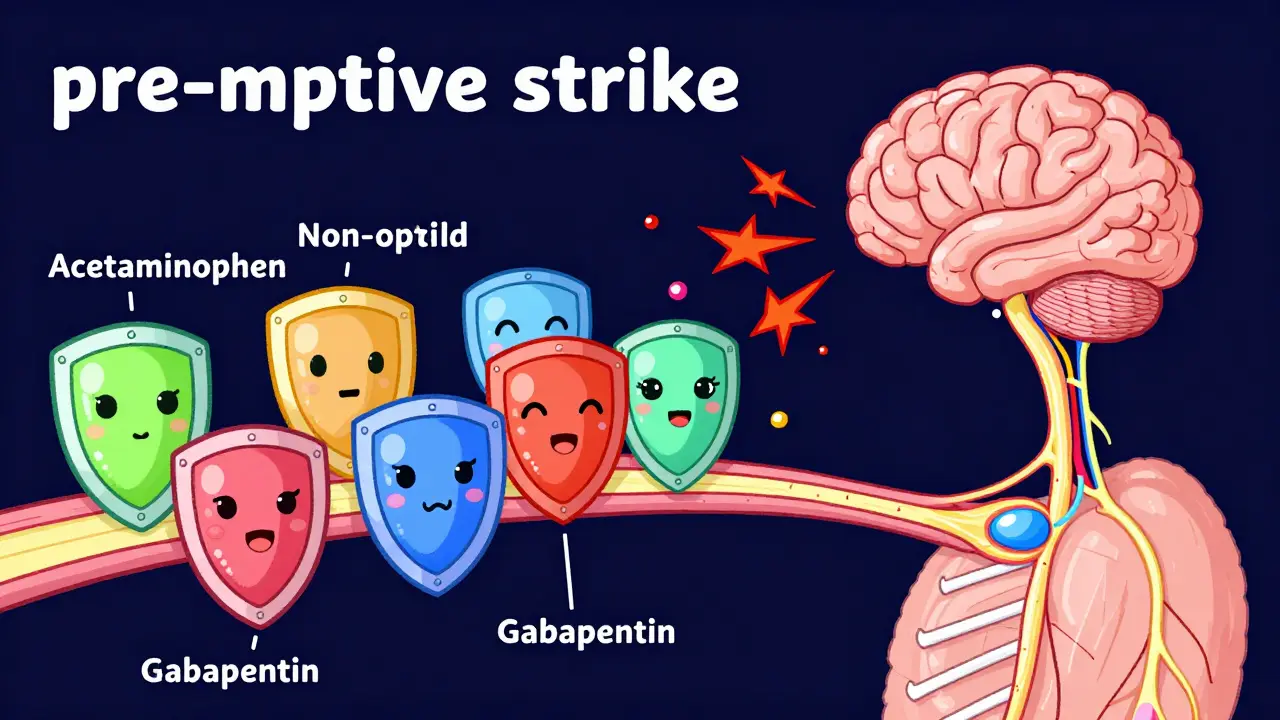
To see how this actually looks in a hospital, we can look at a typical high-intensity protocol, like those used for spine surgery. Instead of waiting for the patient to wake up and ask for meds, a "pre-emptive" strike is launched. This means giving medications *before* the first incision is even made.
A common approach involves a cocktail of non-opioid agents administered across three phases:
- Pre-operative: Patients might receive Acetaminophen (Tylenol) for general pain, Gabapentin to calm overactive nerves, and Celecoxib (a COX-2 inhibitor) to reduce inflammation.
- Intra-operative: While the patient is under, anesthesiologists may use Ketamine or Lidocaine infusions. These drugs don't just numb the area; they help prevent the "wind-up" effect where the nervous system becomes hypersensitive to pain.
- Post-operative: Scheduled doses of acetaminophen and NSAIDs continue, while opioids are kept in reserve, used only in small increments like 1-2mg of morphine IV when necessary.
| Feature | Opioid-Centric Approach | Multimodal Analgesia (MMA) |
|---|---|---|
| Primary Medication | High-dose opioids (e.g., PCA Morphine) | Combination of NSAIDs, Acetaminophen, Gabapentinoids |
| Opioid Consumption | High / Baseline | Reduced by 32% to 60% |
| Common Side Effects | Nausea, constipation, respiratory depression | Lower incidence of nausea (PONV) |
| Recovery Speed | Slower (due to sedation/bowel issues) | Faster (supports ERAS protocols) |
| Complexity | Simple (single drug path) | High (requires coordinated team effort) |
The Real-World Impact: Faster Recovery and Fewer Pills
Does this actually work, or is it just a trend? The data is quite striking. In studies involving over 1,200 patients, MMA protocols reduced total opioid use by 32% to 57% without sacrificing pain control. In some specific settings, like at Rush University Medical Center, doctors saw average daily morphine milligram equivalents (MME) drop from 45.2 to 18.7. That is a massive reduction in drug exposure for the patient.
Beyond the pharmacy bill, the impact on hospital stays is a huge win. For instance, trauma pain pathways at McGovern Medical School helped reduce the average hospital stay by nearly two days (from 7.2 to 5.4 days). Why? Because when you aren't fighting off opioid-induced nausea or waiting for your bowels to wake up after heavy narcotic use, you can get out of bed and start physical therapy much sooner. In some cases, same-day discharge rates jumped from 12% to 37%.
Tailoring the Strategy: High-Risk and Special Cases
Not every patient can follow a one-size-fits-all list. A critical part of the Enhanced Recovery After Surgery (ERAS) process is adjusting for the individual. For example, patients with a low eGFR (kidney function) below 30 mL/min cannot take naproxen, and their gabapentin dose must be slashed to 200mg once daily to avoid toxicity.
Then there are the high-risk patients: those already dependent on opioids, people with chronic pain syndromes, or those who explicitly request an "opioid-free" surgery. For these individuals, doctors lean more heavily on regional anesthesia. This might involve ultrasound-guided nerve blocks or continuous wound infusions of amide anesthetics. By numbing the specific nerve pathways leading to the surgical site, the brain never even receives the full intensity of the pain signal, making it far easier to manage the remaining discomfort with mild non-opioids.
The Logistics of a Team-Based Approach
If MMA is so effective, why isn't every single clinic doing it exactly the same way? Because it's hard to coordinate. An opioid-centric model is simple: the patient pushes a button on a pump, and they get a dose of morphine. MMA requires a synchronized dance between the surgeon, the anesthesiologist, the pharmacist, and the recovery nurses.
The coordination begins in the emergency department and continues through discharge. It requires specialized equipment, such as ultrasound machines for precision nerve blocks, and a commitment to rigorous documentation. Nurses must track pain scores every two hours for the first day to determine if the non-opioid baseline is working or if the "breakthrough" opioid dose needs to be adjusted. It is a shift from a reactive model (treating pain once it exists) to a proactive model (preventing pain before it starts).
Future Directions in Pain Management
Looking toward 2026 and beyond, the trend is moving toward even more extreme personalization. We are seeing a rise in the use of gabapentinoids for a short 5-to-10 day course after discharge. This isn't just about the immediate recovery; it's about preventing the transition from acute surgical pain to chronic, lifelong pain.
Experts like Dr. Edward R. Mariano suggest that we are essentially "resetting the bar" for what acceptable postoperative care looks like. The goal is a world where 85% of all major surgeries incorporate formal MMA protocols. By focusing on the biological pathways of pain rather than just masking them with narcotics, medicine is finally moving toward a safer, more human way to heal.
What is the main difference between traditional pain management and multimodal analgesia?
Traditional management often relies heavily on a single class of drug, usually opioids, to control pain. Multimodal analgesia (MMA) uses a combination of different medications-such as acetaminophen, NSAIDs, and nerve blocks-that work through different mechanisms. This allows for better pain control while using significantly lower doses of opioids, which reduces side effects like nausea and sedation.
Are opioids completely removed in an "opioid-sparing" strategy?
Not necessarily. "Opioid sparing" means reducing the total amount of opioids used. In most MMA protocols, opioids are still available but are reserved strictly for "breakthrough pain"-intense spikes of pain that non-opioid medications cannot manage-rather than being the primary source of relief.
Who should not use certain multimodal medications?
Certain medications in MMA are not safe for everyone. For example, naproxen and other NSAIDs are generally contraindicated for patients with severe kidney impairment (eGFR < 30 mL/min). Additionally, gabapentin dosages must be strictly adjusted for patients with renal issues to prevent toxicity.
How does MMA help patients get home from the hospital faster?
MMA reduces the common side effects of high-dose opioids, such as postoperative nausea, vomiting (PONV), and bowel dysfunction (ileus). When patients aren't dealing with these complications, they can mobilize sooner, eat normally, and meet discharge criteria much faster.
What are some non-drug components of these strategies?
While the focus is often on drugs, modern consensus principles include non-pharmacologic interventions. This includes patient education and counseling before surgery to set realistic expectations and the use of regional anesthesia techniques like nerve blocks that physically stop pain signals from reaching the brain.