
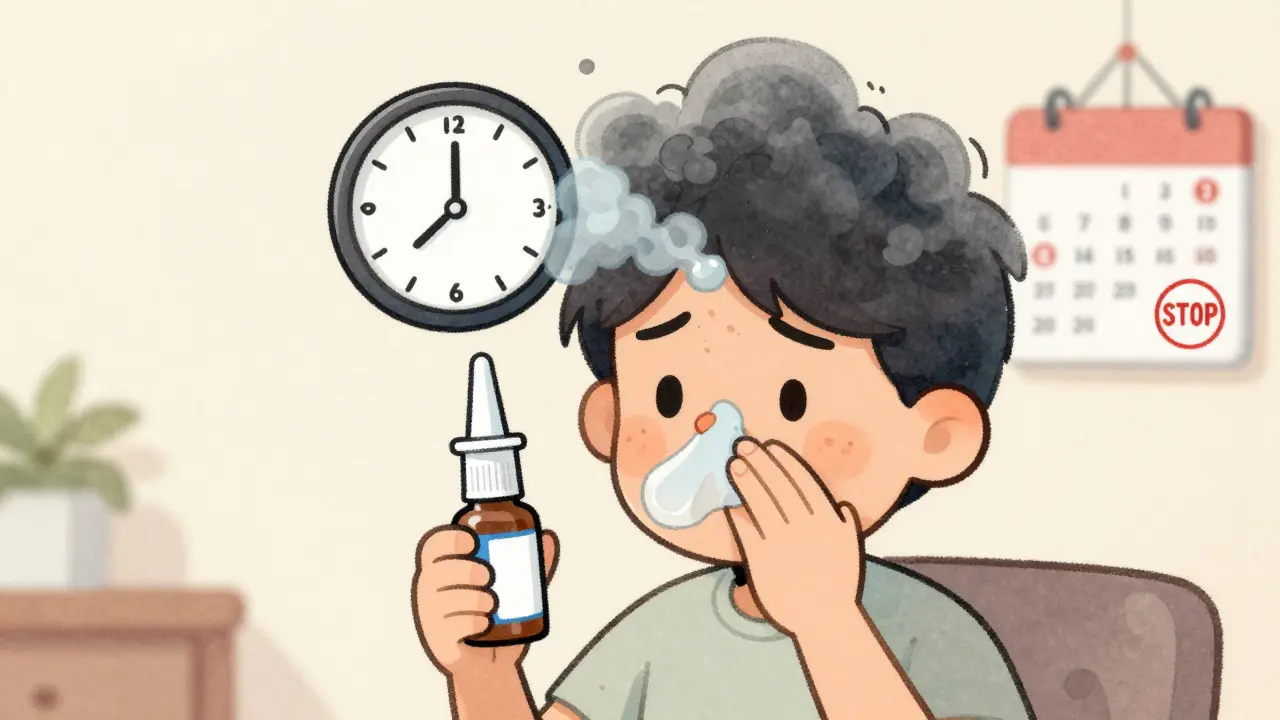
Most people reach for an OTC nasal spray the moment they feel stuffed up. It’s quick, it’s easy, and it works-fast. Within minutes, your nose opens up, your sinuses feel clearer, and you can breathe again. But here’s the catch: if you use it for more than three days, you might be setting yourself up for something worse than the original congestion. Welcome to rebound congestion.
What Is Rebound Congestion?
Rebound congestion, also known as rhinitis medicamentosa, isn’t just a bad cold coming back. It’s your body’s reaction to overusing nasal decongestant sprays. You use the spray, your nose clears, and you feel great. But when the effect wears off-usually within 8 to 12 hours-your nasal passages swell even more than before. So you spray again. And again. Soon, you’re using it six, eight, even ten times a day just to feel normal. That’s not relief. That’s dependence.This isn’t rare. About 1 to 2% of people who use these sprays regularly end up with it. And the worst part? Many don’t realize what’s happening. They think their allergies are getting worse, or they’ve caught another cold. But if your congestion gets worse after stopping the spray-or if it’s worse right before your next dose-that’s a red flag.
How Do These Sprays Work?
OTC nasal decongestant sprays like Afrin, Neo-Synephrine, and Otrivin contain active ingredients like oxymetazoline, phenylephrine, or xylometazoline. These are alpha-adrenergic agonists. In simple terms, they shrink the swollen blood vessels in your nose. That’s why you feel instant relief. The effect kicks in within 5 to 10 minutes and lasts up to 12 hours.But here’s the problem: your nasal tissues aren’t meant to be constricted for long. After three days of continuous use, your blood vessels start to lose their natural ability to regulate themselves. They become oversensitive. When the spray wears off, they don’t just return to normal-they overreact, swelling more than ever. That’s rebound congestion.
It’s not just about frequency-it’s about duration. Even if you stick to two sprays a day, using the spray for four or five days straight can trigger it. Some people see symptoms as early as day three. Others take a couple of weeks. But once it starts, it doesn’t go away just because you stop using the spray.
Who’s at Risk?
Anyone who uses OTC decongestant sprays beyond three days is at risk. But some people are more vulnerable:- People with chronic nasal congestion from allergies or sinus issues who use sprays as a long-term fix
- Those with high blood pressure, since these sprays can raise blood pressure slightly
- People who’ve used them before and had rebound congestion before-they’re more likely to get it again
- Anyone who doesn’t read the label
Here’s something surprising: the brand doesn’t matter. Afrin, store brands, or imported versions like Otrivin-they all contain the same active ingredients. The difference is just price and packaging. A $24 bottle of Afrin works the same as a $9 generic version. And they all carry the same risk.
What Happens When You Stop?
Stopping cold turkey is hard-and painful. When you quit, your nose doesn’t just clear up. It gets worse. For many, congestion peaks 48 to 72 hours after the last spray. You might feel like you’re suffocating. Some people report headaches, pressure behind the eyes, and even trouble sleeping.Rebound congestion can last anywhere from one to three weeks. In some cases, it drags on for six weeks if you don’t manage it right. The good news? Your nose will heal. But only if you stop the spray and give it time.
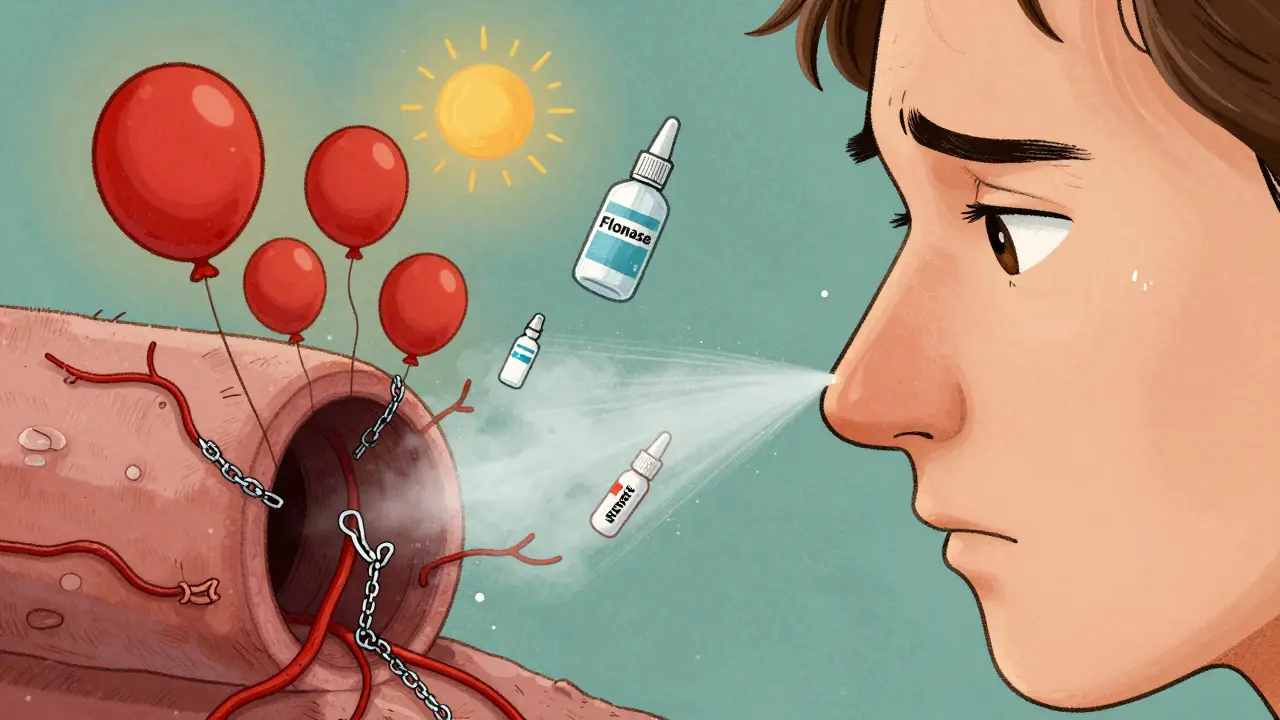
How to Break the Cycle
The key is not to quit cold turkey without a plan. Here’s what works:- Start a steroid nasal spray-like Flonase Sensimist or Nasacort-two days before you plan to stop the decongestant. These take 3 to 5 days to work, but they reduce inflammation without causing rebound. They’re safe for long-term use.
- Use saline spray or rinse-at least four times a day. Saline (salt water) doesn’t cure congestion, but it keeps your nasal passages moist, reduces irritation, and helps flush out mucus. NeilMed Sinus Rinse or simple store-brand saline sprays work fine.
- Taper slowly-don’t stop all at once. If you’re using the spray six times a day, cut back to four on day one, then three on day three, then two, then one. Space it out over 7 to 10 days.
- Use oral decongestants as a bridge-if you’re struggling, pseudoephedrine (Sudafed) can help. But be careful: it can raise blood pressure and cause jitteriness or insomnia. Don’t use it if you have heart problems or high blood pressure without checking with a doctor.
Most people feel better within 7 to 14 days if they follow this plan. Those who quit cold turkey without any support often take 3 to 6 weeks to recover-and that’s with no complications.
What to Use Instead
You don’t need to suffer. There are better, safer options for long-term relief:- Saline nasal sprays-no chemicals, no rebound, safe for daily use. Great for dryness, travel, or mild congestion.
- OTC steroid sprays-Flonase, Nasacort, and Rhinocort are now available without a prescription. They take a few days to work, but they treat the root cause of inflammation. Perfect for allergies or chronic congestion.
- Ipratropium bromide (Atrovent)-if your main problem is a runny nose (not stuffiness), this spray dries up excess mucus without causing rebound.
- Allergy control-if your congestion is allergy-related, avoiding triggers and using antihistamines (like loratadine or cetirizine) can help more than any spray.
Decongestant sprays are great for short-term relief-like during a cold or a sudden sinus flare-up. But they’re not meant for daily use. Think of them like a fire extinguisher: useful in an emergency, dangerous if you keep turning it on.
What the Labels Don’t Tell You
The FDA has required the warning “Do not use for more than 3 days” on these products since 2002. But here’s the truth: 38% of users still go past that limit. Why? Because the relief is so good, and the rebound doesn’t hit right away. People don’t connect the dots.Many assume that because it’s “over-the-counter,” it’s harmless. But just because you don’t need a prescription doesn’t mean it’s safe for long-term use. In fact, chronic misuse can lead to permanent damage-like thinning of the nasal lining or even a hole in the septum (the wall between your nostrils). That’s rare, but it happens.
Real Stories, Real Consequences
Online forums are full of people describing their “Afrin hell.” One Reddit user posted: “I used it for 10 days. When I stopped, I couldn’t breathe for three weeks. I cried every night.” Another wrote: “I thought my allergies were getting worse. Turns out, the spray was making me sick.”These aren’t exaggerations. A 2021 Healthline survey found that 28% of adults have experienced rebound congestion at least once. And 68% of those affected say it lasted 7 to 10 days after they stopped. For some, it took a doctor’s visit and prescription steroid sprays to get back to normal.
How to Use Them Safely
Here’s your simple, no-nonsense guide:- Use only when you really need it-like during a cold, flu, or acute sinus infection.
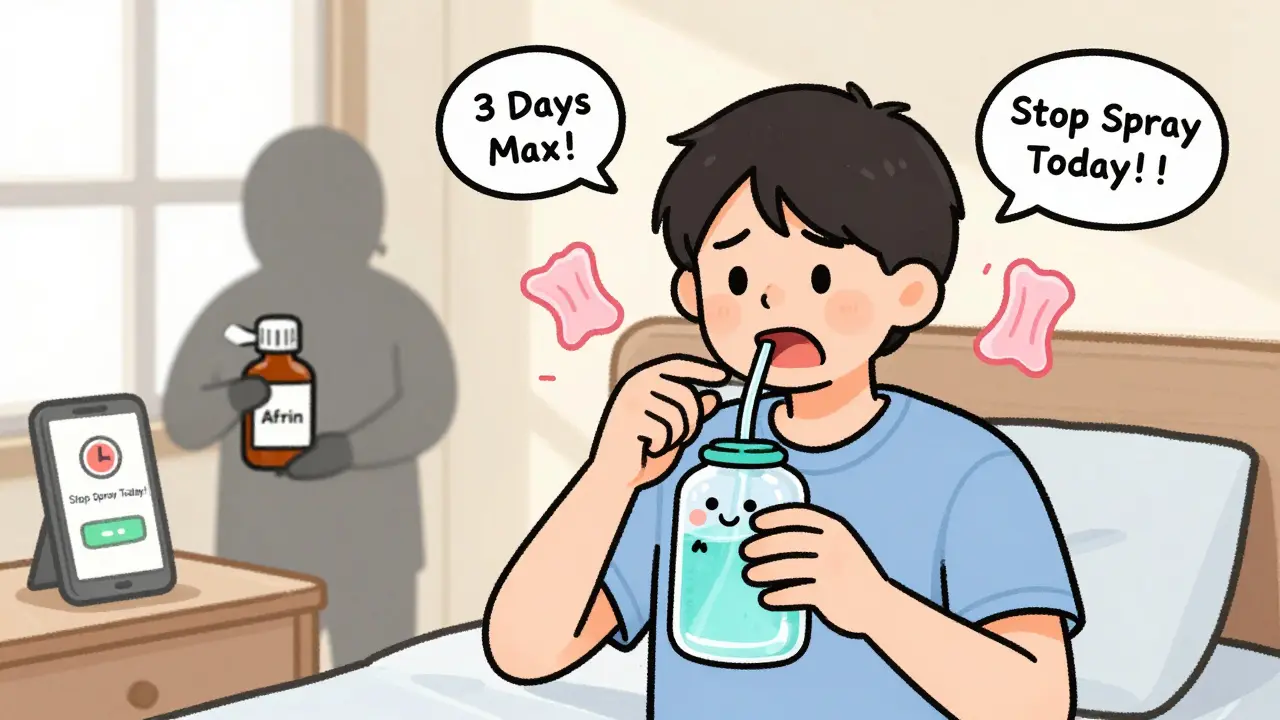
- Never use longer than 3 days-even if you still feel stuffed up.
- Use the lowest effective dose-one spray per nostril, once or twice a day. More doesn’t help.
- Set a reminder-put a note on your phone: “Stop spray on [date].”
- Have a backup plan-keep saline spray and Flonase on hand in case you need to stop early.
- Don’t share sprays-they can spread germs.
If you’ve been using a decongestant spray for more than a week, don’t panic. But do stop. Start saline rinses and a steroid spray. Give your nose time to reset. It will heal.
When to See a Doctor
You don’t need to see a doctor for every sniffle. But if you’ve had rebound congestion and it hasn’t improved after two weeks, or if you’re experiencing:- Bleeding from the nose
- Severe pain or pressure
- Loss of smell
- Yellow or green mucus with fever
Then it’s time to get checked. You might have a sinus infection, or worse-damage to your nasal lining. An ENT specialist can help you recover and prevent future problems.
OTC nasal sprays are powerful tools. But like any tool, they’re only safe when used the right way. Use them for three days, not three weeks. Your nose will thank you.
Can I use OTC nasal sprays every day for allergies?
No. OTC decongestant sprays like Afrin are not meant for daily use. They’re for short-term relief only-three days max. For allergies, use an OTC steroid nasal spray like Flonase or Nasacort instead. These work over several days to reduce inflammation and are safe for long-term use. Decongestant sprays make allergy symptoms worse over time.
How long does rebound congestion last?
Rebound congestion usually lasts 1 to 3 weeks after you stop the spray. If you quit cold turkey without support, it can last up to 6 weeks. Using saline sprays and steroid nasal sprays like Flonase can cut recovery time in half. Most people feel better within 7 to 14 days with proper management.
Is Afrin worse than other nasal sprays?
No. Afrin contains oxymetazoline, which is the same active ingredient found in store brands and other sprays like Otrivin. The brand doesn’t matter-only the ingredient and how long you use it. All decongestant sprays carry the same risk of rebound congestion after three days of use.
Can rebound congestion cause permanent damage?
Yes, in rare cases. Long-term, heavy use of decongestant sprays can thin the nasal lining, damage blood vessels, and even lead to a perforation (hole) in the septum. This is uncommon but serious. The risk increases with use beyond 6 months. Stopping early and using saline or steroid sprays prevents this.
Why do I feel worse after stopping the spray?
Your nasal blood vessels became dependent on the spray to stay constricted. When you stop, they overcompensate by swelling more than before. This is called rebound dilation. It’s not your allergies or a new infection-it’s your body reacting to the medication. It’s temporary, but it feels terrible. Saline rinses and steroid sprays help your nose reset.





Michael Burgess
January 3, 2026 AT 17:37I used Afrin for 10 days straight during a nasty cold and thought I was winning until I couldn’t breathe without it. 😅 When I finally quit? Pure hell. Felt like my nose was a deflated balloon stuffed with cotton. Saline rinses saved me-NeilMed, baby. Took 12 days to feel normal again. Never again. 🙏
Liam Tanner
January 3, 2026 AT 20:17For real, this is one of those things everyone needs to hear before they reach for the spray. I didn’t know rebound congestion was a thing until my doc told me I was addicted to oxymetazoline. Like, I thought I was just ‘allergic to life.’ Turns out I was allergic to my own nose. 🤦♂️
Palesa Makuru
January 4, 2026 AT 08:34Ugh. People really think OTC means ‘safe for life.’ I mean, have you seen the packaging? It literally says ‘3 DAYS MAX’ in bold. But nooo, ‘I’ll just use it a little longer.’ Classic American medical ignorance. 🙄 You wouldn’t take ibuprofen for 30 days straight-why is this different? Same active ingredient. Same risk. Same stupidity.
Hank Pannell
January 5, 2026 AT 23:55There’s a fascinating neurophysiological paradox here: the body’s homeostatic mechanisms, finely tuned over millennia to regulate vascular tone in nasal mucosa, are hijacked by synthetic alpha-agonists. The result? A pathological feedback loop where vasoconstriction becomes dependency, and vasodilation becomes perceived pathology. In essence, we’ve weaponized our own autonomic nervous system. It’s not just a nasal issue-it’s a metaphor for our relationship with quick fixes in modern life. We crave the chemical equilibrium, but refuse the metabolic cost of recalibration. The solution? Patience. And saline. Always saline.
Lori Jackson
January 7, 2026 AT 07:55Wow. Someone finally wrote this without sugarcoating it. I’ve been telling my friends for years: if you’re using nasal spray daily, you’re not treating allergies-you’re treating addiction. And no, Flonase isn’t ‘just as good.’ It’s better. It’s science. You’re not a victim of your sinuses-you’re a victim of your laziness. Stop spraying. Start thinking.
Wren Hamley
January 8, 2026 AT 05:04My dad used Otrivin for 8 months. I found him crying in the bathroom one night because he couldn’t breathe. He thought it was his allergies. Turned out his septum was thinning. We had to get him an ENT. He’s fine now, but he’ll never use decongestants again. If you’re reading this and you’re on day 4… stop. Right now. Go rinse with salt water. Your nose will hate you at first… but it’ll thank you later.
Sarah Little
January 8, 2026 AT 16:49Did you know oxymetazoline has a half-life of 8 hours? That’s why you feel the rebound at the 8–12 hour mark. It’s not your body ‘getting worse’-it’s the drug wearing off and your receptors being hypersensitive. That’s pharmacology 101. If you don’t know this, you shouldn’t be self-medicating. Just saying.
innocent massawe
January 9, 2026 AT 19:07I live in Nigeria and we don’t have Afrin here, but my cousin in the US told me this story. I didn’t believe it until I saw her face after she stopped. She looked like she’d lost a war. I told her: ‘Your nose is not your enemy.’ Saline spray now. Always. 🌿
veronica guillen giles
January 11, 2026 AT 16:43Oh, so now we’re treating nasal sprays like crack cocaine? Next you’ll tell me I shouldn’t use Advil for my headache. Chill. Some people need relief. Not everyone has time to wait 5 days for Flonase to work. Maybe your nose is fine. Mine isn’t. 😘
Ian Ring
January 12, 2026 AT 00:30Thank you for this. I’m British, and we don’t have ‘Afrin’ here-but we have the same stuff under different names. I used it for 6 days last winter. Didn’t realize until I tried to stop. I cried. Literally. Saline rinse + Flonase = saved my life. I now keep a note on my mirror: ‘3 DAYS. NO EXCEPTIONS.’
Tru Vista
January 12, 2026 AT 12:42Rebound congestion? Sounds like a made-up term. Probably just bad allergies. And Flonase is overrated. Just blow your nose.