
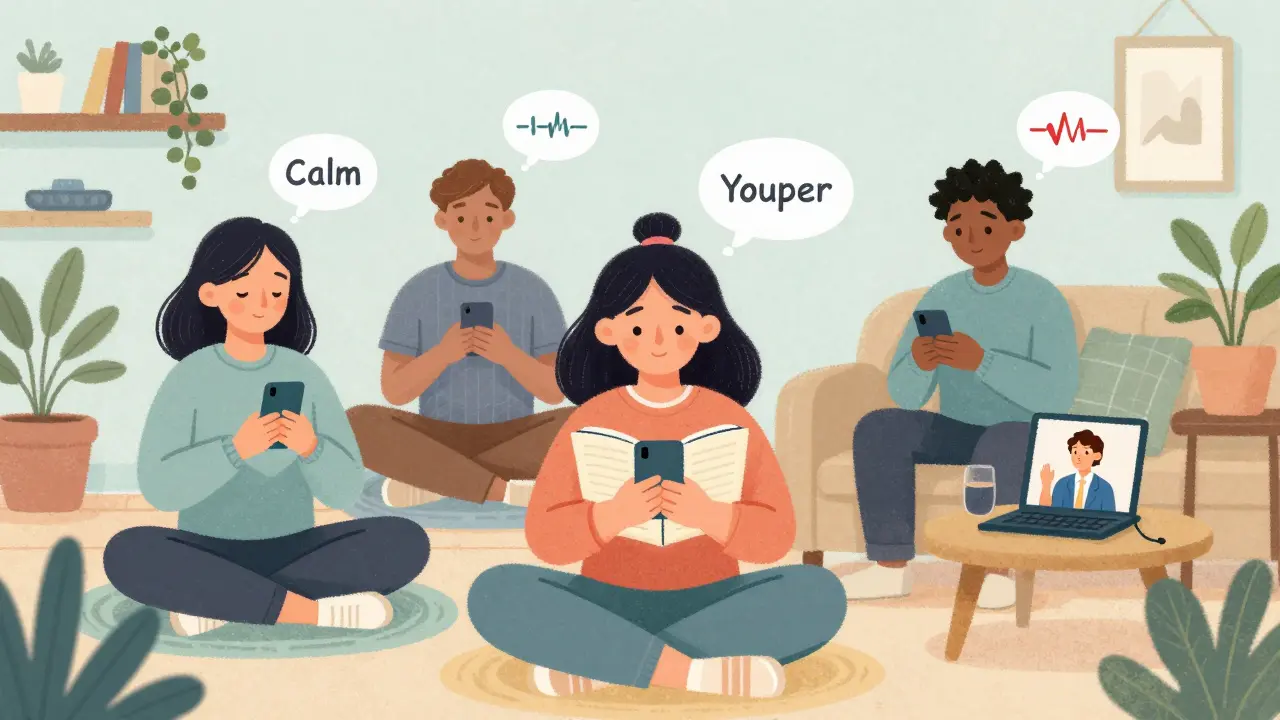
More people are using apps and online therapy than ever before. In 2024, the global market for mental health apps hit $7.48 billion-and it’s expected to nearly double by 2030. That’s not just a trend. It’s a shift in how people get help for anxiety, depression, and stress. But behind the convenience lies a complicated reality: not all apps work, and many put your data at risk.
What’s Actually in These Apps?
Mental health apps aren’t all the same. Some are simple mood trackers. Others use AI to simulate therapy sessions. Calm and Headspace lead the mindfulness space, with over 100 million and 65 million downloads respectively. They offer guided meditations, sleep stories, and breathing exercises. Simple? Yes. Effective? For some, yes-but only if you stick with them. Then there are clinical-grade tools like Wysa and Youper. These aren’t just calming tools. They use cognitive behavioral therapy (CBT) techniques to challenge negative thoughts. Wysa has been tested in 14 clinical studies. Youper has published 7 peer-reviewed papers. That matters. Most apps don’t have any real research backing them. In Germany, things are different. The government approves certain apps as DiGA (Digitale Gesundheitsanwendungen). These aren’t just sold in app stores-they can be prescribed by doctors and covered by public insurance. Nearly half of all approved DiGA apps target mental health, and a quarter are specifically for depression. That’s a model other countries are watching closely.Teletherapy: Therapy in Your Living Room
Teletherapy platforms like BetterHelp and Talkspace connect you with licensed therapists via text, video, or phone. It’s convenient. No commute. No waiting rooms. But it’s not cheap. Most charge $60 to $90 per week for full access. That’s more than some people pay for rent. Users say the therapist matching system works well-78% of positive reviews mention it. But cost is the biggest complaint. Sixty-three percent of negative reviews on Trustpilot cite subscription fees as the reason they quit. And you’re locked in. Canceling isn’t always easy. Some platforms require you to call during business hours. Others bury the cancel button deep in settings. Hybrid models are starting to show better results. Combining self-guided app content with scheduled video sessions leads to 43% higher completion rates than using either method alone. That’s the future: not replacing therapy, but supporting it.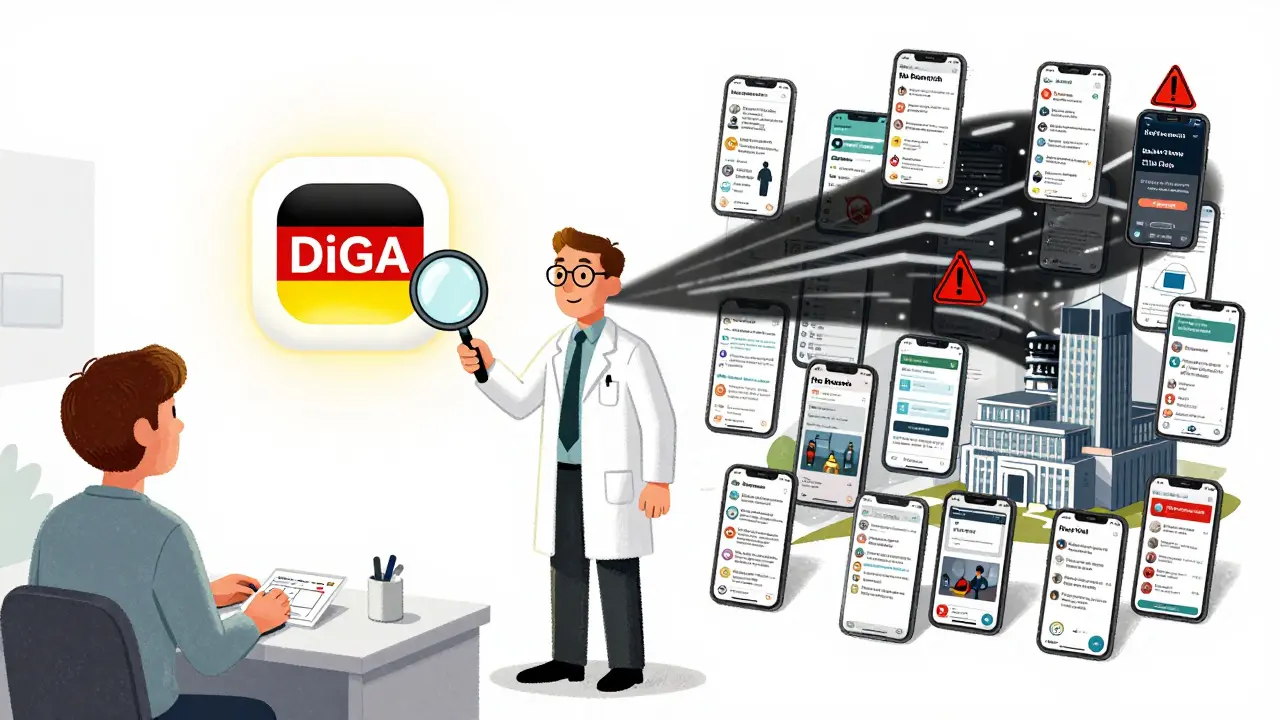
Privacy Risks You Can’t Ignore
You give these apps your mood logs, sleep patterns, journal entries, even voice recordings. Who owns that data? And who can see it? A 2025 review of 578 mental health apps found that 87% had serious privacy flaws. Some sell your data to advertisers. Others share it with third-party analytics companies. A few even store your information unencrypted. That’s not just a breach risk-it’s a safety risk. If someone with access to your data knows you’re struggling with depression, they could use it against you. Even apps that claim to be “anonymous” often collect device IDs, location data, and usage patterns. That’s enough to re-identify you. And if you’re using a workplace wellness program, your employer might get aggregated reports-sometimes even with enough detail to guess who’s struggling. Dr. Imogen Bell from Brown University warns that many apps create a false sense of security. “People think they’re getting help,” she says, “but they’re actually handing over sensitive data to companies with no medical oversight.”Why Most People Quit
You download an app. You use it for a week. Then you stop. You’re not alone. Studies show that only about 29% of young users complete a full digital mental health program. App fatigue is real. Too many notifications. Too many prompts. Too many upsells. Reddit user u/MindfulTechJourney said: “Downloaded five apps during lockdown. Stuck with Calm for three months. Then the free version became useless.” That’s common. Free versions often lock key features behind paywalls. You get a few meditations, then you’re stuck. And the apps don’t always adapt. If you’re having a bad week, most apps don’t notice. They don’t adjust their content. They just keep sending the same meditation on loop. No personalization. No empathy.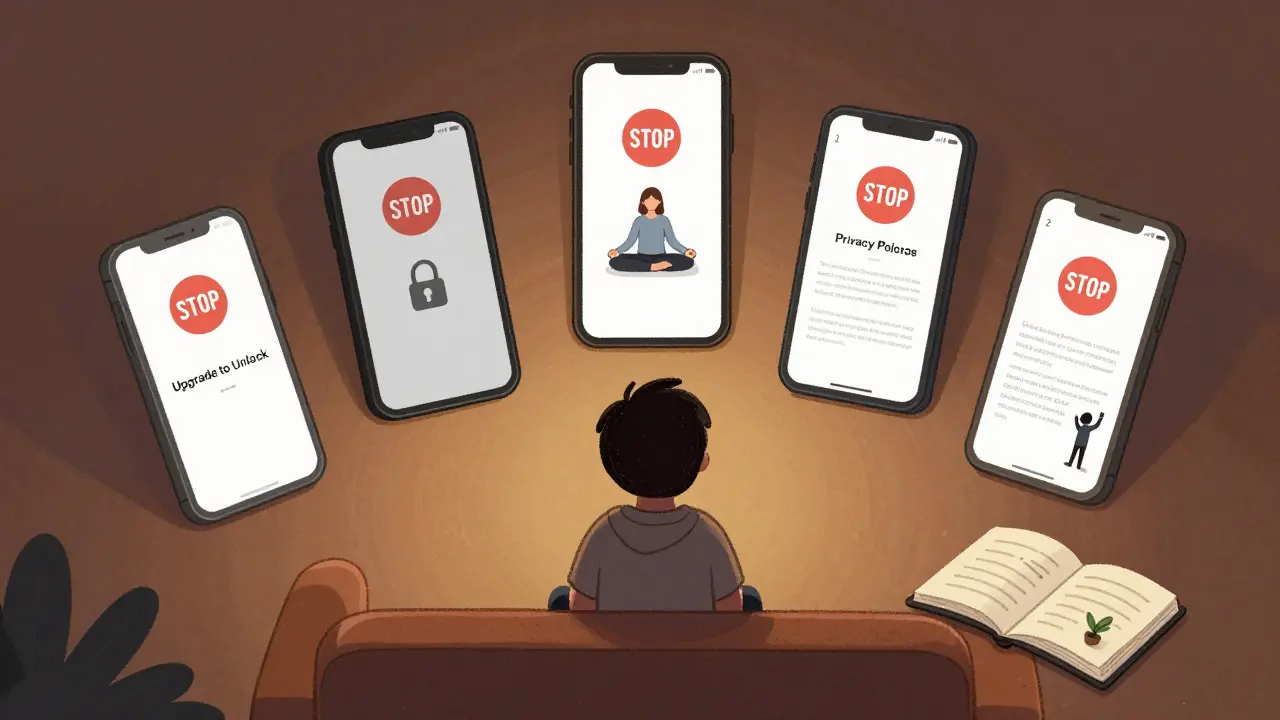
What to Look For (and What to Avoid)
Not all apps are created equal. Here’s how to pick one that actually helps:- Check for clinical validation. Look for apps that cite peer-reviewed studies. If the website doesn’t mention research, be skeptical.
- Read the privacy policy. Does it say they sell your data? Avoid it. Look for apps that say they don’t share identifiable information with third parties.
- Look for transparency. Who built this? Are the developers licensed mental health professionals? Or is it a tech startup with no clinical background?
- Try the free version first. Don’t pay upfront. See if the interface feels intuitive. Does it feel helpful-or like a sales pitch?
- Watch for red flags. If an app promises to “cure” depression or says you don’t need a therapist, walk away. Mental health isn’t a quick fix.
The Bigger Picture
Digital tools aren’t replacing therapists. They’re filling gaps. For people who can’t afford therapy, live in rural areas, or feel too ashamed to walk into a clinic, these apps are lifelines. But they’re not magic. The best outcomes happen when digital tools are part of a larger system. In Germany, DiGA apps are prescribed alongside in-person care. In the U.S., some employers are starting to bundle apps with access to counselors. That’s the model that works. By 2027, experts predict 65% of mental health apps will have direct referral paths to real therapists. That’s progress. But it won’t happen unless users demand better standards-and regulators enforce them. Right now, the market is a wild west. Thousands of apps. Few rules. And millions of people trusting them with their most private thoughts. The question isn’t whether digital mental health is here. It’s whether we’re ready to protect the people using it.Are mental health apps actually effective?
Some are, but most aren’t. Apps with clinical validation-like Wysa or DiGA-approved tools in Germany-have shown measurable benefits for anxiety and depression. But many apps are just guided meditations or mood trackers with no real therapeutic backing. Studies show only about 29% of users complete digital mental health programs, and app fatigue is a major reason why. Effectiveness depends on the app’s design, clinical evidence, and whether it adapts to your needs.
Can teletherapy replace in-person therapy?
For many people, teletherapy is a great alternative, especially if access to local therapists is limited or stigma is a barrier. But it’s not a full replacement. Complex cases, crisis situations, or severe disorders often require in-person care. Hybrid models-combining app-based tools with scheduled video sessions-show the best results, with 43% higher completion rates than fully digital or fully in-person approaches.
Do mental health apps protect my privacy?
Not always. A 2025 review found that 87% of mental health apps had serious privacy vulnerabilities. Many sell user data to advertisers, share it with analytics firms, or store it insecurely. Even apps that claim to be anonymous can be traced through device IDs and usage patterns. Always read the privacy policy. Avoid apps that don’t clearly say they won’t share identifiable data.
Why are mental health apps so expensive?
Many platforms use tiered pricing to push users toward premium subscriptions. Basic features are free, but access to licensed therapists, personalized plans, or advanced tools requires weekly payments of $60-$90. This model works for companies but creates barriers for low-income users. In contrast, Germany’s DiGA system allows approved apps to be prescribed and reimbursed through public health insurance-making them affordable and accessible.
How do I know if an app is legit?
Look for three things: clinical studies published in peer-reviewed journals, transparent ownership (is it built by clinicians or a tech startup?), and a clear privacy policy that says they don’t sell your data. Avoid apps that promise quick fixes or claim to “cure” mental illness. Legit apps support, not replace, professional care. Check if it’s approved by a health authority, like Germany’s DiGA list or the UK’s NHS app library.
Are mental health apps regulated?
In most countries, very little. The U.S. and Canada have minimal oversight for mental health apps unless they claim to diagnose or treat disease. Germany is the exception-its DiGA program requires clinical proof and regulatory approval before an app can be prescribed. Other countries are starting to follow. Without regulation, anyone can build an app and claim it helps with anxiety. That’s why user reviews and independent research are your best tools for judging quality.


Margaret Khaemba
January 22, 2026 AT 22:15I’ve used Wysa for anxiety and it actually helped me notice patterns I never saw before. Not magic, but it made me feel less alone. The thing is, most apps don’t adapt-they just ping you the same meditation every day like a broken record. I quit after two weeks because it felt robotic. But if they could read my mood and shift content? That’d be huge.
Malik Ronquillo
January 23, 2026 AT 05:56These apps are a joke. People think typing ‘I feel sad’ to a bot counts as therapy? Wake up. You’re handing your trauma to some Silicon Valley startup that sells your data to advertisers. I’ve seen it. My cousin used one of those ‘AI therapists’ and got targeted ads for antidepressants the next day. No thanks.
Alec Amiri
January 24, 2026 AT 20:12Let’s be real-90% of these apps are garbage. They’re not therapy. They’re digital crack. You get a little dopamine hit from a guided breath, then you’re back to scrolling. And the privacy? LOL. They’re logging your voice, your location, your sleep cycles-then selling it to the highest bidder. If you’re using one of these, you’re not healing. You’re being mined.
Lana Kabulova
January 25, 2026 AT 11:45Why is no one talking about the fact that most apps are designed by people who’ve never had depression? They think ‘mindfulness’ is a fix-all. I’ve been in therapy for five years. I know what works. These apps? They’re glorified alarm clocks with soothing voices. And the pricing? $90 a week? For what? A bot that says ‘I hear you’? No. Just no.
Ryan Riesterer
January 27, 2026 AT 10:53Empirical data suggests that apps with CBT integration and peer-reviewed validation exhibit statistically significant improvements in PHQ-9 and GAD-7 scores. The DiGA model in Germany represents a regulatory paradigm shift. In contrast, U.S. market fragmentation lacks clinical governance, resulting in high attrition rates and data exploitation risks. Hybrid modalities demonstrate superior adherence metrics.
Akriti Jain
January 29, 2026 AT 04:20Big Tech is watching you cry 😅📱 They’re not here to help-they’re here to sell you more ads, more subscriptions, more anxiety. Next thing you know, your employer gets a report that says ‘user 7342: high stress, low sleep.’ And then… poof. You’re ‘restructuring.’ 😈 #DigitalDystopia
Mike P
January 29, 2026 AT 08:14Germany’s got it right. We’re stuck with billionaires making apps that cost more than our rent while real doctors are in short supply. Why isn’t the U.S. doing this? Because profit > people. If you’re not getting your mental health covered by insurance, you’re being left behind. This isn’t innovation-it’s exploitation dressed up as progress.
Liberty C
January 30, 2026 AT 05:57It’s almost poetic how we’ve outsourced our emotional labor to algorithms. We hand over our most vulnerable thoughts to faceless corporations who couldn’t tell a panic attack from a bad day. And we call it ‘self-care.’ How quaint. How tragic. How utterly bourgeois.
Hilary Miller
January 30, 2026 AT 22:11Used Calm for a year. Quit because it stopped feeling helpful. Just noise.
Keith Helm
January 31, 2026 AT 11:25It is imperative that users exercise due diligence when selecting digital mental health platforms. The absence of regulatory oversight in the United States constitutes a significant public health vulnerability. One must prioritize applications with demonstrable clinical efficacy and transparent data governance protocols.
Daphne Mallari - Tolentino
February 2, 2026 AT 10:17One cannot help but observe the commodification of human suffering under the guise of technological advancement. The notion that a smartphone application can replicate the nuanced therapeutic alliance is not merely naïve-it is ethically indefensible.
Rob Sims
February 4, 2026 AT 03:57LOL at people paying $90/week for an app that says ‘you’re not alone’-while the company makes millions off your data. I’ve seen the inside of a therapist’s office. It’s not a chatbot. It’s a person who remembers your dog’s name and calls you out when you’re BSing. That’s therapy. Not this crap.
Chiraghuddin Qureshi
February 5, 2026 AT 08:31India has 1 psychiatrist per 100k people. So yeah, apps are a lifeline here. Not perfect? No. But better than nothing. My cousin used a free CBT app and finally talked to a real doc. That’s progress. Don’t hate the tool-fix the system.
Patrick Roth
February 5, 2026 AT 11:31Wait-so Germany lets doctors prescribe apps? That’s insane. Next they’ll prescribe TikTok for PTSD. Why not just give everyone a Netflix subscription and call it a day? This is what happens when bureaucrats think tech is medicine. You want real help? Go see a human. Not a bot that says ‘I’m here for you’ while selling your data.
Lauren Wall
February 6, 2026 AT 00:31My employer pushed us to use one of these apps. Then they got a report saying ‘high stress levels in team X.’ Guess who got ‘restructured’? Yeah. So don’t trust them. Not even the ‘free’ ones.