
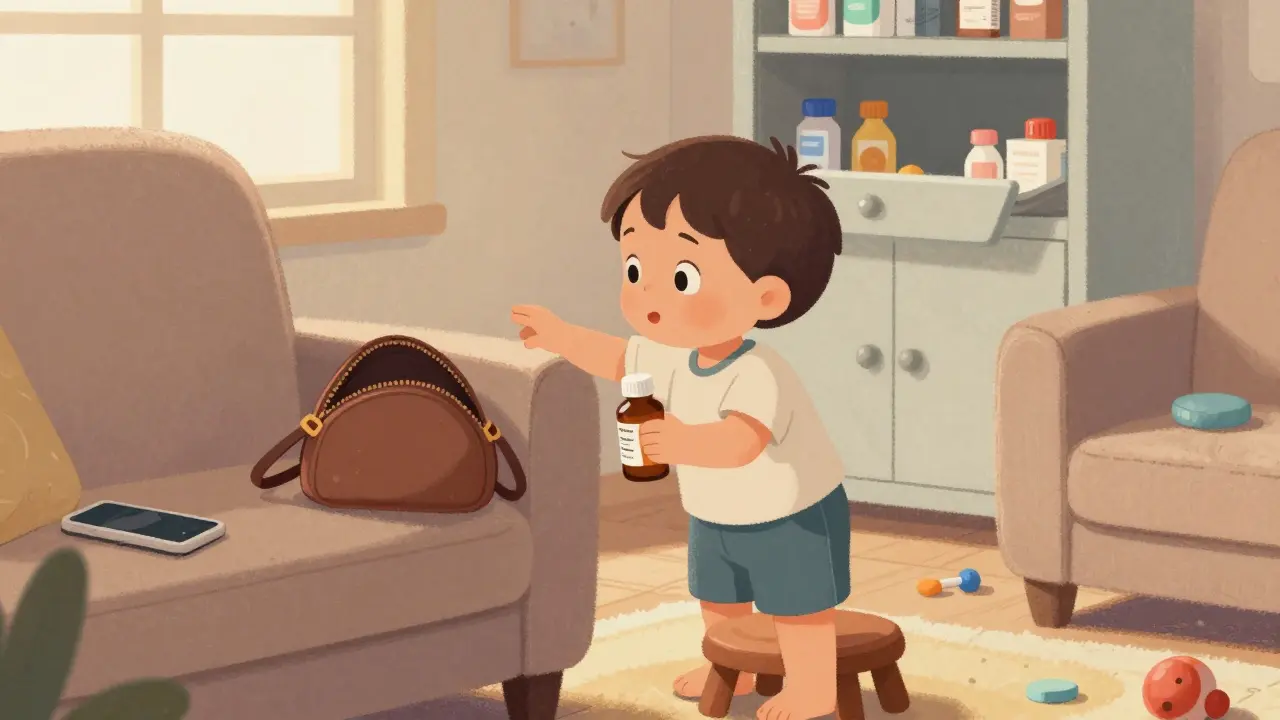
Every year, thousands of toddlers and young children end up in emergency rooms because they got into medicine they weren’t supposed to. It’s not because parents are careless-it’s because medication poisoning happens in split seconds, often when no one is looking. A child climbs onto a stool, reaches into a purse left on the couch, or finds a bottle that looks like candy. And in that moment, everything changes.
In Australia, as in the U.S. and elsewhere, the majority of these incidents happen at home. And the most dangerous part? Most of them are preventable. You don’t need expensive gadgets or perfect memory. You just need to change a few habits-and know what to look for.
Where Poisoning Happens (And Why It’s Not Where You Think)
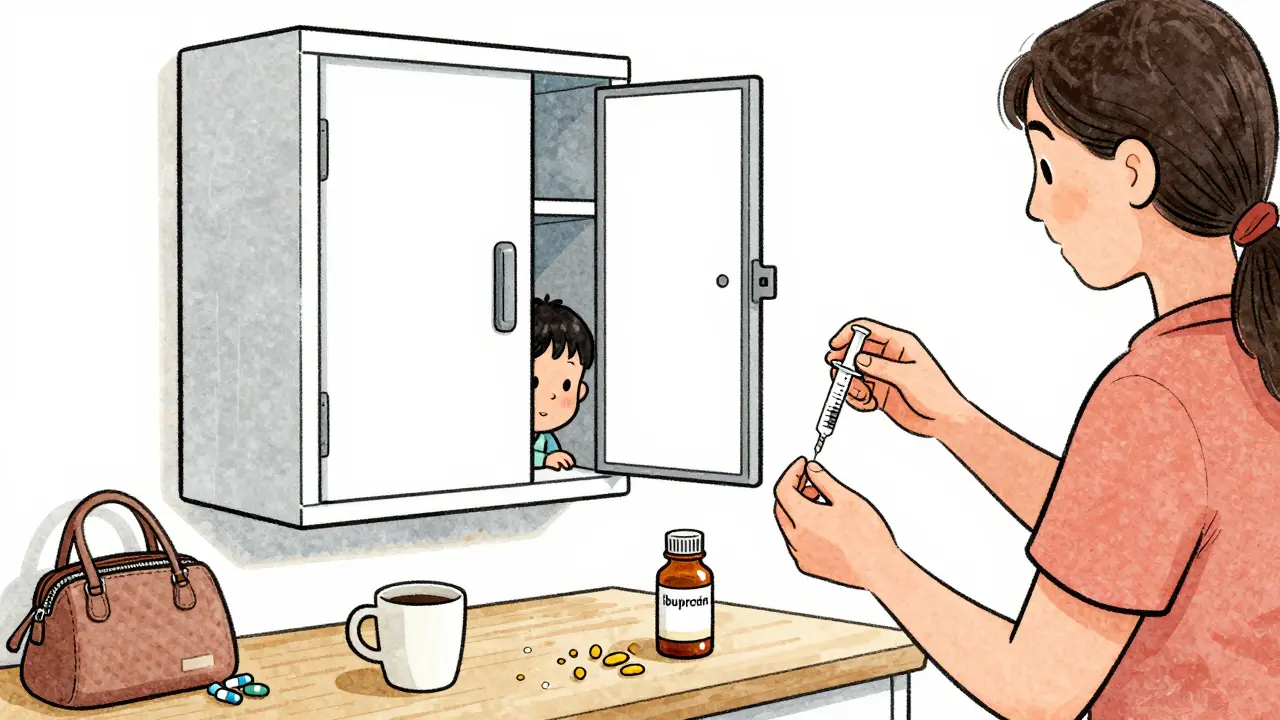
Most people assume medicine is safe if it’s up high. But toddlers can climb. By 18 months, many kids can pull themselves up on furniture, use chairs as ladders, and reach countertops. A 2022 study from Nationwide Children’s Hospital found that 78% of poisoning incidents involved medicines stored below 4 feet-right at a toddler’s eye level.
And it’s not just your medicine cabinet. Thirty percent of exposures come from visitors’ belongings. Grandparents leave pills in their purse. Aunts forget their inhaler on the coffee table. Even a bottle of children’s ibuprofen left on the bathroom counter while you run the bath can be enough.
One mother in Sydney told me her 2-year-old got into a bottle of acetaminophen she’d set down while answering the door. She didn’t think it was a big deal-it was just one dose. But by the time she noticed the empty bottle, her child was already drowsy. That’s the problem: you don’t get a warning.
What Medicines Are Most Dangerous?
Not all pills are equal. The most common culprits in poisonings are over-the-counter meds that seem harmless:
- Acetaminophen (Tylenol) - Even a small overdose can cause liver failure.
- Ibuprofen (Advil, Motrin) - Can lead to stomach bleeding or kidney damage.
- Aspirin - Risk of Reye’s syndrome in children under 12.
- Antihistamines (Benadryl) - Can cause extreme drowsiness, seizures, or coma.
- Liquid nicotine (e-cigarette fluid) - As little as 0.5 mL can be fatal to a toddler.
These aren’t rare cases. In the U.S., analgesics like acetaminophen and ibuprofen made up over 30% of all childhood poisonings in 2023. And it’s not just pills-liquid forms are especially dangerous because they look like juice or candy.
Stop Relying on Child-Resistant Caps
You’ve seen them. The ones that click, twist, or require two hands. They’re called “child-resistant,” not “childproof.” And there’s a big difference.
Studies show that 85% of toddlers can open these caps within 5 minutes if they’re determined. One 2022 UCSF study found kids as young as 15 months learned how to pop them open after watching a parent do it once.
So don’t depend on the cap. Don’t even think about it as your main defense. It’s a backup. The real protection? Locked storage.
Lock It Up-For Real
The single most effective step you can take? Put all medications in a locked cabinet. Not just “out of reach.” Not just “on the top shelf.” Locked.
Use magnetic locks that automatically engage when the door closes. Install them at least 54 inches above the floor-higher than most toddlers can reach, even with climbing. And make sure every room has one: bathroom, kitchen, bedroom, even the guest room.
Here’s a simple test: Get down on your hands and knees. Look around the room like a 2-year-old would. Can they see a bottle? Can they reach it? If yes, it’s not safe.
Some pharmacies in Sydney now offer free lock boxes for families with toddlers. These are small, sturdy containers with keypads or keys. One 2022 program saw a 41% drop in accidental exposures among families who used them.
Never, Ever Call Medicine “Candy”
This one sounds obvious-but it happens more than you think.
“This will taste like grape juice.” “I’ll give you a sweet for your ear.” “Here’s your medicine candy.”
A 2021 analysis from the American Academy of Pediatrics found that kids who were told medicine was candy were 3.2 times more likely to take it without asking. They don’t just confuse it-they actively seek it out.
Even if you’re joking, the message sticks. Say “medicine” every time. Be clear. Be serious. It’s not a treat. It’s not a game. It’s a tool-and it can be deadly if used wrong.
Measure Right-No Kitchen Spoons
One in two dosing mistakes happens because parents use kitchen spoons. A teaspoon isn’t a teaspoon. Your spoon might hold 4 mL. Mine might hold 6. The one from the pharmacy? Exactly 5 mL.
Studies show household spoons vary by 20-40% in volume. That means a child could get half a dose-or double it-just because you used a spoon.
Always use the measuring tool that comes with the medicine: a syringe, a dosing cup, or a dropper with milliliter markings. Keep it with the bottle. And never guess.
Watch Out for Visitors and Changes in Routine
Medication poisonings spike during holidays, visits, and travel. Why? Because routines break.
Grandparents don’t know your rules. Visitors leave pills in their bags. A new babysitter doesn’t know where you store medicine. A trip to the beach means leaving meds in a cooler or beach bag.
Here’s what works: Before anyone comes over, say this: “We’ve got a toddler at home. Could you please keep your pills and vitamins in your bag or car?” Most people will understand. And if they don’t? Bring a lock box with you.
Also, anticipate growth. If your child is starting to climb, secure the medicine cabinet before they start scaling the couch. Don’t wait for the accident.
Know What to Do in an Emergency
If you think your child swallowed medicine-don’t wait. Don’t call your pediatrician first. Don’t Google symptoms.
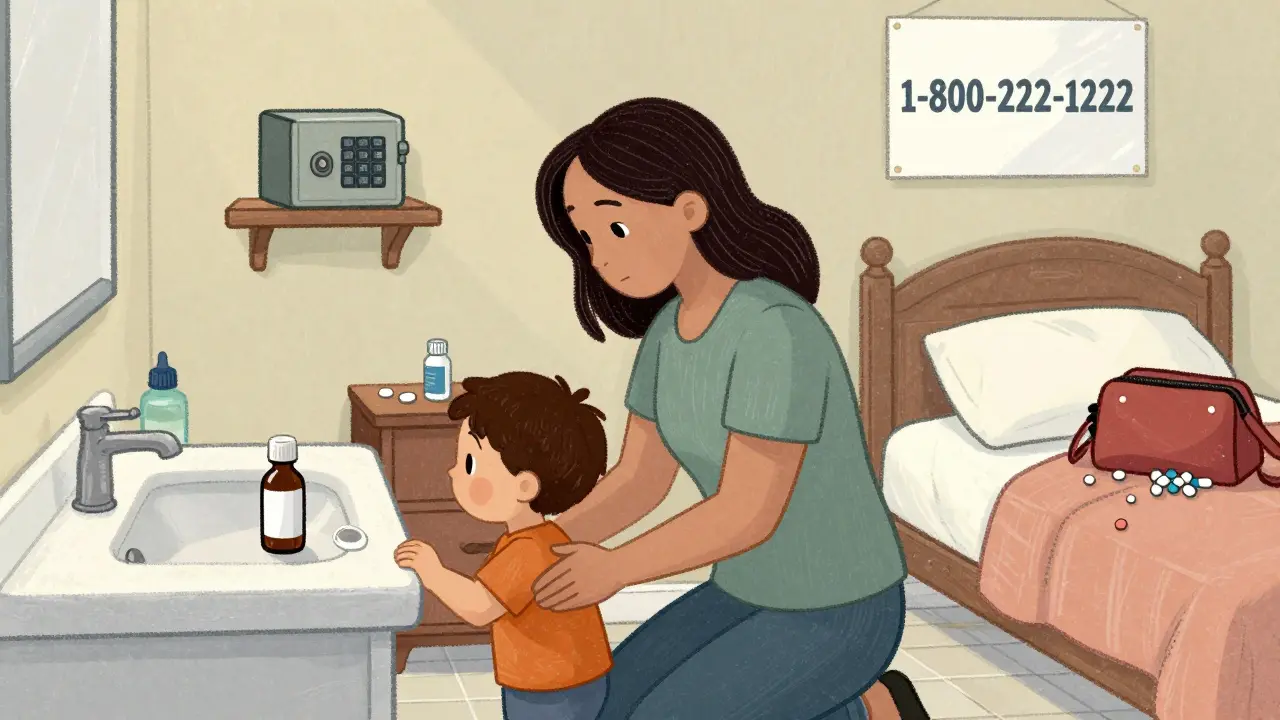
Call Poison Control immediately: 1-800-222-1222. It’s free. It’s available 24/7. And they’ll tell you exactly what to do.
Most poisonings don’t need an ER visit. But they need expert advice-fast. Studies show that calling within 5 minutes improves outcomes by 89%.
Post the number on your fridge, your bathroom mirror, and your phone. Teach older siblings what to do. Practice the call like you’d practice fire drills.
And if your child is unresponsive, not breathing, or having seizures-call 000 (Australia’s emergency number) immediately. While you wait, start CPR if you’ve been trained. Even basic training can save a life.
What About Smart Medicine Containers?
There’s new tech on the horizon. Smart pill bottles that send alerts to your phone if they’re opened. Caps that track when they were last used. Some pilot programs in the U.S. showed a 63% drop in unsupervised access.
But right now? You don’t need tech. You need habits.
Locking, measuring, storing, and knowing the emergency number-that’s the real solution. It’s not glamorous. But it works.
Final Checklist: 5 Things to Do Today
- Lock all medicine in a cabinet with magnetic locks-at least 54 inches high.
- Remove all pills from purses, bags, nightstands, and coat pockets.
- Use only dosing tools that show milliliters-no spoons.
- Post Poison Control’s number (1-800-222-1222) in every room.
- Never say “candy” when giving medicine-say “medicine” every time.
These aren’t extra steps. They’re your family’s safety net. And they take less than 10 minutes to set up.
Lyle Whyatt
February 11, 2026 AT 04:50Man, I read this and immediately checked my own bathroom cabinet. Turns out, my kid’s been climbing onto the sink since he turned 18 months and I had a whole bottle of children’s melatonin right there next to the toothpaste. No joke-this article saved us. I just installed magnetic locks on every cabinet in the house. Even the one in the guest room. Yeah, I know, sounds extreme. But last week, my nephew came over with his grandma’s blood pressure pills in his jacket pocket. I didn’t say a word. I just quietly moved everything into the locked box. No drama. No yelling. Just safety. And now? I sleep better.
Also, I never realized how often visitors leave meds lying around. My sister-in-law brought her antidepressants in a purse last Christmas. My kid pulled it out like it was a toy. I thought she was joking. She wasn’t. Now I ask everyone before they come over: ‘Pills in your bag or car?’ It’s awkward, but it’s better than an ER visit.
And PLEASE stop calling medicine candy. I used to say ‘Here’s your grape medicine candy’ to get my daughter to take her antibiotics. I didn’t think it mattered. Turns out, she started opening every bottle in the house looking for ‘grape candy.’ We caught her with a bottle of Benadryl. She was grinning. I was in tears. Never again. Say ‘medicine.’ Every. Single. Time.
Lock it. Measure it. Know the number. It’s not about being paranoid. It’s about being responsible. And if you’re not doing this? You’re gambling with your child’s life. No one wants to be the parent who finds out too late.
I’m not a doctor. I’m just a dad who got lucky. Please, do this. For your kid. For yourself. For the rest of us who’ve been there.
PS: Sydney Pharmacists are giving away free lock boxes. Go get one. It’s like a baby car seat for your meds. You don’t need it until you do. Then you’re glad you had it.
Ken Cooper
February 11, 2026 AT 11:47soooo… i just locked my meds in the kitchen cabinet… but my 2yo can reach the handle now 😬
also, i use a spoon for liquid ibuprofen bc the dosing cup is always in the laundry… oops
and yeah, i call it 'sugar pills' bc she thinks its candy… wait… nooo
im gonna fix this today. promise. i just need to stop being lazy. and maybe stop leaving my purse on the couch. again. again. again.
MANI V
February 12, 2026 AT 00:10It's not the medicine that's dangerous-it's the parents. You let your child climb on furniture? You leave pills in purses? You call medicine 'candy'? This isn't an accident-it's negligence dressed up as 'I'm too busy.'
Every child who ingests medication is a failure of parenting. Not a statistic. Not a tragedy. A direct result of laziness, distraction, and misplaced trust in 'child-resistant' caps that exist only to make you feel better about your carelessness.
There are countries where parents don't leave medicine lying around. Where children aren't allowed to roam unsupervised. Where 'I didn't think' isn't an excuse. Maybe if you stopped treating your home like a daycare and started treating it like a home, this wouldn't be an issue.
Lock it. Don't ask. Don't hope. Don't wait. If you can't do this, don't have kids. Simple as that.
Andrew Jackson
February 13, 2026 AT 15:57The notion that accidental poisoning is preventable through mere 'habits' is an affront to the foundational principles of personal responsibility. One cannot outsource safety to magnetic locks or poison control hotlines; one must cultivate an environment of disciplined vigilance, wherein the home becomes an extension of the moral order.
It is not sufficient to 'lock' medicine; one must internalize the gravity of its presence. The child who consumes medication does so not because of negligence, but because the parent has failed to instill the proper reverence for authority, structure, and consequence. The fact that we have reduced this to a checklist-'lock it, measure it, post the number'-is symptomatic of a culture that confuses procedure with virtue.
Moreover, to suggest that 'child-resistant' caps are inadequate is to concede defeat to infantile curiosity. A properly raised child does not seek out pills. A properly raised child understands that medicine is not a toy, not a game, not a mystery to be solved. The fault lies not in the cap, but in the character of the parent who permits such behavior to develop.
Let us not mistake convenience for safety. Let us not mistake technology for morality. Let us return to the discipline of vigilance, not the convenience of locks.
John Sonnenberg
February 14, 2026 AT 11:44I just read this and my heart stopped. I had no idea. None. Zero. Nada.
My 19-month-old got into a bottle of Benadryl last month. I thought he just threw it on the floor. Turns out he unscrewed it. He was drowsy for three hours. I didn’t even realize until he didn’t wake up for his nap. I thought he was just tired. I didn’t even think to check the bottle. I just… assumed.
I’ve since installed locks on every cabinet. Even the one in the garage. I’ve thrown out every old pill. I’ve bought five dosing syringes. I’ve printed out the Poison Control number and taped it to my forehead. (Okay, not literally.) But I’ve told everyone. My mom. My sister. My babysitter. My neighbor. I’m obsessed now. I check my own pockets before I leave the house. I’ve become the Medication Nazi.
And you know what? I’d rather be the Medication Nazi than the parent who lost a child because I was too tired to care. This article? It changed my life. I’m not okay. But I’m safe. And so is he.
PAUL MCQUEEN
February 15, 2026 AT 22:14Okay, but let’s be real-how many of these 'preventable' poisonings are actually from parents who don’t read labels? Or who give kids adult doses because 'it’s just one pill'? Or who don’t know the difference between Tylenol and Motrin?
This whole article reads like a PSA for people who never learned basic hygiene. You don’t need a locked cabinet-you need a parenting class. And maybe a brain.
Also, why are we still using milliliters? Who measures in mL? Nobody. Use teaspoons. Or better yet, make the medicine taste like candy so kids don’t fight it. This is overcomplicating a simple problem.
And who the hell puts medicine in the guest room? That’s not a problem-it’s a feature. If your kid is climbing to get to medicine, maybe they’re just smart. Let them be smart. Don’t lock it. Teach it.
glenn mendoza
February 16, 2026 AT 13:44Thank you for this comprehensive and deeply compassionate guide. The clarity with which you articulate the risks-without sensationalism-is profoundly reassuring. I am a pediatric nurse, and I can tell you, every week, we see the consequences of what happens when prevention is delayed. What you’ve outlined here isn’t just advice-it’s a lifeline.
I especially appreciate the emphasis on language. The phrase 'medicine candy' is far more common than most realize, and the psychological impact is profound. Children are not merely confused-they are conditioned. That is why consistency matters so much.
I have distributed this article to every family I counsel. I have shared it with my own children’s daycare. I have encouraged our hospital to partner with local pharmacies for lock box distribution. Because safety is not a solitary act-it is a community effort.
You have done more than inform. You have inspired. And for that, I am deeply grateful.
Kathryn Lenn
February 17, 2026 AT 06:27Of course it’s 'preventable.' Just like plane crashes are 'preventable' if you just don’t fly. Or car accidents are 'preventable' if you don’t own a car. This is just fear-mongering wrapped in a checklist.
Locking medicine? Really? What’s next? Locking the fridge because kids might eat too much sugar? Locking the stairs because they might fall? We’re turning parenting into a prison sentence. And for what? So you can feel like a good parent while your kid grows up terrified of everything?
And who says the poison control number is the answer? What if they’re on hold? What if they give you the wrong advice? What if they’re just some guy in Ohio reading from a script? I’d rather Google symptoms and hope for the best than call some automated hotline.
Also, why is it always the parents’ fault? What about the pharmaceutical companies that make medicine look like candy? What about the fact that every kids’ medicine is packaged like a toy? This isn’t about parenting-it’s about corporate greed. But you won’t hear that here.
Just lock your meds. And your kids. And your soul. Maybe then you’ll feel safe.