

When a life-saving drug runs out, who gets it? This isn’t science fiction. It’s happening right now in hospitals across the U.S. and beyond. In 2023, the FDA recorded 319 active drug shortages, with critical cancer drugs like carboplatin and cisplatin in such short supply that 70% of U.S. cancer centers had to make impossible choices. These aren’t temporary glitches-they’re systemic failures that force doctors, nurses, and pharmacists to decide who lives and who doesn’t, often with no clear guidance.
Why Rationing Happens
Drug shortages aren’t random. They’re the result of a fragile supply chain. Just three companies produce 80% of the generic injectable drugs used in hospitals. If one factory has a quality issue, a single drug can vanish from shelves for months. The 2012 FDA Safety and Innovation Act tried to fix this by requiring manufacturers to give six months’ notice before a shortage. But only 68% actually do. That leaves hospitals scrambling.It’s not just about supply. Demand is rising. More people are getting cancer. More are living with chronic conditions that need expensive injectables. And when a drug like cisplatin-a cornerstone of chemotherapy for ovarian, lung, and testicular cancers-disappears, there’s no easy substitute. Oncologists don’t just adjust doses. They have to choose between patients.
How Ethical Rationing Works
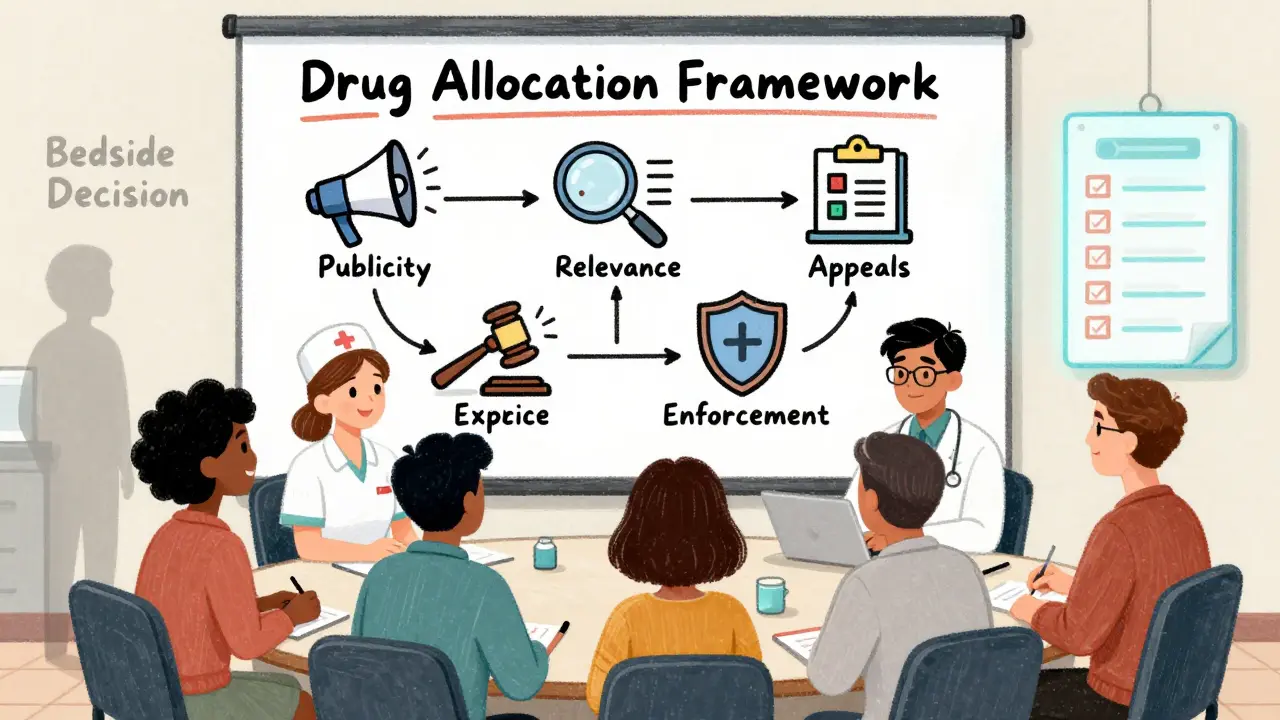
Ethical rationing isn’t about picking patients randomly. It’s about using clear, fair rules so no one person’s bias decides who lives. The most respected framework comes from bioethicists Daniel and Sabin. It’s built on four pillars:- Publicity: Everyone knows how decisions are made.
- Relevance: Choices are based on evidence-not gut feeling.
- Appeals: Patients or families can challenge a decision.
- Enforcement: Someone oversees that rules are followed.
ASCO, the American Society of Clinical Oncology, built on this with its 2023 guidance. They say rationing should happen at the institutional level-not at the bedside. That means a committee, not a single doctor, makes the call. This committee should include pharmacists, nurses, social workers, patient advocates, and ethicists. Not just doctors. Because this isn’t just a medical decision. It’s a moral one.
What Criteria Are Used?
There’s no single rulebook, but most frameworks agree on five key factors:- Urgency of need: Who will die without it?
- Chance of benefit: Who’s most likely to survive or recover?
- Duration of benefit: Who will live longer because of it?
- Years of life saved: Who has more life ahead?
- Instrumental value: Should healthcare workers get priority so they can care for others?
For example, Minnesota’s 2023 guidelines for carboplatin and cisplatin say priority goes to patients with curative intent and no equally effective alternative. That means someone getting chemo to cure their cancer gets first dibs over someone getting it to slow down a terminal illness. It’s harsh, but it’s clear.
What Happens When There’s No Plan?
The scary truth? Most hospitals don’t have a formal system. A 2018 survey of 719 hospitals found only 36% had standing committees for drug shortages. And only 2.8% included ethicists. That means 64% of hospitals are relying on whoever is on call that night.That’s bedside rationing. And it’s a disaster. A 2022 JAMA study found that when decisions are made by individual clinicians, allocation disparities go up by 32%. That means patients from minority groups, rural areas, or lower-income backgrounds are more likely to be left out. One oncologist in Texas told a reporter: “I had to choose between two stage IV ovarian cancer patients for limited carboplatin doses three times this month-with no institutional guidance.”
And it’s not just patients who suffer. Clinicians are drowning in moral distress. Nurses and doctors report nightmares, guilt, and burnout. A 2022 Mayo Clinic study found hospitals with formal ethics committees had 41% lower clinician distress scores. But without those committees, 51.8% of rationing decisions are made alone-by one doctor, under pressure, with no backup.
The Silent Victims: Patients Who Don’t Know
Here’s the darkest part: most patients don’t even know they’re being rationed. Only 36% are told when their treatment is delayed or reduced. That’s not just unethical-it’s a betrayal of trust. The Patient Advocate Foundation documented 127 formal complaints in 2021 from families who only found out after a loved one’s condition worsened.Why hide it? Fear. Fear of panic. Fear of lawsuits. Fear of blame. But secrecy doesn’t protect anyone. It just makes people feel abandoned. Transparency doesn’t mean giving bad news-it means giving honest context. “We don’t have enough of this drug right now. Here’s how we’re deciding who gets it. Here’s how you can appeal.” That’s dignity. That’s care.

Who’s Left Behind?
Rural hospitals are hit hardest. Sixty-eight percent of them have no formal rationing protocol. Academic centers? Only 32% lack one. Why? Rural hospitals don’t have ethicists on staff. They don’t have the staff to form committees. They don’t have the time to wait 72 hours for a meeting while a patient’s tumor grows.And it gets worse. A 2021 Hastings Center Report found that 78% of rationing protocols don’t include any equity metrics. That means race, income, zip code, and insurance status don’t even factor into the rules. In practice, that means the same systemic inequalities that exist in healthcare today get baked into who lives and who dies during a shortage.
What’s Being Done?
There’s hope. ASCO launched an online decision support tool in May 2023. The CDC updated its Crisis Standards of Care toolkit in March 2023. And the FDA’s new Drug Shortage Task Force is building an AI-powered early warning system to predict shortages before they happen-targeting a 30% reduction in duration by 2025.But the biggest step forward? Certification. The American Society for Bioethics and Humanities is launching pilot programs in 15 states in early 2024 to certify hospital rationing committees. Think of it like a safety certification for hospitals: if you want to handle drug shortages, you have to meet minimum standards. Training. Transparency. Accountability.
What Can Be Done Now?
If you’re a patient or family member: ask. Ask your doctor: “Do you have a plan for drug shortages? Have I been told if my treatment might be affected?” If you’re a healthcare worker: push for a committee. Demand ethics training. Push for documentation in your EHR system. If you’re a policymaker: fund rural hospital support. Mandate transparency. Require manufacturers to report shortages on time.There’s no perfect solution. But there’s a clear path forward: stop making these decisions alone. Stop hiding them. Stop letting profit and convenience dictate who gets medicine. Ethical rationing isn’t about choosing who lives. It’s about making sure no one is chosen arbitrarily.
Is it legal to ration medications?
Yes, but only under structured, transparent systems. There’s no law that says hospitals must ration, but in a crisis, they’re legally allowed to allocate scarce resources if they follow ethical guidelines. The problem isn’t legality-it’s consistency. Many hospitals ration without rules, which opens them to legal and ethical risk.
Can patients appeal a rationing decision?
In well-run systems, yes. The Daniels and Sabin framework requires an appeals process. But in practice, fewer than 15% of hospitals have one. Patients often don’t even know they can appeal. Ethical guidelines say every patient must be told how to challenge a decision-and who to contact. If your hospital doesn’t offer that, ask why.
Why don’t hospitals just make more of the drugs?
Many of these drugs are generic injectables-low-profit, high-risk products. Manufacturers don’t make money on them, so they don’t invest in backup factories. Just three companies control 80% of the market. If one shuts down, there’s no alternative. The FDA has tried to incentivize production, but without major policy changes, shortages will keep happening.
Are there alternatives to rationed drugs?
Sometimes. For example, if cisplatin is unavailable, some oncologists switch to carboplatin-but it’s not always as effective. Others use different chemotherapy regimens or adjust dosing schedules. But for many patients, especially those with aggressive cancers, there’s no real substitute. That’s why rationing becomes unavoidable.
What’s the difference between rationing and prioritizing?
Prioritizing is about ordering who gets care first when resources are tight but still available. Rationing is when there’s not enough for everyone, so some people get nothing. Rationing means someone is left out. Prioritizing means you’re still getting care-it just might be delayed. The difference is life or death.
How can I find out if my hospital has a rationing plan?
Ask your doctor or hospital ethics committee. If they don’t have one, ask for a copy of their drug shortage policy. Most hospitals have a general policy, but fewer than 40% have a detailed, ethics-reviewed plan. If they can’t show you one, it’s a red flag. You have a right to know how decisions will be made if your treatment is at risk.
Do insurance companies play a role in rationing?
Not directly. Insurance companies don’t decide who gets a drug. But they influence supply. If insurers pay too little for a drug, manufacturers won’t produce it. And if a drug is expensive and not covered well, patients may not get it even when it’s available. So while insurers don’t ration, their payment policies can drive shortages.

THANGAVEL PARASAKTHI
February 8, 2026 AT 18:32Man this hits different when you live in a country where even basic meds are hard to get. In India, we don’t even have the luxury of rationing frameworks-just whoever can pay or has connections. The fact that US hospitals are at least trying to build systems is kinda insane to me. Still, the criteria? Years of life saved? That’s cold. What about quality? Someone with 10 years left but in constant pain vs someone with 5 but thriving? No one talks about that.
Frank Baumann
February 8, 2026 AT 19:08Let me tell you something-this isn’t just about drugs, this is about the entire healthcare system being held together by duct tape and hope. I’ve seen nurses cry in the supply closet because they had to tell a 28-year-old mom she couldn’t get her chemo because ‘the batch expired’-not because it was unsafe, but because the damn factory in China had a power outage and no one had backup. And now we’re debating whether a 65-year-old with lung cancer gets priority over a 42-year-old with testicular? Jesus. We’re not making ethical decisions-we’re playing Russian roulette with human lives and calling it ‘protocol.’
Chelsea Deflyss
February 9, 2026 AT 14:40Ugh this whole thing is so frustrating. I work in oncology and we dont even have a committee. Just me and the pharmacist winging it. And the worst part? Patients think we’re being unfair. But we’re just following what the hospital told us. And no one ever tells us how to handle the guilt. Also-why do they always say ‘no equally effective alternative’? Carboplatin IS effective! Its just not as good. But we use it anyway. Why not say ‘use carboplatin if cisplatin is gone’ instead of pretending there’s a perfect solution?
Scott Conner
February 10, 2026 AT 19:07So wait-so the FDA requires 6 months notice but only 68% comply? That’s like a fire alarm that only works 2/3 of the time. And we wonder why hospitals are scrambling? And then they say ‘ethics committees’ like it’s a magic fix. But 64% of hospitals don’t even have one. What’s the point of having a framework if no one’s enforcing it? It’s like having a rulebook for a game and then saying ‘just play nice.’ That’s not ethics-that’s wishful thinking.
Alex Ogle
February 12, 2026 AT 01:42I’ve been a nurse for 18 years. I’ve seen this happen. I’ve held a patient’s hand while they cried because their drug was delayed. I’ve seen the same person come back 3 months later, stage IV, because they didn’t get the first round. And you know what? No one ever apologized. No one ever said ‘we didn’t have enough.’ We just said ‘we’re out of stock.’ That’s not transparency. That’s cowardice. And now we’re talking about ‘instrumental value’-like nurses and doctors should get priority? What about the single mom who’s the only caregiver for her 12-year-old? Her life matters too. I’m tired of pretending this is about fairness. It’s about who’s loud enough to be heard.
Brandon Osborne
February 12, 2026 AT 18:30STOP pretending this is ethical. This is capitalism. Three companies control 80% of the market? That’s not a supply chain failure-that’s a cartel. And the FDA? They’re asleep at the wheel. They know this is happening. They’ve known for a decade. But they don’t want to force manufacturers to build backup plants because ‘it’s too expensive.’ So now we’re left with doctors choosing who lives? That’s not triage. That’s murder by bureaucracy. And if you think ‘transparency’ fixes this, you’re delusional. Transparency doesn’t bring drugs back. It just makes people feel worse while they die.
Marie Fontaine
February 12, 2026 AT 23:42Lyle Whyatt
February 14, 2026 AT 01:43From Australia, where we have universal access but still face shortages-our system’s different, but the moral weight is the same. We don’t have ‘bedside rationing’ per se, but we do have waitlists and regional allocation. What struck me most here is how little public discourse there is. In Australia, when we had a vaccine shortage, we had town halls. We had clear messaging. Here? Silence. And silence breeds fear. And fear breeds inequality. The fact that 78% of protocols ignore equity metrics? That’s not oversight-that’s systemic bias baked into policy. We need to stop treating this like a medical problem and start treating it like a civil rights issue.
Ken Cooper
February 14, 2026 AT 19:19Okay, I’m a pharmacist. And I’m gonna say this: the whole ‘no substitute’ thing? Bullshit. There are alternatives. Sometimes they’re less effective. Sometimes they cost more. But we’re not even trying. Why? Because the hospital doesn’t want to pay for the new drug. Insurance won’t cover it. So we stick with the ‘gold standard’ even when it’s gone. And then we pretend we’re ethical. We’re not. We’re just following the path of least resistance. And patients? They’re the ones who pay. Literally. With their lives.
MANI V
February 15, 2026 AT 12:08This whole article is just another liberal fantasy. You think committees fix this? You think ethics changes anything? The truth? The rich get the drugs. The poor get told to wait. The system isn’t broken-it’s working exactly as designed. And you want to ‘certify’ committees? Like that’ll help? You’re not solving the problem. You’re just giving the rich a prettier way to die first. Wake up.
Susan Kwan
February 17, 2026 AT 05:00Random Guy
February 18, 2026 AT 12:02