

If you have asthma and reach for ibuprofen or aspirin for a headache, you could be setting off a silent alarm in your airways. For about 7% of people with asthma, common painkillers aren’t just ineffective-they can trigger a dangerous asthma attack, nasal swelling, and even hospitalization. This isn’t an allergy in the traditional sense. It’s a condition called NSAID-Exacerbated Respiratory Disease (NERD), also known as Aspirin-Exacerbated Respiratory Disease (AERD). And if you’re not aware of it, you might be walking into a medical emergency every time you take an over-the-counter pill.
How NSAIDs Trigger Asthma Reactions
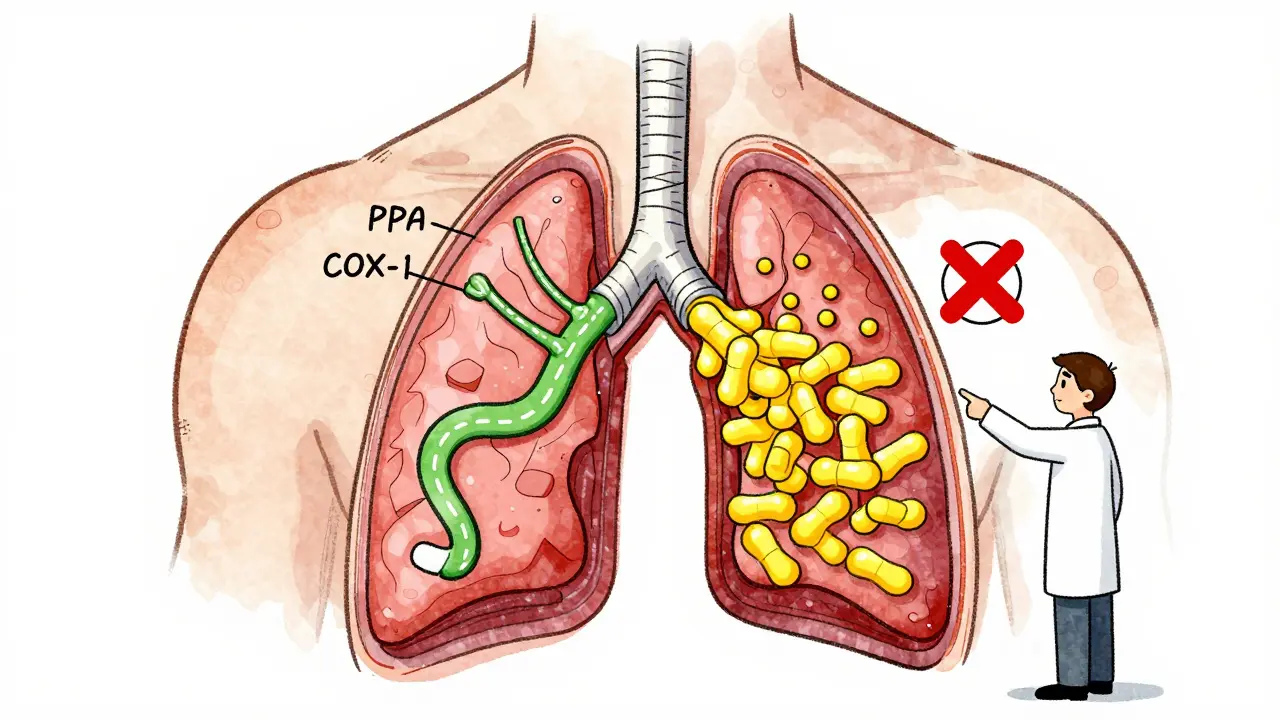
NSAIDs like aspirin, ibuprofen, and naproxen work by blocking an enzyme called COX-1. That’s how they reduce pain and inflammation. But for people with NERD, that same mechanism backfires. When COX-1 is blocked, the body shifts its chemical production toward a different pathway-this one spews out large amounts of leukotrienes, powerful inflammatory chemicals that tighten airways, swell nasal passages, and flood the lungs with mucus.
Think of it like a traffic jam. Normally, your body uses COX-1 to make protective prostaglandins that keep airways open. When NSAIDs shut that road down, all the traffic gets rerouted into the leukotriene lane-and it’s a one-way street to trouble. The result? Sudden wheezing, chest tightness, and a runny nose that feels like a cold, but hits fast-often within 30 minutes to three hours after taking the drug.
What makes this worse is that you don’t need a large dose. Some patients react to just 75 mg of aspirin-the amount in a low-dose heart pill. And if you’ve had one reaction, you’ll likely react to all NSAIDs. It’s not about the brand. It’s about the chemistry.
Who’s Most at Risk?
NERD doesn’t show up randomly. It follows a pattern. Most people are diagnosed between ages 30 and 40. Women make up about 70% of cases. Many are overweight. And nearly half of those with chronic sinus problems and nasal polyps also have NERD. That’s not a coincidence-it’s a red flag.
If you’ve had asthma since childhood, your risk is low. But if your asthma started in your 30s or 40s, especially if you also have constant nasal congestion, loss of smell, or recurring sinus infections, you’re in a high-risk group. Nasal polyps-those soft, noncancerous growths in your nose-are one of the strongest indicators. Studies show that 40-50% of people with these polyps also have NERD.
Smoking history, family asthma, or a history of allergies also raise your odds. But even if you don’t fit the profile, a sudden asthma flare after taking painkillers should never be ignored.
What the Reaction Feels Like
It doesn’t start with a cough. It starts with a stuffy nose-fast. Then comes the watery eyes, the sneezing, the feeling that your throat is closing. Within minutes, your chest tightens. Breathing becomes a struggle. You might feel dizzy. Your peak flow meter drops. Some people vomit. Others panic because they think it’s a heart attack.
Many patients describe their first reaction as "a cold that came out of nowhere." They took an Advil for a headache, and suddenly couldn’t breathe. They went to the ER, got treated for asthma, and left without knowing why it happened. Months later, they take another NSAID-and it happens again. That’s when they start asking questions.
Unlike allergic reactions (like peanut or bee sting allergies), NERD doesn’t involve IgE antibodies. That means standard allergy tests won’t catch it. You won’t get a positive skin prick or blood test. Diagnosis comes from history-and sometimes, a supervised aspirin challenge in a hospital setting.
What Pain Relief Is Safe?
You don’t have to suffer in pain. But you need to know what’s safe.
Acetaminophen (Tylenol) is usually the go-to. Most NERD patients can take up to 1,000 mg per dose without issue. But about 5-10% still react, especially at higher doses. So start low, monitor closely, and avoid long-term daily use unless cleared by your doctor.
Celecoxib (Celebrex) is a COX-2 selective NSAID. Unlike aspirin or ibuprofen, it doesn’t block COX-1 significantly. Multiple studies show it’s safe for most NERD patients. But it’s a prescription drug, and not everyone can take it due to heart risks.
Other NSAIDs? Avoid them. That includes:
- Aspirin
- Ibuprofen (Advil, Motrin)
- Naproxen (Aleve)
- Diclofenac (Voltaren)
- Ketoprofen
- Indomethacin
And here’s the trap: these drugs hide in cold medicines, menstrual relief pills, and even some topical creams. Check labels for ingredients like "ibuprofen," "naproxen sodium," or "ketoprofen." Don’t assume "natural" or "herbal" means safe-some herbal supplements can have NSAID-like effects.
Aspirin Desensitization: A Possible Lifeline
For some, there’s a path forward. Aspirin desensitization is a medical procedure done in a controlled clinic. You’re given tiny, increasing doses of aspirin over hours or days until your body adjusts. Once desensitized, you can take daily aspirin without triggering symptoms.
Why would you want that? Because daily aspirin doesn’t just prevent pain-it can actually reduce nasal polyp growth, improve breathing, and lower the need for steroid sprays or surgery. Studies show patients who complete desensitization often have fewer asthma attacks and better quality of life.
It’s not for everyone. You need stable asthma control. You need a specialist. And you need to commit to lifelong daily aspirin. But for those who qualify, it’s life-changing.

What You Need to Do Now
If you have asthma and have ever had a bad reaction after taking a painkiller, here’s your action plan:
- Stop taking NSAIDs until you know your status. Even one reaction means you’re at risk.
- Keep a symptom diary. Note when you took a pain reliever, what you took, and what happened-within 30 minutes, 2 hours, or 6 hours.
- Ask your doctor for a referral to an allergist or immunologist who specializes in respiratory diseases.
- Carry a list of all NSAIDs to avoid. Print it. Save it on your phone. Show it to pharmacists.
- Wear a medical alert bracelet if you’ve had a severe reaction. It could save your life in an emergency.
Don’t wait for a hospital visit to learn this. If you’re over 30, have nasal polyps, or your asthma got worse after age 25, talk to your doctor today. NERD is underdiagnosed-and preventable.
What About Children?
Studies show that short-term use of NSAIDs in kids with asthma can increase the risk of an asthma attack by nearly 50%. That’s why many pediatricians now recommend acetaminophen as the first choice for fever or pain in children with asthma.
But NERD rarely starts in childhood. It’s mostly an adult-onset condition. Still, if your child has asthma and nasal congestion, and their symptoms worsen after taking ibuprofen, don’t dismiss it as coincidence. Document it. Talk to your doctor. Early recognition matters.
The Bigger Picture
NERD isn’t just about avoiding pills. It’s about understanding how your body’s chemistry works-and how drugs can accidentally turn against you. It’s a reminder that "over-the-counter" doesn’t mean "risk-free."
Doctors need to ask: "Have you ever had trouble breathing after taking painkillers?" Patients need to answer honestly. Pharmacists need to double-check labels. And everyone needs to know: if you have asthma and chronic sinus issues, you’re not just sensitive to NSAIDs-you’re in a high-risk group that deserves proactive care.
This isn’t about fear. It’s about awareness. And awareness saves lives.
Can I take Tylenol if I have NSAID-sensitive asthma?
Yes, most people with NSAID-sensitive asthma can safely take acetaminophen (Tylenol) at doses up to 1,000 mg per dose. However, about 5-10% of patients still react to higher doses or long-term use. Always start with the lowest effective dose and monitor for symptoms like wheezing or nasal congestion. If you’ve had a reaction to acetaminophen before, avoid it entirely and consult your doctor.
Are all NSAIDs equally dangerous for asthma patients?
Not all NSAIDs work the same way, but if you’re sensitive to one, you’re likely sensitive to all. That’s because they all inhibit COX-1, the enzyme that triggers the dangerous inflammatory cascade in NERD. Aspirin, ibuprofen, naproxen, diclofenac-any drug in this class carries risk. The exception is celecoxib (Celebrex), a COX-2 selective inhibitor, which is generally safe for most NERD patients. But never assume safety without checking with your doctor.
Can I be tested for NSAID sensitivity?
There’s no standard blood or skin test for NERD. Diagnosis is based on your medical history and symptoms. In some cases, a supervised aspirin challenge test is performed in a hospital or allergy clinic. During this test, you’re given small, increasing doses of aspirin while your breathing is closely monitored. It’s safe when done by trained professionals and is the only way to confirm the diagnosis if your history is unclear.
Do nasal polyps always mean I have NERD?
No, but they’re a major red flag. About 40-50% of people with chronic rhinosinusitis and nasal polyps also have NERD. If you have both asthma and nasal polyps, your risk is significantly higher than the general asthma population. Even if you’ve never reacted to NSAIDs, you should assume you’re at risk and avoid them until you’ve been evaluated by a specialist.
Is aspirin desensitization worth it?
For many, yes. Aspirin desensitization can reduce nasal polyp size, improve breathing, decrease asthma attacks, and lower reliance on steroids or surgery. It requires daily aspirin use afterward and must be done under medical supervision. It’s not for everyone-especially if your asthma is unstable-but for those with severe, persistent symptoms, it’s one of the most effective long-term treatments available.
What should I do if I accidentally take an NSAID?
If you have a history of NSAID sensitivity and accidentally take one, monitor yourself closely for 3-4 hours. Watch for nasal congestion, wheezing, chest tightness, or difficulty breathing. If symptoms develop, use your rescue inhaler immediately. If your symptoms worsen or don’t improve, call emergency services. Don’t wait. Even if you’ve only had mild reactions before, the next one could be severe.


Victoria Rogers
December 17, 2025 AT 06:03Evelyn Vélez Mejía
December 18, 2025 AT 16:57The pathophysiology of NERD is not merely a biochemical misfire-it is a symphony of dysregulated eicosanoid metabolism, wherein the inhibition of COX-1 precipitates a cascade of leukotriene overproduction, effectively transforming the respiratory mucosa into a battlefield of inflammatory excess. The elegance of this mechanism, though perilous, reveals the exquisite fragility of human homeostasis when pharmacological intervention disregards evolutionary nuance.
It is not merely an allergy-it is a constitutional vulnerability, a phenotypic signature etched into the genomic architecture of certain individuals, particularly those with a triad of asthma, nasal polyps, and late-onset respiratory distress. To dismiss it as 'sensitivity' is to sanitize the severity of its clinical expression.
And yet, the medical establishment continues to underdiagnose it, because it does not conform to the tidy boxes of IgE-mediated allergy, nor does it yield to the convenience of rapid diagnostic assays. We rely on history, on patient narrative, on the quiet desperation of someone who has suffered three ER visits and still doesn't know why.
The aspirin desensitization protocol, though arduous, is not merely a treatment-it is a reclamation of agency. To be granted the ability to take a pill without fearing suffocation is not a luxury; it is a restoration of autonomy.
And yet, we still treat this as a niche concern. Why? Because it disproportionately affects women. Because it is linked to chronic sinus disease, which society dismisses as 'just congestion.' Because it doesn't kill instantly, so it doesn't make headlines.
Let this be a manifesto: if you have asthma and nasal polyps, assume NERD until proven otherwise. Demand the aspirin challenge. Refuse to be a statistic. Your airways are not a gamble.
Meghan O'Shaughnessy
December 20, 2025 AT 11:40My mom had this and didn't know until she ended up in the ICU after taking Aleve for her arthritis. She thought it was just a bad cold. Now she carries a card in her wallet that says 'NO NSAIDS - NERD'. She's been fine for 8 years since she started aspirin desensitization. Honestly, if you have polyps and asthma, just assume you have it. Better safe than sorry.
BETH VON KAUFFMANN
December 21, 2025 AT 12:45Let’s be clear: the COX-1/COX-2 dichotomy is oversimplified in lay literature. The real issue lies in the shunting of arachidonic acid toward the 5-LOX pathway, which generates CysLTs (cysteinyl leukotrienes) that bind to CysLT1 receptors on bronchial smooth muscle-inducing bronchoconstriction, mucus hypersecretion, and vascular permeability. Celecoxib’s COX-2 selectivity spares this pathway, hence its relative safety. But even this is not absolute; genetic polymorphisms in ALOX5 or LTC4S may still confer risk. Hence, individualized pharmacogenomic assessment is warranted before prescribing any NSAID analogue.
Moreover, the 7% prevalence figure is likely an underestimate due to diagnostic bias-most primary care providers don’t screen for NERD unless the patient presents with an acute reaction. Retrospective cohort studies suggest true prevalence may approach 15% in adult-onset asthma with nasal polyposis.
Patrick A. Ck. Trip
December 23, 2025 AT 10:30This is one of those topics that should be taught in every high school health class. I never knew NSAIDs could do this. My sister has asthma and polyps and she took ibuprofen for years before she had her first attack. She’s lucky to be alive. I’m printing this out for my family.
Thank you for writing this with such clarity. We need more of this kind of information-not fear, just facts.
Sam Clark
December 23, 2025 AT 23:36I’ve worked as a respiratory therapist for 14 years, and I’ve seen too many patients come in gasping after popping an Advil for a headache. They always say, 'But it’s just a painkiller.'
This post is spot-on. The key is early recognition. If someone over 30 develops asthma and chronic sinus issues, NERD should be on the differential before you even order a chest X-ray.
And yes-Tylenol is usually safe, but don’t assume. Start at 500 mg. Watch for 30 minutes. If there’s even a hint of nasal stuffiness or throat tightness, stop. Document it. Tell your doctor.
And if you’re considering aspirin desensitization? Do it. It’s not a cure, but it’s the closest thing we have to a reset button for your airways.
Virginia Seitz
December 25, 2025 AT 05:54Marie Mee
December 25, 2025 AT 18:10Naomi Lopez
December 26, 2025 AT 04:19It’s fascinating how the medical community still treats NERD as a fringe condition rather than a paradigmatic example of pharmacodynamic idiosyncrasy. The fact that aspirin desensitization is underutilized speaks volumes about systemic inertia in clinical practice.
Moreover, the emphasis on 'over-the-counter' safety is a dangerous illusion. The FDA’s classification system is fundamentally flawed when it comes to pharmacogenomic risk stratification. A pill doesn’t become benign because it lacks a prescription label.
And yet, we continue to allow pharmacists to dispense naproxen without a single warning about asthma comorbidity. This isn’t negligence-it’s negligence institutionalized.
Salome Perez
December 26, 2025 AT 06:21I’m an allergist in Chicago, and I see this every week. A woman in her 30s comes in with chronic sinus infections and asthma that got worse after 25. She’s been taking Motrin for years. She thinks she’s 'just sensitive to medicine.' We do the challenge, confirm NERD, and within six months of aspirin desensitization, her polyps shrink, her peak flow doubles, and she stops needing oral steroids.
This isn’t magic. It’s science. And it’s available to anyone who asks.
If you’re reading this and you have asthma + nasal congestion + polyps, please, please, please don’t wait for a hospital visit. Make the call. Find an immunologist. Bring this article with you.
You don’t need to live like this. There’s a path forward-and it starts with one conversation.
Jody Patrick
December 26, 2025 AT 11:37Erik J
December 27, 2025 AT 22:34Does anyone know if topical NSAIDs (like Voltaren gel) can trigger NERD? I’ve been using it for knee pain and haven’t had issues, but I’m nervous now.