

Depression isn’t just feeling sad. It’s a persistent weight that makes getting out of bed hard, turns hobbies into chores, and silences even the loudest voices inside you. If you’ve been stuck like this for weeks or months, you’re not weak-you’re dealing with a real medical condition. Major depressive disorder affects 280 million people worldwide, and it’s the top cause of disability on the planet. The good news? We now have clear, evidence-backed ways to manage it-not just one fix, but a mix of medications, therapy, and lifestyle changes that work better together than alone.
Medications: Not a Quick Fix, But a Tool
When doctors talk about antidepressants, they’re usually referring to second-generation drugs like SSRIs (selective serotonin reuptake inhibitors). These include sertraline, citalopram, and fluoxetine. They’re not magic pills. They don’t make you happy instantly. What they do is slowly help your brain regain balance, making it easier to respond to therapy and lifestyle shifts. Sertraline is often the first choice in the UK because it’s affordable and has fewer side effects than older options. But side effects still happen. About 30-50% of people on SSRIs report sexual problems. SNRIs like venlafaxine can raise blood pressure in 10-15% of users. Bupropion, on the other hand, tends to spare sexual function but carries a small seizure risk-about 0.4% at normal doses. If one drug doesn’t work after 4-8 weeks at the right dose, switching isn’t failure. It’s part of the process. The STAR*D trial showed that even after three failed attempts, 67% of people eventually found relief with careful sequencing. For treatment-resistant depression-where two or more meds haven’t helped-doctors may add lithium, thyroid hormone, or even low-dose antipsychotics like quetiapine. In severe cases, especially with psychosis, electroconvulsive therapy (ECT) can bring remission in 70-90% of patients.Therapy: Rewiring How You Think and Feel
Medications help your brain chemistry. Therapy helps your brain patterns. Cognitive Behavioral Therapy (CBT) is the most studied. It teaches you to spot negative thoughts like “I’m worthless” or “Nothing will ever get better,” and challenge them with facts. Eight to 28 weekly sessions can lead to a 50-60% improvement in mild to moderate depression. Interpersonal Therapy (IPT) focuses on relationships. If your depression is tied to grief, conflict, or isolation, IPT helps you rebuild connections. Twelve to 16 sessions show results just as strong as medication. For people who’ve had depression more than once, Mindfulness-Based Cognitive Therapy (MBCT) cuts relapse risk by 31% over a year. It’s not about clearing your mind-it’s about noticing when your thoughts spiral and choosing not to follow them. Couples therapy can help if your depression is tangled up in relationship stress. One study found 40-50% symptom improvement when both partners joined therapy, compared to 25-30% with individual sessions alone.Lifestyle Changes: The Hidden Powerhouses
You’ve heard it before: “Exercise more.” “Sleep better.” “Eat well.” But here’s what the science actually says: Exercise isn’t just for your body. Three to five sessions a week of brisk walking, cycling, or swimming-30 to 45 minutes each-can match the effect of antidepressants for mild depression. A 2020 meta-analysis found it had a standardized effect size of -0.68, which is clinically meaningful. Sleep is non-negotiable. Seven out of ten people with depression have trouble sleeping. Fixing sleep hygiene can slash depression scores by 30-40%. That means: same bedtime and wake-up time (even weekends), no screens an hour before bed, and only going to bed when you’re actually tired. If you’re in bed for 8 hours but only sleeping 5, you’re training your brain to associate bed with wakefulness. Diet matters more than most think. The SMILES trial gave people with depression a 12-week Mediterranean diet-lots of veggies, fruits, whole grains, fish, nuts, and olive oil. After that, 32% went into remission. Only 8% did in the control group, which got social support but no dietary changes. Stress reduction techniques like daily 10-20 minute mindfulness, yoga twice a week, or tai chi can lower symptoms with moderate effect sizes. You don’t need to become a monk. Just 10 minutes a day of focused breathing or body scanning can reset your nervous system.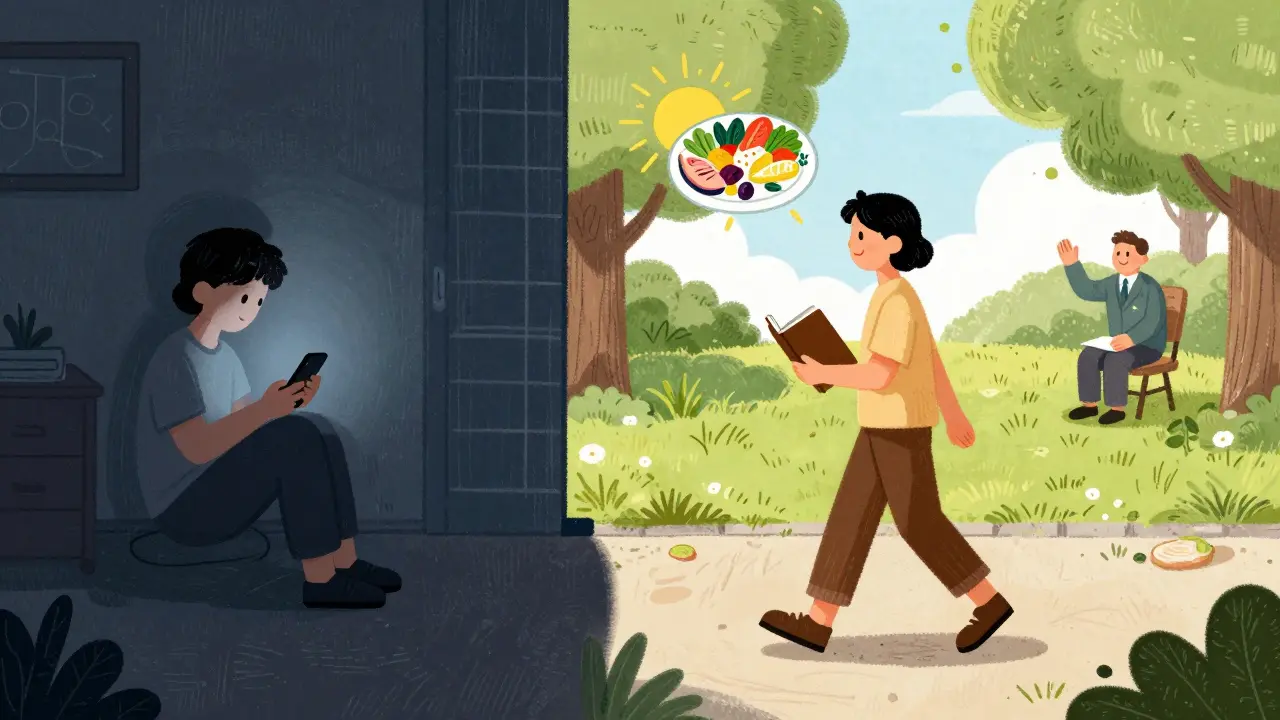
What Works Depends on How Bad It Is
There’s no one-size-fits-all. Treatment depends on severity, measured by the PHQ-9 scale:- Mild (score 5-9): Skip meds unless you ask for them. Start with exercise, guided self-help apps, or weekly check-ins with a clinician.
- Moderate (score 10-14): Pick either CBT or an SSRI. Or do both. Combination therapy gives you a 55-60% response rate.
- Severe (score 15+): Start with both medication and therapy. ECT is an option if you’re stuck or in crisis.
- Chronic (lasting 2+ years): CBASP (Cognitive Behavioral Analysis System of Psychotherapy) is designed for this. It helps you understand how your behavior affects relationships and mood. One study showed 48% improvement with CBASP plus meds-compared to 28% with meds alone.
Barriers and Real-World Challenges
Knowing what works isn’t the same as getting it. In the US, only 35.6% of people with depression get any mental health care. In the UK, waiting lists for NHS therapy can stretch months. That’s why digital tools are growing fast. Apps like reSET, approved by the FDA, have shown 47% response rates in trials. But adoption is still low-under 5% of clinics use them. Telehealth changed everything. In 2019, only 18% of therapists offered video sessions. By 2022, it was 68%. Now, you can get CBT from your couch. That’s progress.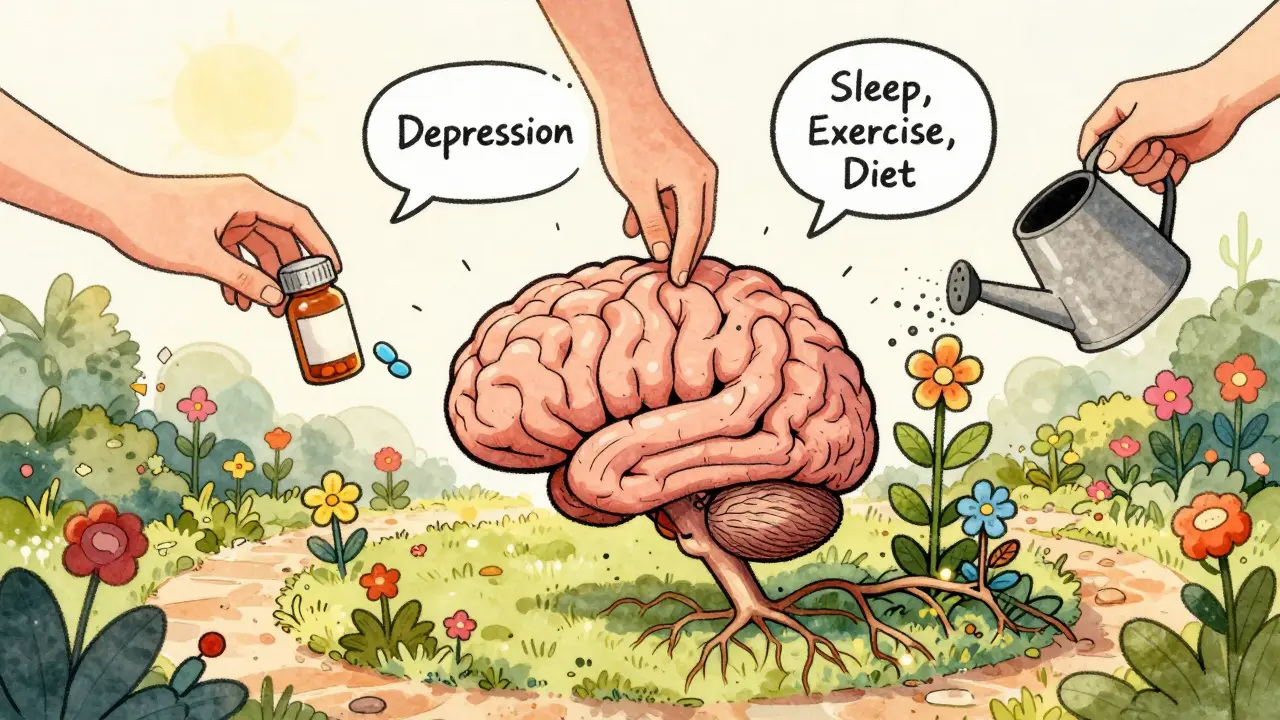
What’s Next? The Future of Depression Care
The field is moving fast. Psilocybin-assisted therapy showed a 71% response rate in a 2021 trial. It’s not legal yet, but it’s coming. Smartphone apps that track your speech patterns, movement, and social activity can predict a depressive episode up to a week in advance with 82% accuracy. We’re also learning that depression isn’t the same in everyone. Racial and ethnic minorities in the US have a 50% higher risk. Women are diagnosed more often. Older adults often present with fatigue or pain instead of sadness. Personalized care isn’t a buzzword-it’s the new standard.What to Do Right Now
If you’re struggling:- Use the PHQ-9 questionnaire (free online) to gauge severity.
- If it’s mild: Try 30 minutes of brisk walking five days a week, and cut back on sugar and processed foods.
- If it’s moderate or worse: Talk to your GP. Ask about CBT or an SSRI. Don’t wait for “it to get worse.”
- Track your sleep. Set a consistent bedtime. No screens after 9 p.m.
- Consider a digital tool like a mindfulness app or CBT-based program. They’re low-cost and available now.
Can I just take medication and skip therapy?
You can, but combining medication with therapy gives you better long-term results. Medication helps you feel stable enough to engage in therapy. Therapy helps you build skills so you don’t slide back when you stop taking pills. Studies show combination treatment leads to a 55-60% response rate, compared to 45-50% for medication alone.
How long before antidepressants start working?
Most people notice small improvements after 2-4 weeks, but full effects usually take 6-8 weeks. Don’t stop because you don’t feel better right away. If there’s no change after 8 weeks at the right dose, talk to your doctor about switching or adding something else.
Is exercise really as effective as medication?
For mild depression, yes-research shows regular moderate exercise can match the effect of SSRIs. It doesn’t work as well for severe cases on its own, but it boosts medication and therapy. Plus, it has no side effects and improves heart health, sleep, and self-esteem.
What if I can’t afford therapy or medication?
Many NHS services offer free CBT via digital platforms or group sessions. Libraries and community centers sometimes host mindfulness or walking groups. Generic SSRIs like sertraline cost under £10 a month in the UK. If cost is a barrier, tell your GP-you’re not alone, and there are options.
Can diet really change how I feel?
Yes. The SMILES trial proved it: 12 weeks of eating whole foods-vegetables, fish, nuts, legumes-led to remission in 32% of people with depression. Processed foods, sugar, and fried items worsen inflammation, which is linked to low mood. You don’t need to go perfect. Just add more veggies and reduce packaged snacks.
Is depression treatment different for older adults?
Yes. Older adults often show depression as fatigue, memory problems, or physical pain-not sadness. They’re more sensitive to side effects, so doctors start with lower doses. Therapy is especially helpful because it doesn’t interact with other medications they might be taking. Social isolation is a big trigger, so group activities or family support matter more.
What’s the difference between sadness and depression?
Sadness comes and goes. Depression lasts most of the day, nearly every day, for at least two weeks. It doesn’t lift with good news. You lose interest in things you used to love. You might feel numb, guilty, or worthless. You may sleep too much or too little. You might not be able to concentrate or make decisions. These aren’t just bad days-they’re symptoms of a medical condition.
Are there any risks with stopping medication suddenly?
Yes. Stopping SSRIs or SNRIs abruptly can cause dizziness, nausea, brain zaps, or a return of depression. Always taper off slowly under your doctor’s guidance. Even if you feel better, staying on medication for 6-12 months after improvement reduces relapse risk.
Takeysha Turnquest
December 19, 2025 AT 12:04The weight isn't metaphorical. It's in your bones. You wake up and it's already there like a second skin. No amount of positive thinking peels it off. I tried. It doesn't work. Medication didn't fix me. But it let me breathe long enough to find therapy. And therapy didn't make me happy. It made me stop hating myself for not being happy.
That's the real win.
You don't need to be fixed. You just need to stop fighting yourself.
That's enough.
Lynsey Tyson
December 20, 2025 AT 09:18I know this sounds cheesy but I really think the sleep thing is the quiet hero here. Like no one talks about how your brain literally forgets how to rest when you're depressed. I started setting a 10:30 bedtime with no phone. No music. Just dark. And after two weeks I noticed I wasn't crying in the shower anymore. Not because I was suddenly happy. But because I had energy to not care as much. Small wins.
Also I eat more vegetables now. Not because I care about health. But because I can't stand the guilt of eating chips at 2am anymore. Weird how that works.
Edington Renwick
December 21, 2025 AT 16:43Let’s be real. SSRIs are just chemical pacifiers. You’re not healing. You’re numbing. And don’t get me started on ‘mindfulness.’ It’s just capitalism’s way of telling you to accept your suffering instead of changing the system that created it. Exercise? Sure. But why should I have to run on a treadmill to fix a society that doesn’t care if I live or die?
Therapy helps you adjust to hell. That’s not treatment. That’s adaptation.
And the SMILES trial? Cute. But most people can’t afford organic kale. This whole system is rigged.
Aboobakar Muhammedali
December 22, 2025 AT 03:48I’m from India and here depression is still called ‘stress’ or ‘weak mind.’ My mom thought I just needed more chai and prayer. I didn’t tell anyone for 5 years. Then I found a free telehealth CBT program through a university. It was in English. I didn’t understand half of it. But I kept going. Because even if I didn’t get it, I felt like someone was watching. Not judging. Just watching.
Now I do 20 minutes of breathing every night. No apps. Just me and the ceiling. It’s not magic. But it’s mine.
You don’t need to be brave. Just show up.
Even if it’s just for 10 seconds.
anthony funes gomez
December 23, 2025 AT 09:44Neurochemically speaking, the monoamine hypothesis remains empirically robust despite its reductionist limitations-SSRIs modulate serotonergic transmission via SERT blockade, which-via downstream transcriptional regulation of BDNF and hippocampal neurogenesis-induces synaptic plasticity over a 4–8-week temporal window. This aligns with the neurotrophic model of depression. However, the clinical efficacy of CBT appears to stem from prefrontal cortex-mediated top-down regulation of amygdala hyperactivity, as evidenced by fMRI studies (Goldapple et al., 2004).
Yet, the SMILES trial’s dietary intervention suggests a gut-brain axis mechanism, wherein microbial diversity influences systemic inflammation (CRP, IL-6), which correlates with PHQ-9 scores. This implies a polyfactorial etiology: pharmacological, behavioral, immunological, and epigenetic. Therefore, the synergy isn’t additive-it’s emergent.
And yes, exercise upregulates endocannabinoids and cortisol normalization. But we’re still missing the epigenetic component. Who’s studying methylation patterns in treatment responders? No one. We’re treating symptoms, not root causes.
Also, ECT? That’s neurosurgical intervention. It’s not ‘last resort.’ It’s underutilized. We’re afraid of the stigma, not the science.
Laura Hamill
December 23, 2025 AT 19:03THE GOVERNMENT IS PUTTING ANTIDEPRESSANTS IN THE WATER. I KNOW THIS BECAUSE MY NEIGHBOR’S DOG STOPPED BARKING AFTER THEY PUT IN THE NEW WATER FILTER. THEY’RE TRYING TO MAKE US QUIET. THEY DON’T WANT US TO TALK. THE PHONE APPS? TRACKING US. THE MINDFULNESS APPS? THEY’RE LISTENING TO YOUR BREATHING. THEY KNOW WHEN YOU SLEEP. THEY KNOW WHEN YOU CRY. THEY’RE BUILDING A PROFILE.
AND WHY IS EVERYTHING SO EXPENSIVE? BECAUSE THEY WANT YOU TO BE DEPRESSED SO YOU’LL BUY MORE STUFF. THE PHARMACOMPANY IS A CULT. I SAW A VIDEO. THE DOCTORS WEAR BLACK CLOAKS. THEY HAVE A SECRET SIGIL.
JUST STOP TAKING THE PILLS. GO OFF THE GRID. LIVE IN THE WOODS. EAT RAW FOOD. NO PHONE. NO INTERNET. NO THERAPY. THEY CAN’T CONTROL YOU THEN.
AND WHY IS THE ARTICLE SO LONG? TO CONFUSE YOU. THEY WANT YOU TO THINK YOU NEED A SYSTEM. YOU DON’T. YOU JUST NEED TO WAKE UP.
THEY’RE SCARED OF YOU.
Alana Koerts
December 25, 2025 AT 10:05Everyone acts like this is groundbreaking. Newsflash: we’ve known exercise helps since the 90s. CBT? 70s. Mediterranean diet? 2010. The only new thing here is the marketing. This article reads like a pharma pamphlet with a therapist’s footnote. Where’s the data on dropout rates? On long-term relapse? On how many people quit meds because of sexual side effects and never come back?
And why is the ‘final thought’ so patronizing? ‘Be patient.’ ‘Don’t give up.’ Like it’s that simple. Like you’re not already exhausted from trying.
This isn’t advice. It’s a sales pitch dressed as hope.
Dominic Suyo
December 25, 2025 AT 14:29Let’s not romanticize this. The UK’s NHS waiting list is 18 months for CBT. That’s not ‘access.’ That’s abandonment. And ‘generic sertraline costs £10’? Sure. If you’re not on a zero-hours contract and can afford to take time off to get the prescription filled. If you’re working two jobs and your kid has asthma and your landlord just raised the rent. You don’t have time for mindfulness. You don’t have energy for a walk. You have survival.
So yeah, the science is cool. But if your life is a house on fire, nobody gives a shit about the color of the fire extinguisher.
They need a damn helicopter.
This article is written by someone who’s never had to choose between meds and groceries.
Kevin Motta Top
December 26, 2025 AT 09:55My dad had depression. Didn’t talk about it. Just stopped coming to family dinners. Took a pill every morning. Didn’t say thank you. Didn’t say anything. But he started gardening again. Just roses. No reason. Just dirt and sun. Three years later he said, ‘I think I’m okay.’
He never went to therapy. Never used an app. Didn’t read a single article.
He just kept showing up.
That’s all I need to know.
Henry Marcus
December 27, 2025 AT 22:55THEY’RE USING YOUR DATA TO TRAIN AI TO PREDICT WHEN YOU’LL TRY TO KILL YOURSELF. THAT’S WHY THEY PUSH THE APPS. THEY WANT TO KNOW THE SIGNS BEFORE YOU EVEN KNOW THEM. THEY’RE NOT HELPING YOU. THEY’RE COLLECTING YOUR EMOTIONAL FINGERPRINTS. THE ECT MACHINE? IT’S A CONTROL DEVICE. THEY’RE REMOVING YOUR MEMORIES TO MAKE YOU MORE COMPLIANT. THE PHARMACOMPANIES OWN THE HOSPITALS. THE HOSPITALS OWN THE DOCTORS. THE DOCTORS OWN THE PRESCRIPTIONS. YOU’RE NOT A PATIENT. YOU’RE A DATA POINT.
THEY WANT YOU TO BELIEVE THERE’S A SYSTEM. THERE’S NOT. THERE’S JUST A MACHINE THAT EATS PEOPLE AND SPITS OUT BILLS.
STOP TRUSTING THE SYSTEM.
THEY’RE LYING TO YOU.
William Liu
December 28, 2025 AT 02:36You’re not broken. You’re just tired. And that’s okay.
One step. One day. One breath.
I believe in you.