
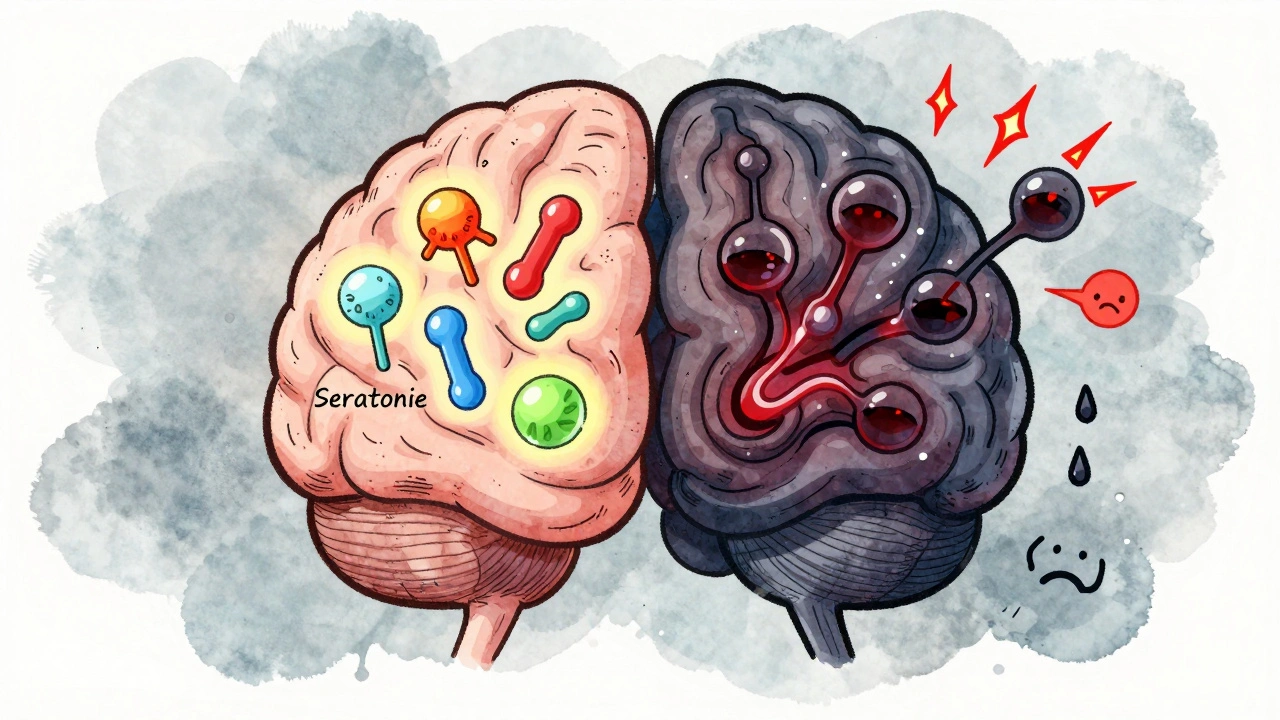
Combining antidepressants and alcohol isn’t just a bad idea-it can be deadly. You might think having a glass of wine or a beer won’t hurt if you’re on medication for depression. But the science says otherwise. Even one drink can throw off your brain chemistry, make your depression worse, and increase your risk of serious harm or death.
How Antidepressants and Alcohol Interact in Your Brain
Antidepressants work by balancing chemicals in your brain, like serotonin, norepinephrine, and dopamine. These neurotransmitters help regulate mood, sleep, and stress. Alcohol, on the other hand, is a depressant. It slows down your central nervous system. When you mix the two, they don’t just cancel each other out-they amplify the worst parts of both.For example, if you’re taking an SSRI like sertraline (Zoloft) or fluoxetine (Prozac), alcohol makes you get drunk faster. Studies show people on SSRIs feel the effects of alcohol 30-50% more intensely. That means one drink feels like two. You might feel dizzy, nauseous, or extremely sleepy-even if you’ve only had a sip.
Tricyclic antidepressants (TCAs) like amitriptyline are even more dangerous. They already cause drowsiness. Add alcohol, and your breathing can slow to dangerous levels. There are documented cases of respiratory failure at blood alcohol levels as low as 0.05%-that’s just one drink for most people.
The worst offenders are MAOIs like phenelzine (Nardil) or tranylcypromine (Parnate). These older antidepressants react with tyramine, a chemical found in beer, wine, and aged cheeses. When combined with alcohol, they can trigger a hypertensive crisis-your blood pressure spikes to 220/120 mmHg or higher. That’s enough to cause a stroke, heart attack, or death within minutes.
Wellbutrin and Alcohol: A Hidden Danger
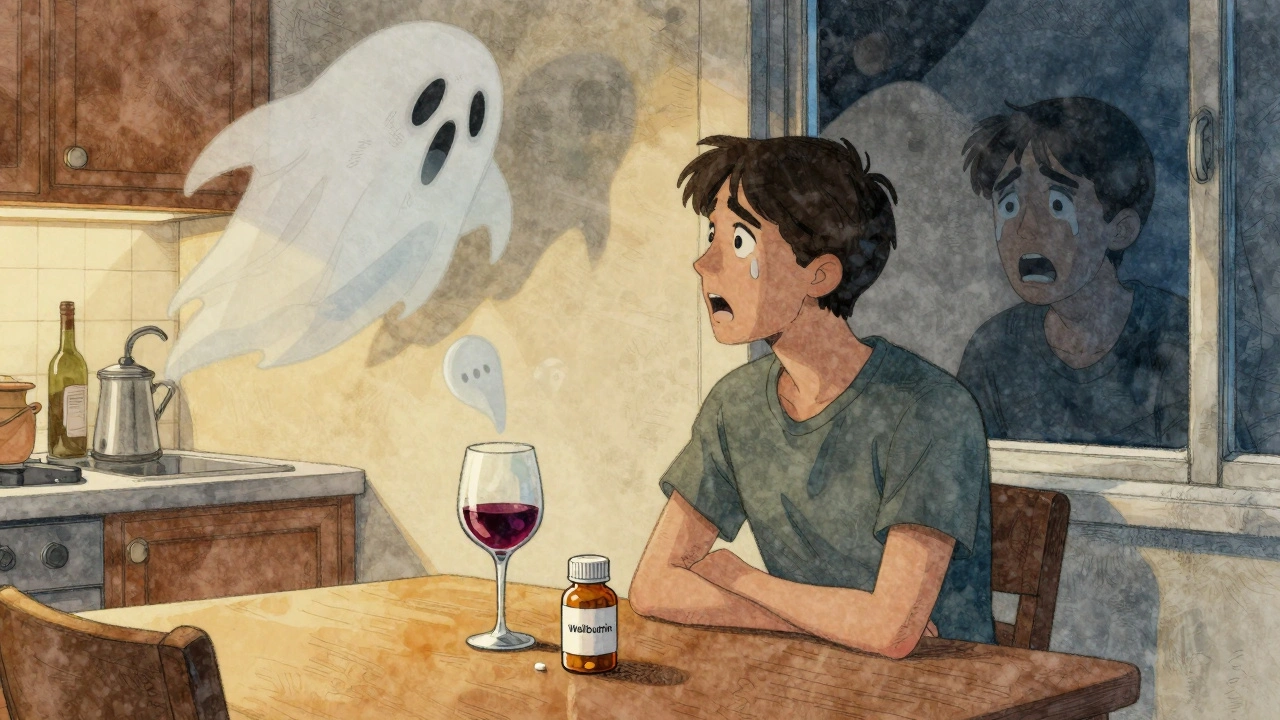
Wellbutrin (bupropion) is often prescribed because it doesn’t cause sexual side effects like SSRIs. But it comes with its own risk. When combined with alcohol, it can flood your brain with dopamine. This doesn’t feel good-it feels terrifying.People who mix Wellbutrin and alcohol report hearing voices, having delusions, or feeling like they’re losing touch with reality. In one clinical study, 12% of users who drank while on Wellbutrin ended up in the emergency room. One patient on PatientsLikeMe wrote: “After two glasses of wine, I started hearing voices telling me to harm myself. I spent 24 hours in the ER.”
This isn’t rare. FHE Health’s 2022 data shows that 1 in 8 people who combine Wellbutrin and alcohol experience psychotic symptoms. These aren’t side effects you can “tough out.” They require immediate medical care.
Alcohol Makes Depression Worse
You might think drinking helps you relax or numb your feelings. But alcohol is a depressant. It doesn’t fix your mood-it deepens it.A 2021 study in the Journal of Clinical Psychiatry found that people who avoided alcohol while on antidepressants had a 62% higher chance of recovering from depression. That’s huge. But most patients aren’t told this. A 2022 NAMI survey found that only 29% of people on antidepressants were warned about alcohol’s impact on their treatment.
Even one drink per day can reduce the effectiveness of your medication by 35-50%. That means your doctor’s prescription isn’t working like it should. You might feel like the drug isn’t helping, when the real problem is the alcohol.
And it gets worse. A 2022 study from Columbia University showed that low alcohol use in people with depression increases impulsivity by 27%. That means you’re more likely to act on suicidal thoughts. Patients who drink while on antidepressants are 2.7 times more likely to attempt suicide than those who don’t.
What the Experts Really Say
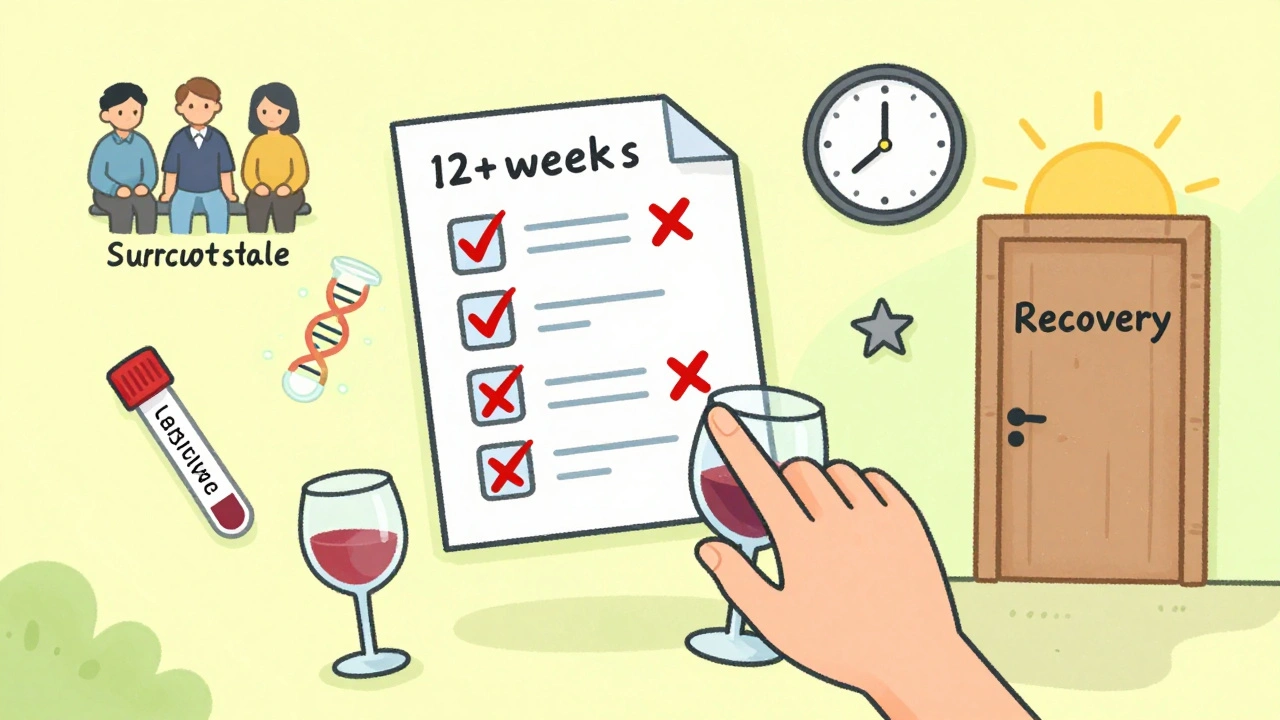
You’ll hear conflicting advice. Some doctors say “one drink a week is fine.” Others say “never.” The truth lies in the details.The American Psychiatric Association updated its guidelines in 2023. For patients on SSRIs who’ve been stable for 12+ weeks and have no history of alcohol abuse, they now say limited drinking-no more than one standard drink once a week-might be acceptable with close monitoring.
But that’s not a green light. It’s a cautious exception. For most people, especially those in the first 8 weeks of treatment, the rule is simple: avoid alcohol completely. That’s what the National Institute on Alcohol Abuse and Alcoholism (NIAAA), the FDA, and the American Addiction Centers all agree on.
Dr. David Baron of FHE Health says: “Mixing Wellbutrin and alcohol can lead to symptoms resembling psychosis-a serious mental condition that requires hospitalization.” Dr. Mark R. Gold of American Addiction Centers adds: “Drinking alcohol while taking antidepressants can make depression worse and increase suicide risk.”
Even if your doctor says it’s okay, don’t assume you’re the exception. Most people underestimate how little alcohol it takes to cause harm. A 2022 survey found that 62% of patients believed “one drink is safe”-despite evidence showing even that small amount can trigger dangerous reactions.
Real Stories, Real Risks
Online forums are full of people who thought they could handle it. One Reddit user on r/mentalhealth wrote: “I had one beer with my Zoloft. Within 20 minutes, I was completely drunk. Dizzy. Nauseous. Couldn’t stand up. It lasted 12 hours.”Another person on Healthline’s medication review site said: “I drank one glass of wine and had uncontrollable emotional outbursts. I cried for hours over nothing.”
These aren’t outliers. A 2022 survey by the Depression and Bipolar Support Alliance of over 4,300 people found that 67% who mixed antidepressants and alcohol reported worse depression within 48 hours. Nearly 30% said their anxiety got worse. And 28% reported intensified suicidal thoughts.
Only 3% of users reported no negative effects. That’s not a risk worth taking.
What You Should Do Instead
If you’re on antidepressants, the safest choice is to avoid alcohol entirely-especially in the first few months. Your brain is adjusting. Your medication is building up. Adding alcohol disrupts that process.If you’re struggling with cravings or using alcohol to cope with anxiety or sadness, talk to your doctor. There are better tools:
- Cognitive behavioral therapy (CBT) for alcohol use has a 47% success rate in helping people on antidepressants cut back or quit.
- Medication management appointments every 2-4 weeks in the early stages can catch problems before they escalate.
- Support groups like NAMI or the Depression and Bipolar Support Alliance offer free, peer-led meetings where people share real experiences.
And if you’re already drinking while on antidepressants, don’t panic. Don’t quit cold turkey without talking to your doctor. But do stop. Now. Write down how you feel after each drink. Track your mood, sleep, and energy. Bring that to your next appointment.
New Tools Are Emerging
There’s some hope on the horizon. In March 2023, the FDA approved the first genetic test-GeneSight Psychotropic-that can tell you if you’re more likely to have bad reactions when mixing antidepressants and alcohol. It checks for variations in liver enzymes (CYP2D6 and CYP2C19) that affect how your body breaks down both substances.Researchers at Columbia University also found that people with a specific gene variant (ADH1B*2) get 2.3 times more impaired when drinking while on SSRIs. This isn’t just theory-it’s personalized medicine.
The National Institute of Mental Health is funding a 5-year study starting in January 2024 to see if occasional, controlled drinking is ever safe for stable patients. But until then, the safest answer is still no.
Antidepressants are powerful tools. Alcohol isn’t a side dish-it’s a saboteur. You’re not weak for wanting to drink. You’re human. But your brain is fighting an uphill battle. Don’t make it harder.
Can I have one drink while on antidepressants?
For most people, no. Even one drink can increase drowsiness, worsen depression, reduce medication effectiveness, and raise suicide risk. Some doctors may allow one standard drink (5 oz wine or 12 oz beer) once a week for patients who’ve been stable on SSRIs for over a year-but only with close monitoring. Never assume you’re the exception.
Does alcohol cancel out antidepressants?
It doesn’t cancel them out-it weakens them. Research shows even one drink per day reduces antidepressant effectiveness by 35-50% in 78% of users. That means your medication isn’t working as well as it should, and your symptoms may return or get worse.
Is it safe to drink alcohol with SSRIs like Zoloft or Lexapro?
No. SSRIs don’t make alcohol safe. In fact, they make you get drunk faster and more intensely. You’re more likely to feel dizzy, nauseous, or extremely sleepy. There’s also a higher risk of worsening depression and suicidal thoughts. The FDA and NIAAA both warn against mixing them.
What happens if I drink alcohol while on Wellbutrin?
It can trigger psychosis-like symptoms: hallucinations, delusions, paranoia, or intense suicidal thoughts. About 12% of users who mix Wellbutrin and alcohol end up in the ER. This isn’t a myth-it’s documented in clinical data. Avoid alcohol completely if you’re on bupropion.
How long after stopping antidepressants can I drink alcohol?
Wait at least 1-2 weeks after your last dose, depending on the medication. Some antidepressants, like fluoxetine (Prozac), stay in your system for weeks. Always check with your doctor before drinking. Even after stopping, your brain is still adjusting. Alcohol can trigger a relapse or withdrawal symptoms.
Can alcohol cause antidepressants to stop working permanently?
Not permanently, but long-term drinking can lead to treatment-resistant depression. If you consistently mix alcohol with antidepressants, your brain may stop responding to the medication. You might need higher doses, different drugs, or more intensive therapy. The longer you delay addressing the alcohol use, the harder recovery becomes.
Kurt Russell
December 7, 2025 AT 08:26This is the kind of post that saves lives. I used to think one beer wasn't a big deal on my Zoloft - until I woke up on the bathroom floor at 3 AM crying over a broken toaster. I didn't even know I'd passed out. Don't be me.
Olivia Hand
December 8, 2025 AT 01:05Let’s be real - the real danger isn’t the alcohol, it’s the silence around it. Doctors don’t talk about this because they’re overworked. Pharmacies don’t warn you because it’s not profitable. And we don’t ask because we’re ashamed. But here’s the truth: your brain is a temple. Don’t pour gasoline on the altar.
Louis Llaine
December 9, 2025 AT 13:22So... if I just sip it slowly, does that count as "responsible"? Or am I just the guy who thinks he’s the exception because he’s "good at alcohol"? 🤔
Jane Quitain
December 10, 2025 AT 09:51OMG I JUST REALIZED I’VE BEEN DRINKING ON MY ANTIDEPRESSANTS FOR 6 MONTHS AND MY MOOD IS STILL SH*T. NO WONDER I FELT LIKE A ZOMBIE. TIME TO QUIT. THANKS FOR THIS POST!! 💪
Sam Mathew Cheriyan
December 11, 2025 AT 12:49lol i think this is all just pharma propaganda. alcohol is natural, pills are chemicals. why are they scared of wine? maybe they dont want you to feel better without their drugs. also i heard the government puts fluoride in beer to make you docile. 🍺🧠
Nancy Carlsen
December 12, 2025 AT 02:54you’re not alone 💛 i stopped drinking after my first ER trip on Wellbutrin - now i drink sparkling water with lime and feel like a queen. your brain deserves better than a chemical rollercoaster 🌸
Ted Rosenwasser
December 13, 2025 AT 07:45As a neuropharmacology graduate, I must emphasize: the CYP2D6 polymorphism data is statistically significant (p < 0.01), yet this post grossly oversimplifies the pharmacokinetics. The real issue isn’t alcohol per se - it’s the lack of pharmacogenomic screening prior to prescribing. Most clinicians are operating in the Stone Age.
Ashley Farmer
December 14, 2025 AT 08:33I’ve been sober for 11 months since my last depressive episode. I used to think wine helped me unwind. Turns out, it just made me cry harder and sleep worse. The peace I found without it? Way deeper than any buzz ever gave me. You’re not weak for wanting to drink - you’re brave for choosing to stop.
Kyle Oksten
December 14, 2025 AT 21:59There’s a quiet arrogance in assuming you can control the interaction between a psychoactive drug and a depressant. It’s not about willpower. It’s about chemistry. Your brain isn’t a cocktail shaker - it’s a precision instrument. Don’t shake it with ethanol.
David Brooks
December 16, 2025 AT 19:14I used to think I was being strong by drinking through my depression. Turns out I was just delaying healing. Now I hike, journal, and sip chamomile tea. My mood? Better than it’s been since college. You got this. One day at a time. 🙌
Kyle Flores
December 18, 2025 AT 10:56my therapist said one glass of wine on weekends was fine... but then i started having nightmares and crying in the shower for no reason. turned out the wine was killing my seratonin. i quit. 3 months later i feel like me again. thanks for posting this. it helped me realize i wasn’t crazy - i was just poisoned.
Ryan Sullivan
December 19, 2025 AT 18:34While the post is empirically sound, it fails to contextualize the sociocultural dimensions of alcohol use within depressive symptomatology. The reductionist pharmacological framing obscures the existential function of alcohol as a temporary ontological buffer - a coping mechanism rooted in systemic abandonment, not personal failure. Your neurochemistry is not your destiny.
Wesley Phillips
December 20, 2025 AT 12:48Y’all are overreacting. I’ve been drinking on Lexapro for 5 years. I’m fine. My job’s fine. My dog still loves me. Maybe you just need to chill. Also, if you’re crying over a glass of wine you’re probably not depressed - you’re just dramatic
Desmond Khoo
December 21, 2025 AT 15:13just wanted to say - if you’re reading this and you’re scared to quit drinking while on meds? you’re not alone. i was too. but i started with one day without. then two. now it’s been 8 months. i still have bad days. but they’re mine. not the alcohol’s. you got this. 🌱